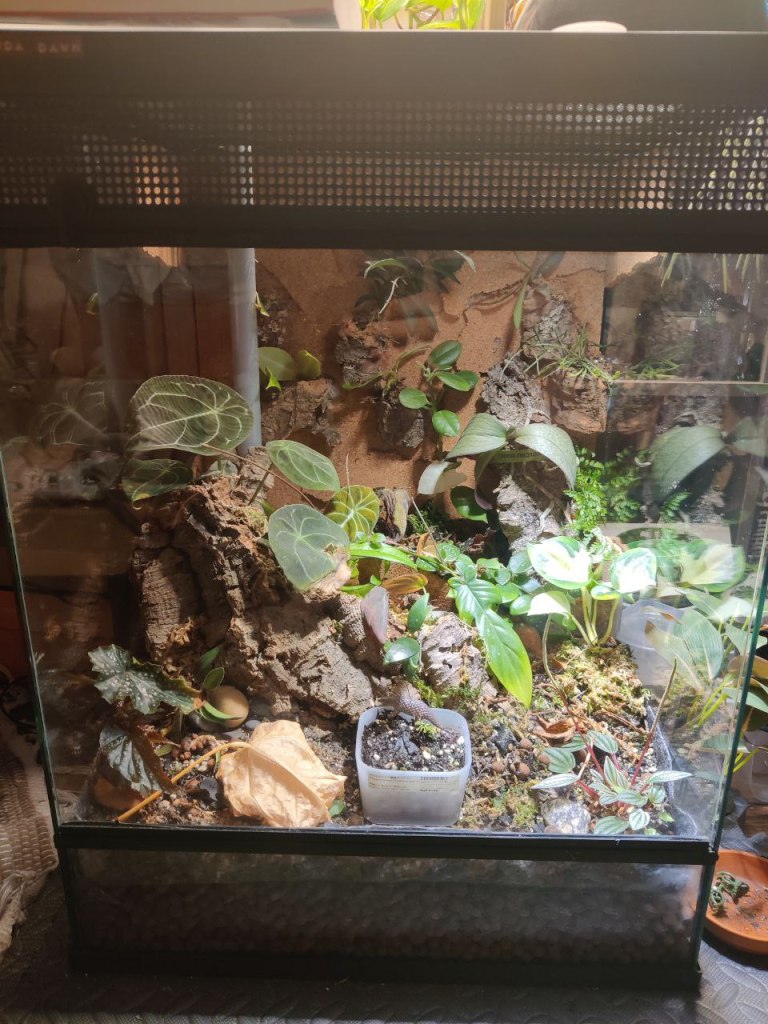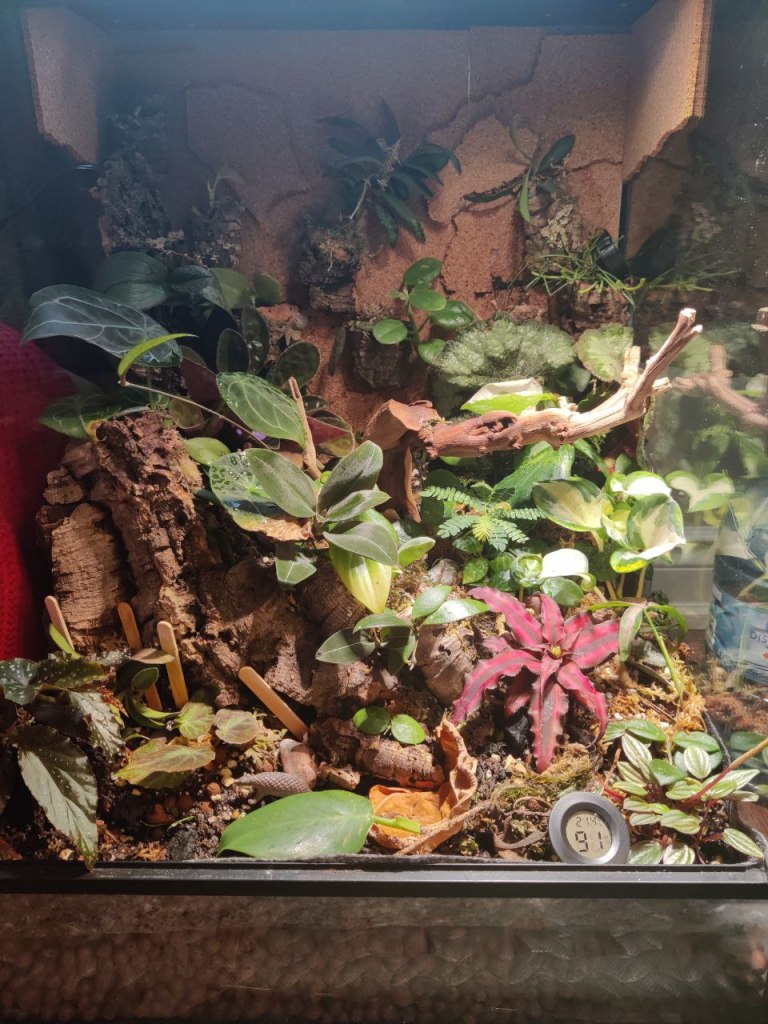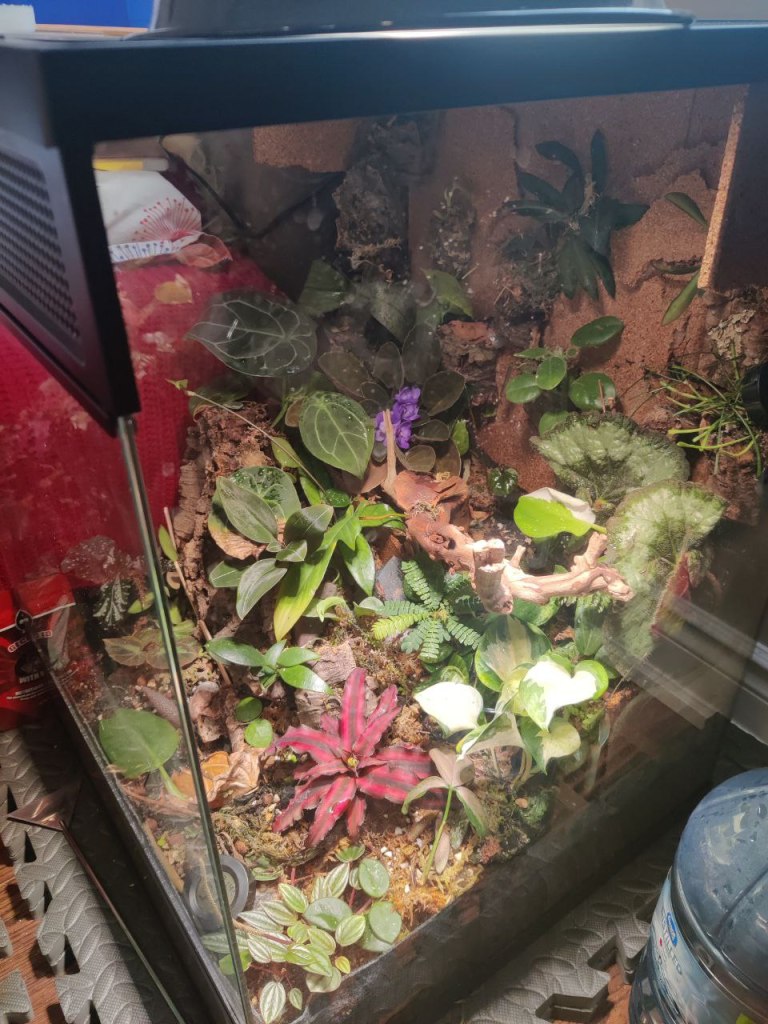
A friend of mine and I have been talking about orchids lately. The dendrobium papilo comes from a relatively cool growing area in the Phillipines. What that means is it probably is happy at typical household temperatures during Canadian winters, slightly warmer during the day, and a cool drop at night. What it is not so happy about is the humidity. Some quick googling suggests that 70-80% RH would be appropriate for this plant in its natural habitat. Naturally, this is impractical to maintain in a home and good practice would be to support the plants needs by keeping it regularly watered and preventing the growing media from growing out. But what if we could bump up the humidity even a little bit? Surely 50% RH is better than 30%? My friend wondered if putting a pebble tray beneath the plant might do any good.
Here’s where the sketchy science comes in. At 21C, 30% RH gives us an absolute humidity of 5.5 g/m3 (https://www.ready.noaa.gov/READYmoistcal.php). To get it up to 50% RH, we would need 9.1 g/m3, with the inrease required being 3.6 g/m3, that doesn’t seem too much. Let’s pretend we’re in the bathroom in the average US home of 40 square feet, with a height of 10 ft. That gives us 11.3 m3 and would require about 40.7 g of water added into the air. This is readily done by taking a shower. However, hopefully shower users have noticed their bathrooms drying out over time. The turnover rate of air in a house starts around once every 3 hours. For convenience, let’s consider that 1/3 of the air is replaced every hour. At the start of the hour, we’ve added the 40.7 g. We lose a third of this if the air (TWC: 102.8 g) is well-mixed (-34.3 g) and it is replaced with the 30% RH air (+20.7). To maintain the 50% RH, we need to make up for the difference and add 13.6 g. Since we’re no longer runing the shower, how long does it take to add 13.6 g into the air passively via evaporation?
Let’s use an airflow rate of 20 m/s (72 km/h) if the pebble tray is sitting right in front of the vent. For a 3 inch saucer, that’s about182 cm2 of surface area. Let’s say 300 cm2 (0.03 m2) if you add lots of porous pebbles. Under the most efficient evaporation rate (when the RH is 30%), the evaporation rate is 131.7 g/hour, or 131.7 mL/hour. That’s pretty darned good! All you need to do now is add 3 kg of water a day. The tray is probably at most 3 cm deep by the way, so it can hold just under 550 cm3 of water, or 550 mL. So you only need to top off every 3-4 hours really.
The problem is, none of what I’ve posed above is realistic. First, the air being exchanged in is probably close to 0. Currently where I am, it’s 80% RH outside. From -10 C outside to 21 C indoors, we would have just under 10% RH air coming in. So instead of adding 20.7 g, into the air with the exchange, we’re adding about 6.4 g of water. Which means we need to make up for an additional 14.3 g, double what we had earlier for a total of 27.9g. Our plants usually don’t sit right by the vent, and I had used the *main* duct velocity. According to this reddit post (https://www.reddit.com/r/AskEngineers/comments/t5yfj0/how_to_calculate_air_velocity_after_it_exits/), the plants need at least 0.5 m/s for good airflow (which I pointed out might be a concern with resting your plant right on top of a tray if it covers up the entire surface). Let’s say the airflow is 5 m/s right out of the vent, which is about the upper realistic value for a low pressure duct. It is likely much lower elsewhere, but let’s call it 5 m/s anyhow. Now we’re at an evaporation rate of 390.0 g/hour (https://www.omnicalculator.com/physics/evaporation-rate#google_vignette). At 0.5 m/s, this is reduced to 112.1 g/hour. Still, about 3 times the replacement rate that we needed. Right now we’re assuming that the cooler, higher humidity air from above the tray is mixing into the overall bathroom and the airflow is directly passing over the surface.
At this point, the bathroom is looking like a pretty good spot. There are some unrealistic assumptions I’ve made, like the hourly time step, but overall it might be possible to maintain 50% RH in the bathroom!
Now let’s think about the living space. Let us increase the size of the space and call it 50 m3. The water content at 50%RH in this room is 455 g, and the water loss from the 3x turn over is -151.7 g + 29.3 g = 122.4 g. The same saucer is placed somewhere with good airflow, and evaporates at 112.1 g/hour. This is now less than our target 50%RH. If you run this forward by 24 hours with continual water top-ups, you end up with 455 g – (122.4 g – 112.1 g) x24 = 455 g – 247.2 g = 207.8 g of water. That’s 4.15 g/m3 and about 23%RH (note that evaporation will of course increase once you hit below by previous threshold of 30% RH).
Here’s the real practical test. Spill about 100 g of water in a relatively small room that still has airflow. Measures the relative humidity every few minutes in the room. How long does it actually take to evaporate? If you start at 30% RH, what do you end up with after a few minutes? (For reference, I add about 1.5 kg of water into my ~ 20-30 m3 room each day just topping up plants and fish tanks, my room sits between 45 – 50%RH. The water loss is mostly via transpiration through plants, and dehydration of the extremely high surface area of spaghnum moss topping most my plants, not the fish tank! The surface area of the tank is a bit under a square meter, but it’s a shallow tank where the humidity is partially trapped by a plexiglass pane so it does not mix readily into the rest of the room.)
A while back I was invited to give a talk at Nicolas Cowan’s lab group meeting. The meeting was slated for November 5, 2025 at 11:00 am. The plan was for me to give an overview of some of my thesis work (time allowance between 20 – 40 minutes), entertain some Q&A, then head out to lunch with the group. Here’s how it played out in chronological order with approximate time stamps.
Days before departure. I work on my presentation, get feedback from the PVL lab, and confirm people would be interested in Montreal style bagels upon my return.
Night before deparature. I decided to downsize my small duffle into an even smaller messenger bag. I would be travelling by bus and I prefer to have my gear with me at all times if possible. I had already purchased my travel tickets and booked a room to stay. The only things I needed to prep were a change of clothes, electronics, a notebook, and some hygiene items. I set an alarm clock for 7:15 am.
7:15 am. Groggily wake up and roll back into bed.
7:45 am. Force myself up and crack open a new container of toothpaste (the previous one had been packed away since I couldn’t find any travel sized ones).
8:00 am. Make coffee. Get dressed. Wonder where my keys are. Search for keys. Fill up water bottles (3 L, who knows!).
8:30 am. Out the door…and into the car. It’s about an hour drive from where I live to Black Creek Pioneer Village where I was planning on parking.
9:45 am. I arrive later than planned. I had accounted for traffic, but it still made me nervous. As someone who regularly gets lost walking around campus, I pulled out my phone and triple check I’m actually headed towards the subway station.
9:55 am. Quick bathroom stop at the Chemistry building! I knew the bus would have one, but… well.
10:00 am. I reach the subway station, slightly wheezing and wondering why I brought such heavy bags and why my laptop has to weigh 5 lbs and my preferred notebook is of prodigious size (I looked it up, it weighs around 480 g). I need to add money to my Presto card. I catch the subway just as I reach the bottom of the Pioneer Village station terminal.
10:20 am. I’ve sent a message that says, “tba if I catch my bus”
10:30 am. We’re stopped. Why are we stopped.
10:40 am. I think we arrive at Union. It is now time for me to figure out where the bus station actually is. Has anyone seen Union station? It is a big station. At least construction is done.
10:58 am. My phone messages indicate that I made it onto the bus. I recall arriving around 10:45 am, scarfing down some food, and watching as someone got their bag stuck in an escalator. Instead of trying to remove their bag from the escalator, their immediate first thought was to call someone on the phone. Meanwhile 2 other kind passerbys were trying to help disentagle the person’s bag while a third person pretended to help but was actually just waving their hands around.
11:00 am. Departure. I message the friend I’m meeting for dinner and let them know I’ll be in touch. On the bus, we stop twice. Once at the Scarborough pickup location and once in Kingston (1:59 pm). The Tim Hortons near the Kingston stop had shockingly palatable food. We also did a strange bus change up that was unexpected and I ended up on the second level of a double decker. I think the first half I was more frustrated at the passengers nearby. One person purposely sprawled out over two seats so no one boarding at Scarborough could sit down next to him. In the second leg, an influencer family managed to take up 6 seats while snapping at each other and the person behind me yawned very loudly every other minute. Earplugs were insufficient.
3:48 pm. I give my friend a heads up that the bus may be running a bit later than expected and schedule dinner for 7.
6:05 pm. “j’arrive! in montreal traffic that is. shall report in when I check into the hotel”. My plan was to go to the hotel (15 minutes away by transit), drop off bags, and head out to dinner.
6:22 pm. The bus seems to have stopped moving, but nothing is happening. No one moved. A few minutes passed and we started looking at each other.
6:26 pm. I finally decide to go downstairs and find that everyone on the first level has already disembarked. I guess they just didn’t feel like announcing anything to the folks upstairs. I start trekking to the subway station. I was prepared! I had looked up how transit would work and I knew I could buy a ticket there.
6:30 pm. I finally find the metro and I am met with someone that says, “it’s closed”. Oh, okay, I guess there’s an issue with the subway. That happens back home too. I purchase a bus ticket for 24 hours instead. There are many options to purchase. I notify my friend I will be late for dinner, and I get back the following message “um, transit is about to not be working”. Why yes! How did they know? “the stm is striking”. Oh. OH. (STM = Société de transport de Montréal)
6:33 pm. So much for going to my hotel to drop stuff off first, I’m off to dinner directly!
6:43 pm. I can’t find my friend 😦 Is it possible I’ve forgotten what they look like? He sends me a location pin. Oops. He’s next door and definitely not in the extremely rowdy pub. We have dinner with him and his wife, catch up, and I eat some Montreal smoked meat poutine. It might have been the wrong choice, but it was the choice I made. I saw videos of Gwen (their cat) pretending to chew plants to get attention. It was an excellent dinner, though we did try for 5 minutes to get a waiter’s attention.
8:30 pm. We head out and my friends walk me to my hotel over 20 minutes away since it was on their way, and well, the STM is on strike.
9:00 pm. I get settled in, do a requisite check for any critters hiding in the sheets, and pull out the 5 lb laptop. It’s time to do work.
11:00 pm. I close my laptop and set an alarm. I think I’ll try taking transit tomorrow morning if I can figure it out! If it doesn’t work out, McGill is about a 35 minute walk away.
8:30 am. Continental breakfast. They were playing American television I think. Check out.
9:10 am. I have reached the metro and… I got the wrong ticket. Walking to McGill it is.
9:45 am. I arrive in front of the Trottier building. I go inside and look around. The building is quite large, and I wasn’t told where people would be. I check my email again. Wrong building.
9:48 am. I’ve made it to the Trottier Space Institute. The front entrance is up a set of metal stairs and the building seems like it could have been an older house. The first floor has a few meeting rooms. I am looking for a graduate student who typically starts work around 10. I trek up to the second floor to look around. At last! A familiar face! Nic welcomes me and we chat for a bit about McGill, though he indicates he has a meeting at 10. I had been invited to come a bit early to meet folks, but it seemed that he was the only person around. We discuss how bikable Montreal is, and I reveal that my biking skills are mediocre. I also get a better understanding of how the two different Trottier fellowships work. I admire his adansonii hanging in the window quietly.
9:59 am. Nic unlocks the grad offices for me and indicates that if I sit on the couch, I might just get a squirrel come sit with me.
10:21 am. I am a little stressed about the upcoming meeting. I message a friend who used to go to McGill and ask about his bagel recommendations, I had missed what Nic suggested. We discuss how reasonable it is to go for a two hour walk for bagels. It seems reasonable if I leave my items at the office. I think about getting a tote bag to carry bagels (as my bags are full) from St. Viateur. It is threatening to rain. I am informed there are albino squirrels in Parc lafontaine. I nearly fall asleep staring at the tradescantias on the window sill.
10:45 am. One of the grad students comes in, I introduce myself and ask about the squirrels since I had yet to see one. I note that the promised construction noises had appeared.
10:55 am. We head off to the Rutherford building for the group meeting.
11:00 am. The meeting starts! I get brief introductions from each one of the group members present, and hear short summaries about their interests. A few folks aren’t present due to injury or travel. it seems the STM strike did throw off a few schedules. We are astounded that the projector worsk immediately when I plug the HDMI cable it into my laptop. I deliver my presentation (around 35 minutes running time) and periodically get questions throughout.
12:05 pm. We head out to our reservation for lunch (about 8 of us). The menu comes as a surprise, it seems the restaurant has refreshed it! The rosemary lemonade was excellent. I receive a few more questions about my work and consider whether or not planetary defense might be a good angle for relevance when writing up proposals. I explain the concept of semi-hydro for growing office plants when away for long periods of time.
1:30 pm. Nic offers to take another look at my application and we review for ‘WTF’ sections. This version is much better. We discuss what specific contributions I might have for exoplanetary science investigations and illustrate a few different phenomena that affect lava planets. He suggests I chat with one of his PhD students who has been working on the problem from a different perspective.
2:00 pm. We’re cutting it a bit tight to go get bagels, but I swing by to see the grad student (we had met earlier this year at DPS-EPSC, so it was good to catch up!) while he’s prepping coffee for some sort of daily meeting. We chat phase curves and transit methods, and start thinking about the implications for observations of lava planet atmospheres.
3:06 pm. I inform my friend that I may not acquire St. Viateur’s.
3:10 pm. We had forgotten the coffee. Fortunately all was good and we got cookies ready for the coffee and cookie hangout the folks in the building did on the daily. I heard about designs for telescopes. I explained what I was up to and why I was around. People were interested in whether or not we would get explosions on Titan. We get turfed out when they start the astro journal club.
3:45 pm. There is no way I am going to St. Viateur’s at this point. I might as well stick around and write down a few of the ideas we had come up with. We look at a few proposals and I think about how infrared is really not going to get what I want, which is atmospheric composition. I get an alternate bagel shop recommendation and info on the bus station. I am told there is an overhang area. It is still raining. No squirrels have come to say hello thus far.
4:05 pm. I’m pushing it real last minute. I speed walk to a bagel shop, get a pack of 6 and order a buttered one to eat.
4:40 pm. I’ve arrived at the bus station and investigate the public bathroom.
4:50 pm. We start to board. Traffic is bad as you might expect. Rush hour, rain, and Montreal. I complain about the early sunset. I attempt to sleep on the bus. This goes poorly and my shoulder hurts.
8:30 pm. We arrive at Kingston and the bus driver informs us to return at 8:40 pm on the dot.
9:06 pm. We are still in the parking lot. The driver is walking to and from the bus. I am considering alternative plans if the bus does not return to Toronto in time, and calculating at what point the subway would shutdown before I reached Pioneer Village station. I contemplate staying the night in Kingston as I’m likely too tired to drive safely when I do get back.
9:11 pm. A cryptic message about not using the front stairs plays over the intercom, and we’re off.
12:05 am. We reach the terminal station.
12:08 am. We finally begin to disembark. A friend greets me (I promised bagels in exchange for crashing the night). We go get late night coffee and try out robo coffee. There is a lid dispensing button that is very delightful.
3:00 am. We continue to discuss various game systems and a boardgame design I’m working on. It is far too late to be awake.
8:30 am. I get on the subway.
9:30 am. I make a slight detour to drop off a bagel for our undergraduate administrator and transfer the remainder of the bag to one of my labmates.
9:45 am. I’m in the car, on my way home. Phew.
It was a very long and fun two days. It is unfortunate that it was raining on the second day, but the day I arrived the city was quite beautiful. The strike had thrown me off a bit, but I had intentionally planned my travel so that it was walkable if I wanted that option. The second day was quite a blur, so the timeline around coffee might not be quite right. Much thanks to the folks who made this all possible.
I managed to take 3 whole photos while I was physically in Montreal.
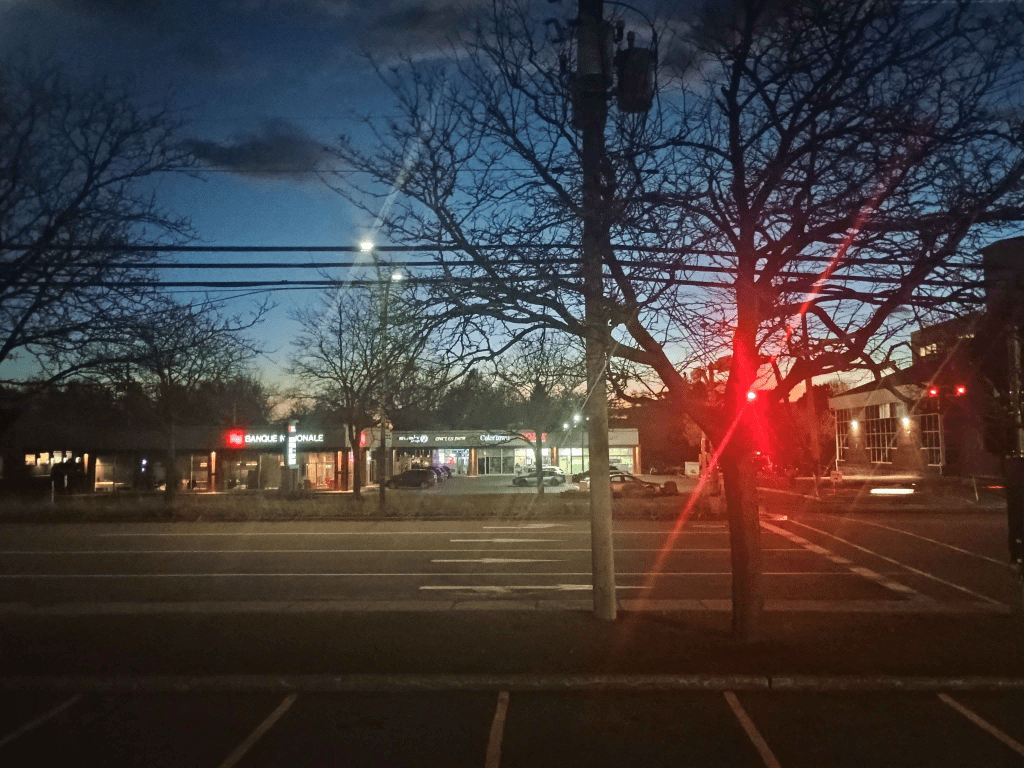
Figure 1. Nov 4, 2025. 5:15 pm. A mysterious stop location in Kirkland, right before my final stop in Montreal.Figure 2. Nov 5, 2025. 2:05 pm. A detailed image of my upcoming exoplanetary project proposal taken as I was dashing out of Nic’s office since I was delaying someone from their meeting!Figure 3. Nov 5, 2025. 4:27 pm. I realize I haven’t taken any nice photos of the city while I’m waiting for the light to change from red to green.
September has been…a month. Conference! Travel! 15 meetings in a week! TA squabbles! Getting towed home for the first time! and wrapping it up with a good dose of houseplants and paper and proposal submissions.
We’ve been using the following format on a shared Google Slides document in the PVL group meetings for the past few months, and it’s been working quite well! It goes: list one accomplishment and one challenge you’ve experience since the last group meeting, and put down your goal to complete by next meeting. Most folks end up putting more than one item, and it functions as a quick status update for everyone. Occasionally we linger longer on certain slides to discuss a figure someone has chosen to represent their week, or we chime in to help out with the challenge or offer support for the goal. My list is rather long since it’s been a while.
Accomplishment(s):
finished putting together animated slides for a presentation I gave at EPSC-DPS! I think the audience enjoyed it
Met a potential postdoc supervisor or two (networking things)
conducted two health and safety inspections (and described 150+ photos as part of the recommendations)
Convinced people to help me with 3 separate Global Climate Models! Yay data!
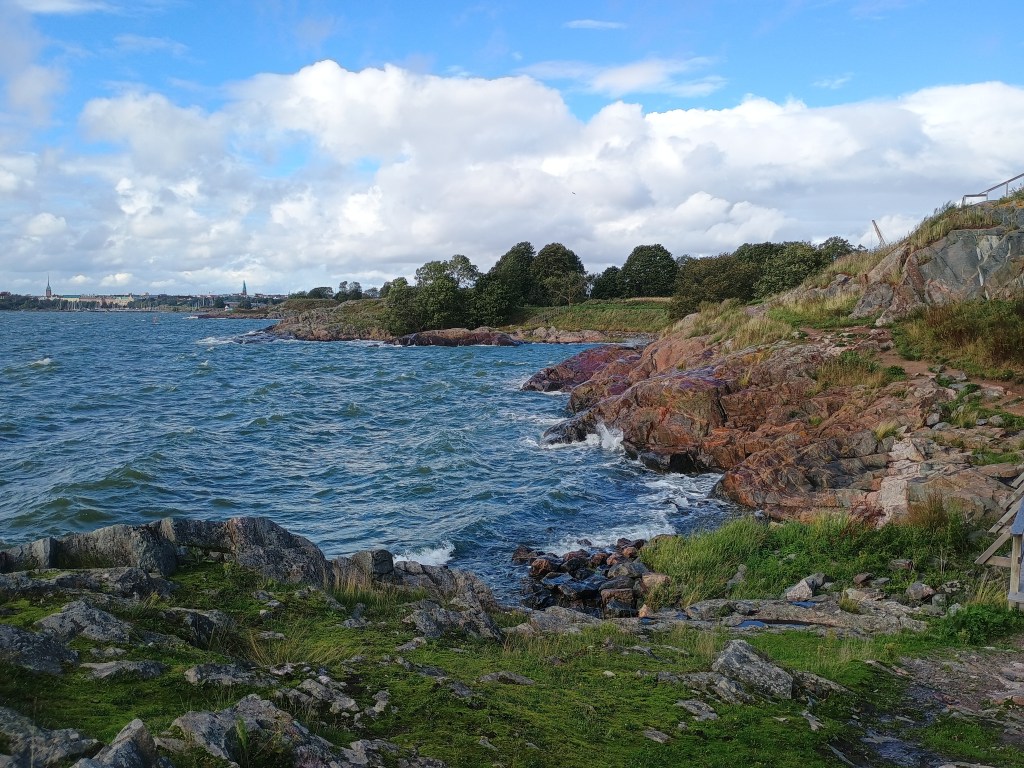
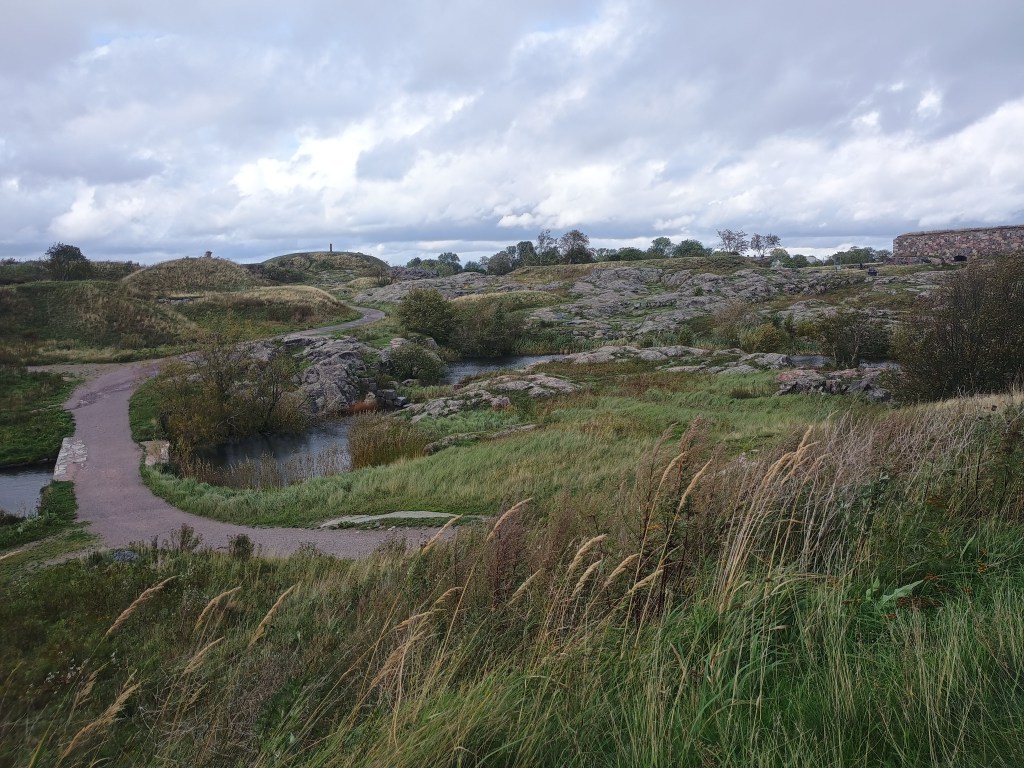
Stayed a few extra days to get to know Finland a little better, meet some friends, and trek around the country! Figures 1 and 2 highlight a couple of easily accessible landscapes
Figure 1. A photo of the southern side of Suomenlinna, the Fortress Island a 15 minute ferry ride south of a Helsinki port. This island has seen three different sets of wartime preparations. The southern coast has numerous cannons, a King’s Gate, and really slippery rocks! Towards the north it looks more like a park. Figure 2. Slightly more inland photo of Suomenlinna. Here you can see the smoothed out rocky features that likely experienced glaciers moving over them. You can also see how different the weather was! Finnish clouds move fast, though we were told this year was abnormally humid at this time of year.
Challenge(s):
Time. It’s always time. I managed to schedule 3 weeks worth of meetings into one week on my return. Ouch.
I might also be feeling a little bit sick!
Goal(s):
Clean up my inbox. There are at least 10 emails I should really get around to responding!
Send in three papery things. A revised manuscript (done!), a fellowship application, and a travel grant. Maybe another fellowship application if time permits
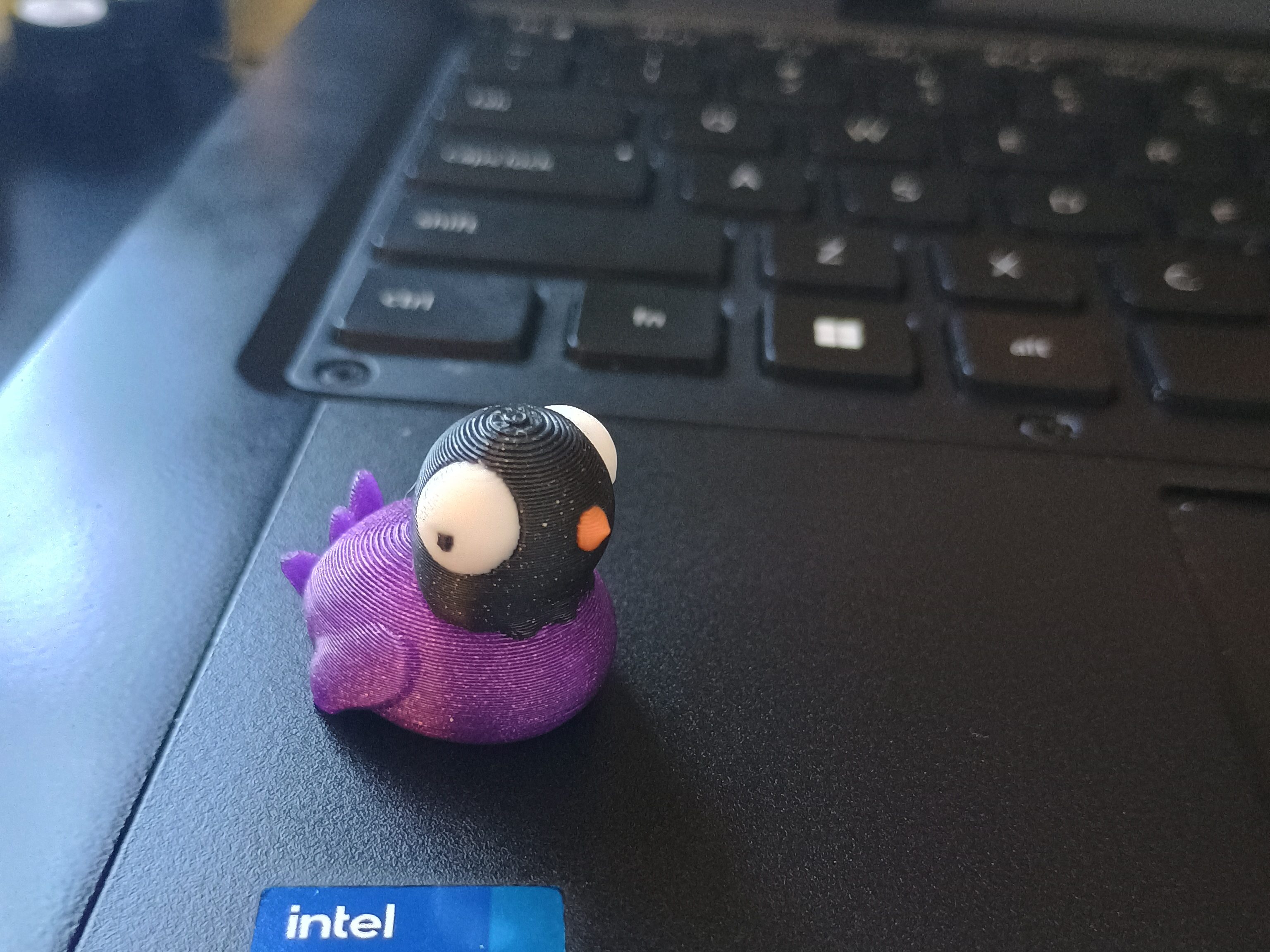
Upload my code already. Xml the pidgeon has thoughts (Fig. 3)
Figure 3. Xml! The judgey pidgeon from the PDS looking at you for not formatting to standard.
Normally I’d be all like, I need to take the weekend and do more work! Squeeze in some extra hours! When I’ve done this in the past, what it really means is I lounge about and feel guilty about not typing away. This time around, I had a few scheduled social events already in my calendar and I simply didn’t have the time to do too much weekend work because I was busy sleeping to have energy to do social things!
Looking Forward into October
Things have relaxed a bit since the hectic go go go upon my immediate return. I’ve pushed back my optimistic (and slightly unrealistic) goal of defending my dissertation super early since all the postdoc positions I’m applying to have a tentative start date in September 2026. Sleep has been caught up on. And I’ve received some excellent feedback on the structure and delivery of some of the proposals and statements I was working on. I did commit to several boardgame and table top RPG sessions this month, so we’ll see if packing in social events bites me in the butt in October.
Personal Updates
Accomplishment(s):
plants are growing! Here’s a list of highlights on blooms
Hoya linearis – these peduncles have been around for months. Will they ever expand? Only time will tell
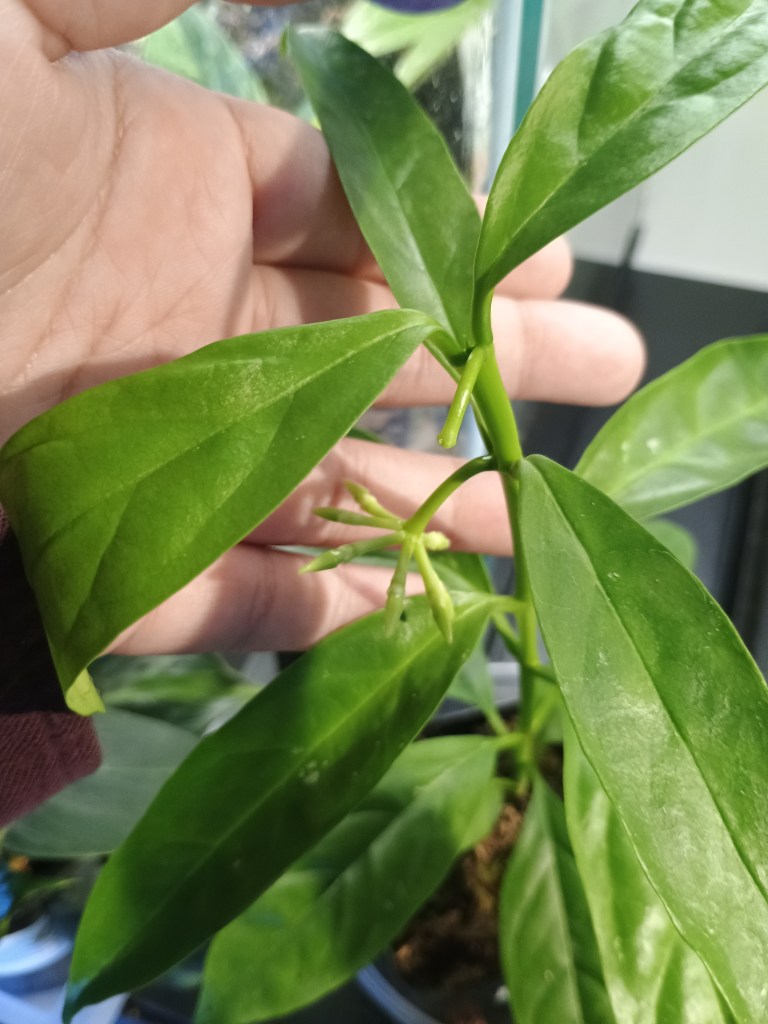
Hoya decipulae – I bought this plant for the blooms, and it looks like I might have two soon! (Fig. 4)
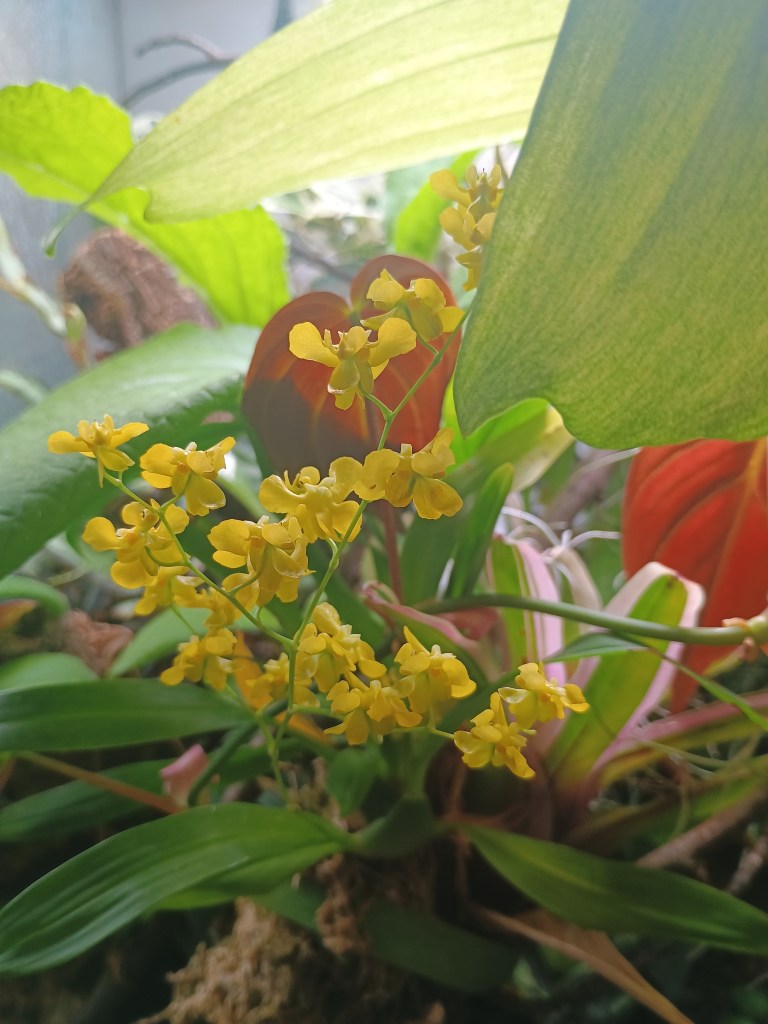
Oncidium cheirophorum- already in bloom, I caught these opening up right before I left the country, so the first stalk has been around for just under a month and the blossoms are starting to dry up. These smell… for lack of better words, clean floral. There’s a faint herbaceousness to it, and damp, but that could be the terrarium it lives in. Figure 5 shows the blooms on the day I got back!
90% unpacked from the previous trip
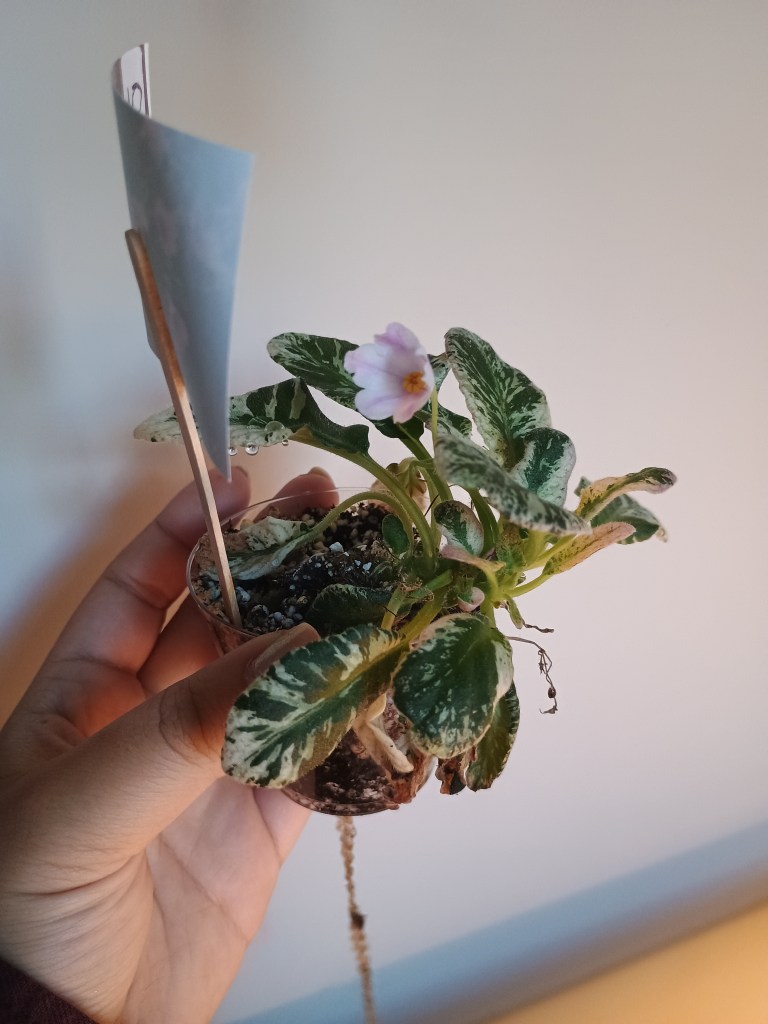
successfully purchased things at the african violet show for a remote friend! Example in Figure 6 of a plant we’re going to split
Figure 4. Hoya decipulae peduncle and flowers on the way! They’re supposed to look like eggbeaters…Figure 5. Oncidium cheirophorum. I bought this in bloom last year as a gift, took a small setion as a backup, and here we are today! It lives in a terrarium mounted in dried sphagnum moss next to a NoID bromeliad, philodendron micans trying to craw over everything, and a philodendron florida ghost casually flopped over it.Figure 6. LE Erika! We’re both excited for this one. It’s a trailing type african violet that seems to be difficult to grow. The white variegation blushes pink with enough light, and it should self-propagate given enough horizontal space to grow into.
Challenge(s):
anthuriums are starting to rot and look uphappy left and right!
Froggy still hasn’t received her upgraded tank
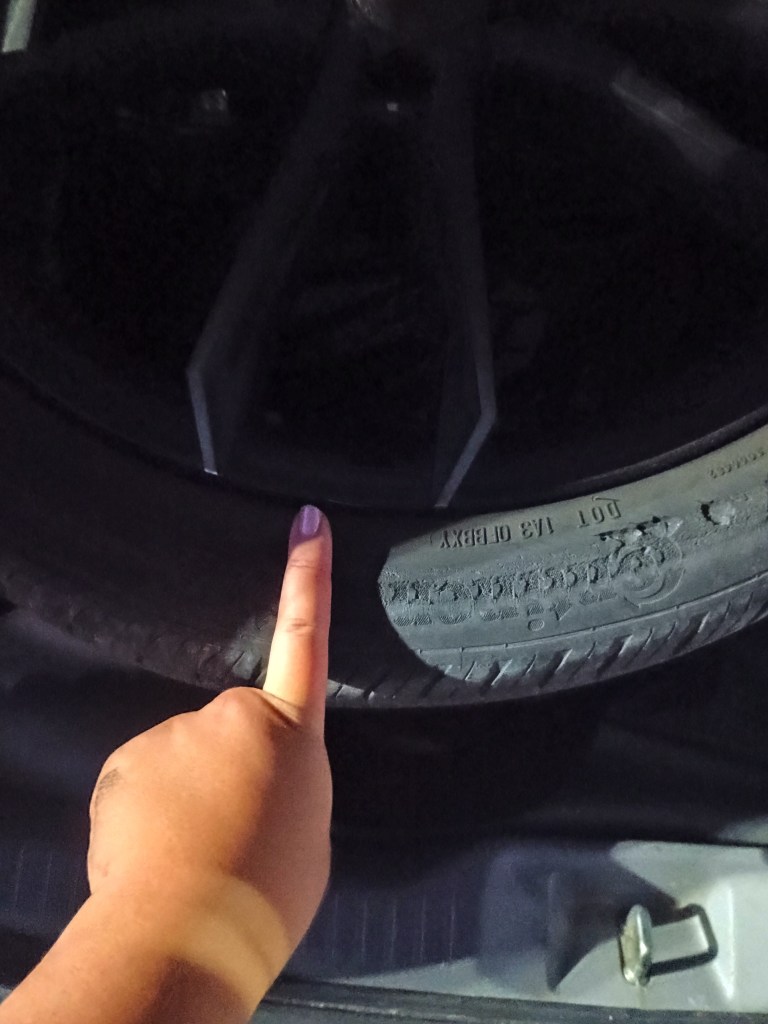
getting towed home was a thing, but this was a surprisingly quick situation to deal with. The major consequence is my wallet being $250 lighter (tire change and then some) and getting bruised on my knee for hauling aroud my previously oversized tires. See Figure 7 for the culprit.
ruined two pairs of pants! I dropped candle wax all over my favourite sweat pants, and had a ballpoint explode on another pair of pants (this one is partially addressed, but still hanging on a rack for me to deal with)
Time, of course
Figure 7. Check out the thickness of that tire post deflation.
Goal(s):
build or find a stand for the custom tank (Figure 8 is an image of the future resident!)
This leads to finally clearing my floor of all the plant propagations I have stacked in bins meant to fill said tank
fully unpack from last trip
finish writing the draft for an RPG module that I wanted to use as an outreach tool (and fun times) that I was hoping to get done in Summer!
take a look at all the moss photos I took in Finland and distribute them as need be!
Figure 8. Frogfoot Meteor awaits her upgrade patiently and not at all threateningly.
Truthfully, my personal life usually is about this chaotic, if not more so. Things are always in motion and mechanical items have limited lifespans. Having hobbies that involve living things also means that sometimes things happen outside of my control. One thing that’s been weighing on my mind is how to pass along all my plants if I move out of the country. Or what to do with my geckos if I move to a place where they aren’t allowed pets. A problem for a future me I suppose.
Figure 9. A realistic representation of me in my daily life.
I’ve been encouraged to write freely this week, so here we are! At first I wanted to discuss travelling in the current climate since I just went down to Baltimore, MD for a workshop (delightful, ended up with some strange plots and more questions than I went with!). I’ve been travelling internationally alone for the last decade or so, and it hasn’t always gone smoothly. Typically my travel related posts have to do with taking care of plants while I’m gone, this time is no different. Except it has a few additional critters in the mix (Exhibit A: Figure 1).
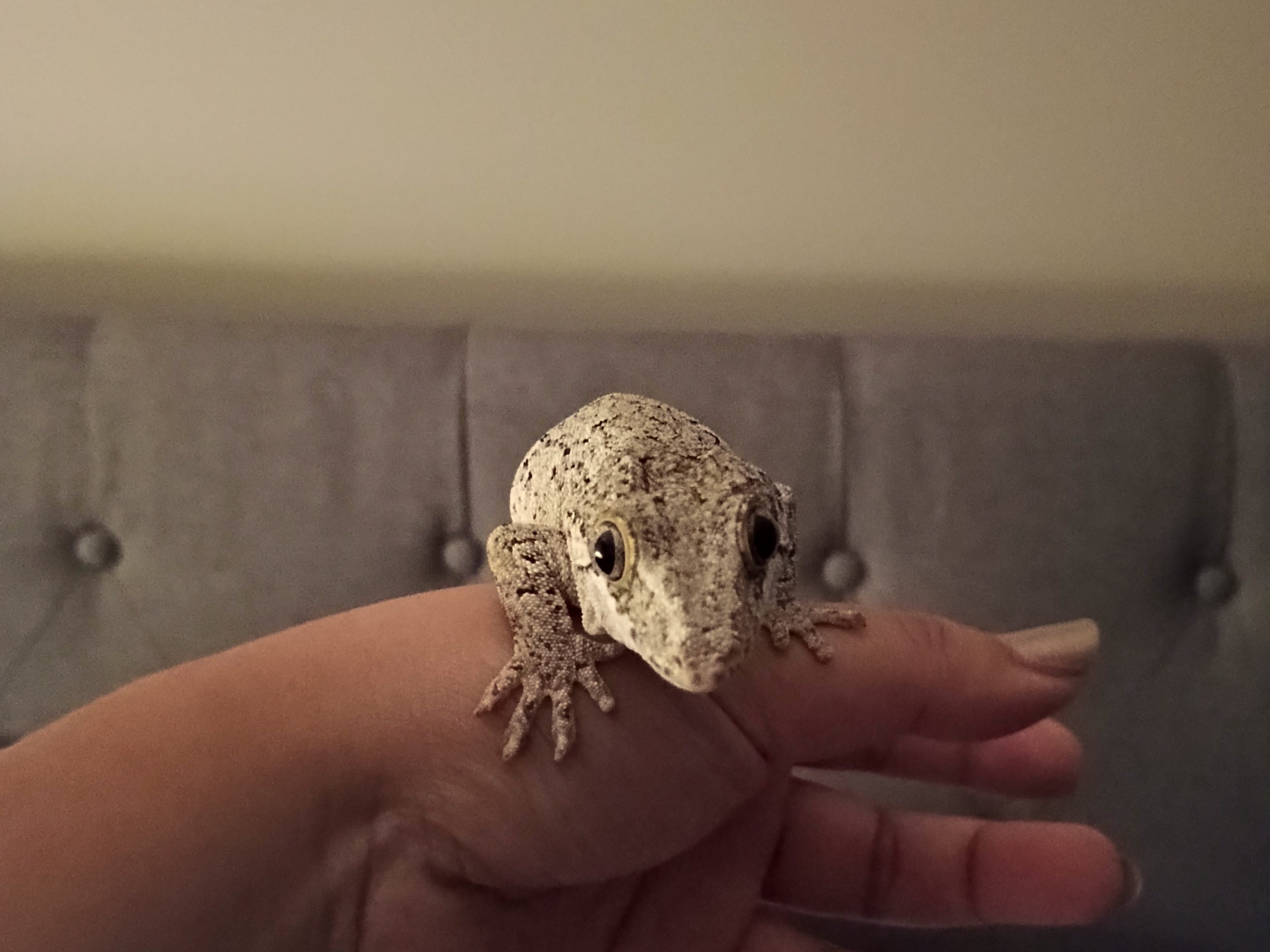
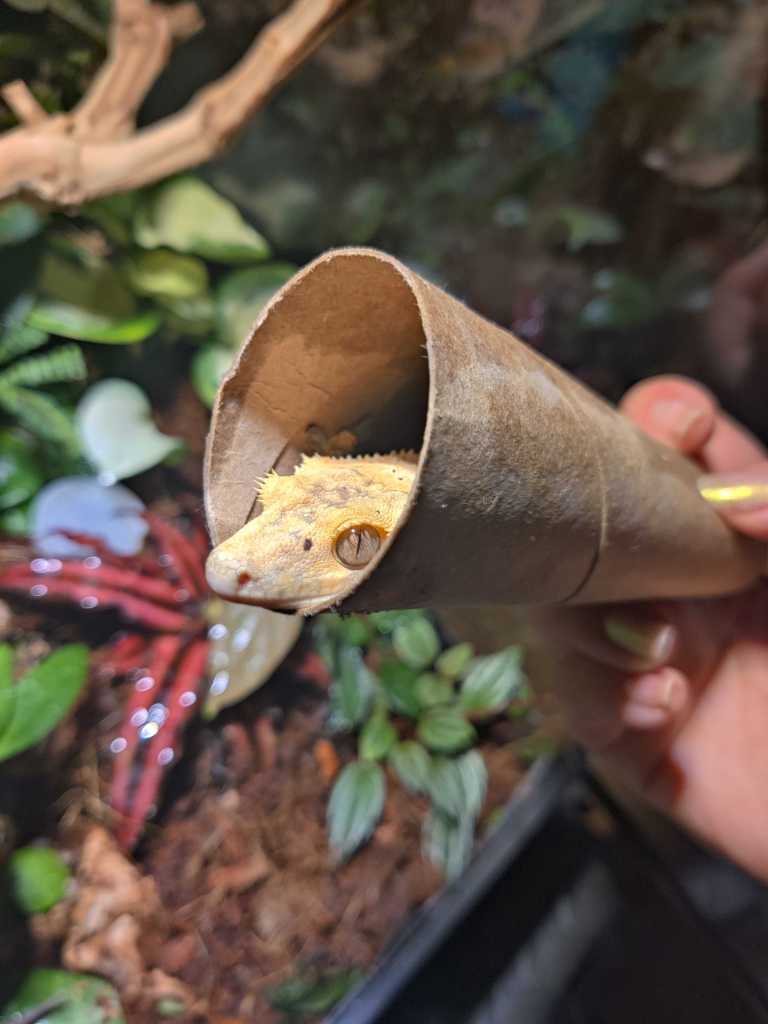
Figure 1. Gecko! Xavion has a little spinal kink from prior to my acquisition, but he’s a delightful gaming companion when he isn’t trying to interact with my touch screens. I got Xavion as a young adult, so his growth will be extremely slow in comparison to the others.
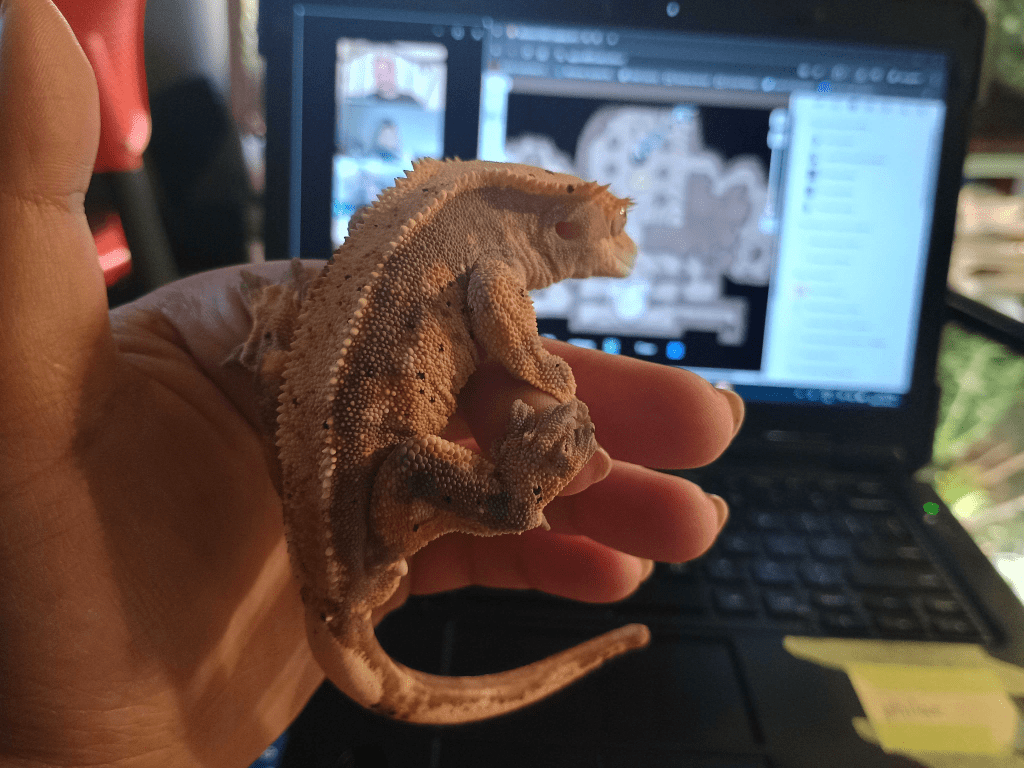
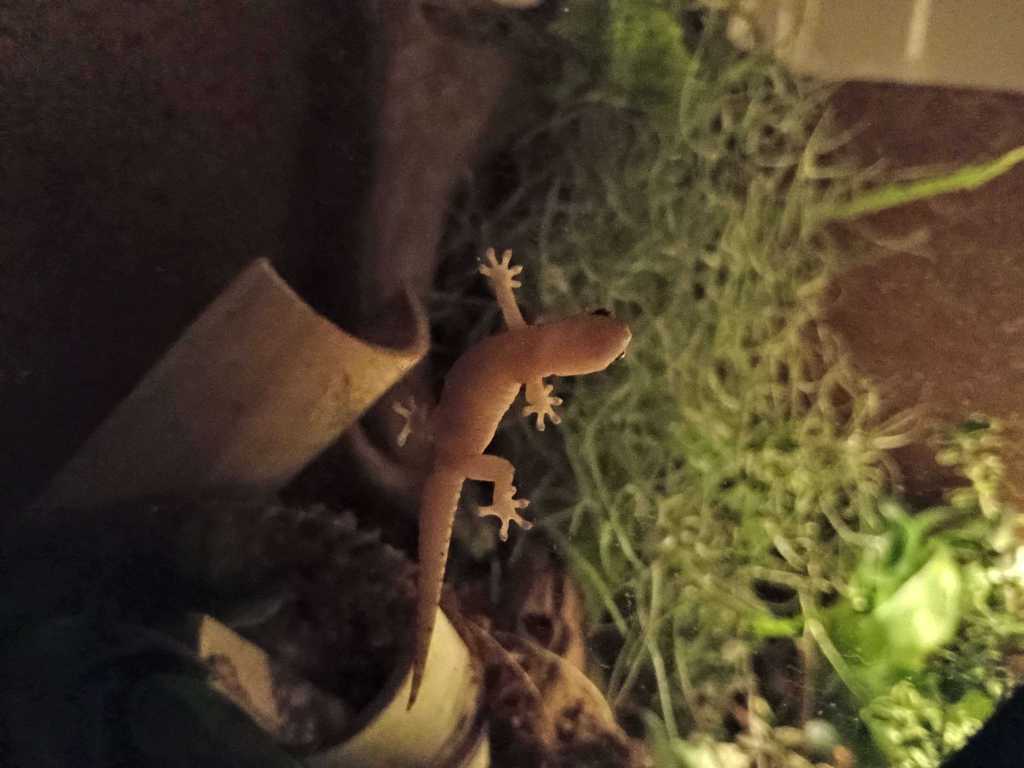
Shortly after I returned from my trip in South Korea, I decided to acquire a single crested gecko. I had some time to dial in the terrarium that I had built for my plants to survive my time away, and build a second one just in case I got a very small gecko. There’s no real compelling reason to put a very small gecko in a smaller enclosure, but I figured it would be better for me to keep an eye on the health of a very young animal in an easier to scan through enclosure for a while before upgrading it as it grew larger. In the back of my mind, I was looking for a high-contrast gecko with long, fluttery lashes. On an aesthetic level, I was looking for a red and white pattern. After quite a bit of research however, I concluded that all crested geckos were cute (except for the ones with genetic problems from bad breeding, looking at those is somewhat distressing) and I’d be happy with a patternless one as well. My goal was to have a happy and friendly gecko that was not opposed to being held from time to time (Figure 2 is an example of an endlessly smiling gecko that is very relaxed when hanging out. So relaxed that he tends to go to the bathroom on people once settled in).
Figure 2. A Spicy Cream Cheese Wonton. Spicy enjoys hanging off my plants and prefers his food to be a day old at least. I got Spicy fairly young, and he’s expected to pack on quite a bit more weight in the next couple of years!
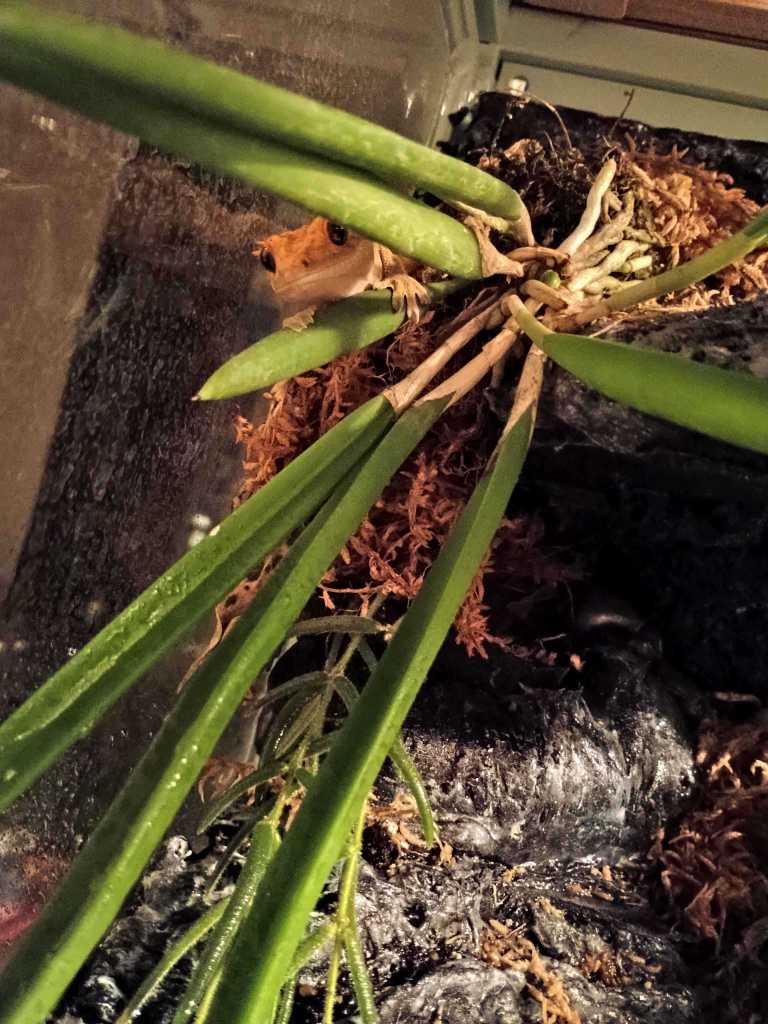
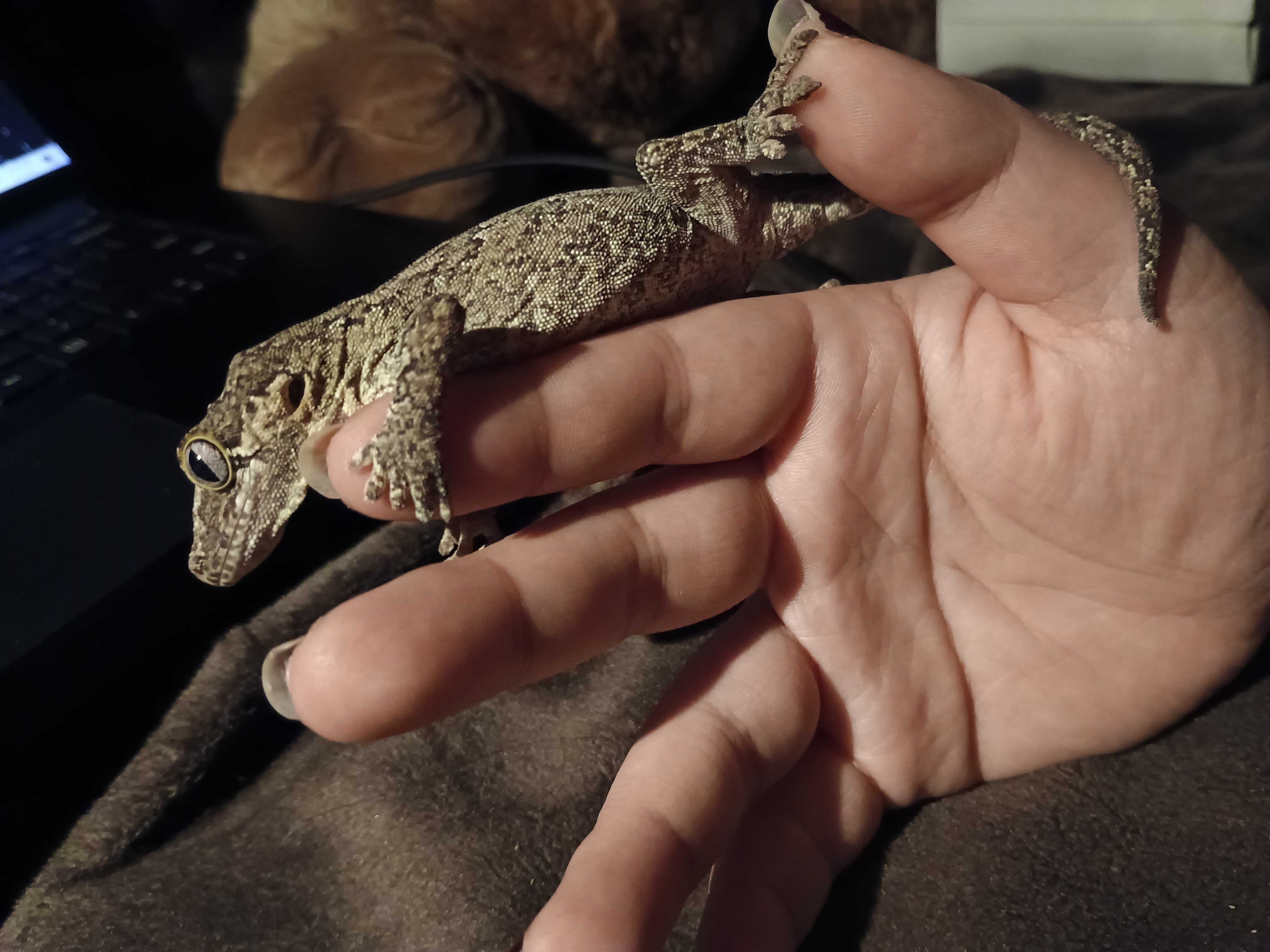
Anyhow, I ended up with two after visiting a local breeder (Xavion – 32.7 g to 38.6 g, and Spicy Cream Cheese Wonton – 13.5 g to 23.7 g, respectively, see Figures 1 and 2). Not too long after, I acquired a gargoyle gecko in relatively poor health (Frogfoot Meteor, 11.9 g to 30.1 g, Fig. 3). She was somewhat underfed, and terrified of humans. I’m happy to report that she’s doing much better now and lives in a far larger enclosure than what the breeder insisted was her “upgrade”. She’s put on a healthy amount of weight and is significantly less skittish than before.
Figure 3. There’s a Froggy in here, promise!
Here she is! She’s short a few toes and has been steadily moving towards adulthood (the tummy is normal for gargoyle geckos). She has the most robust appetite of all the geckos and I expect her to hit full adult size before Spicy does.
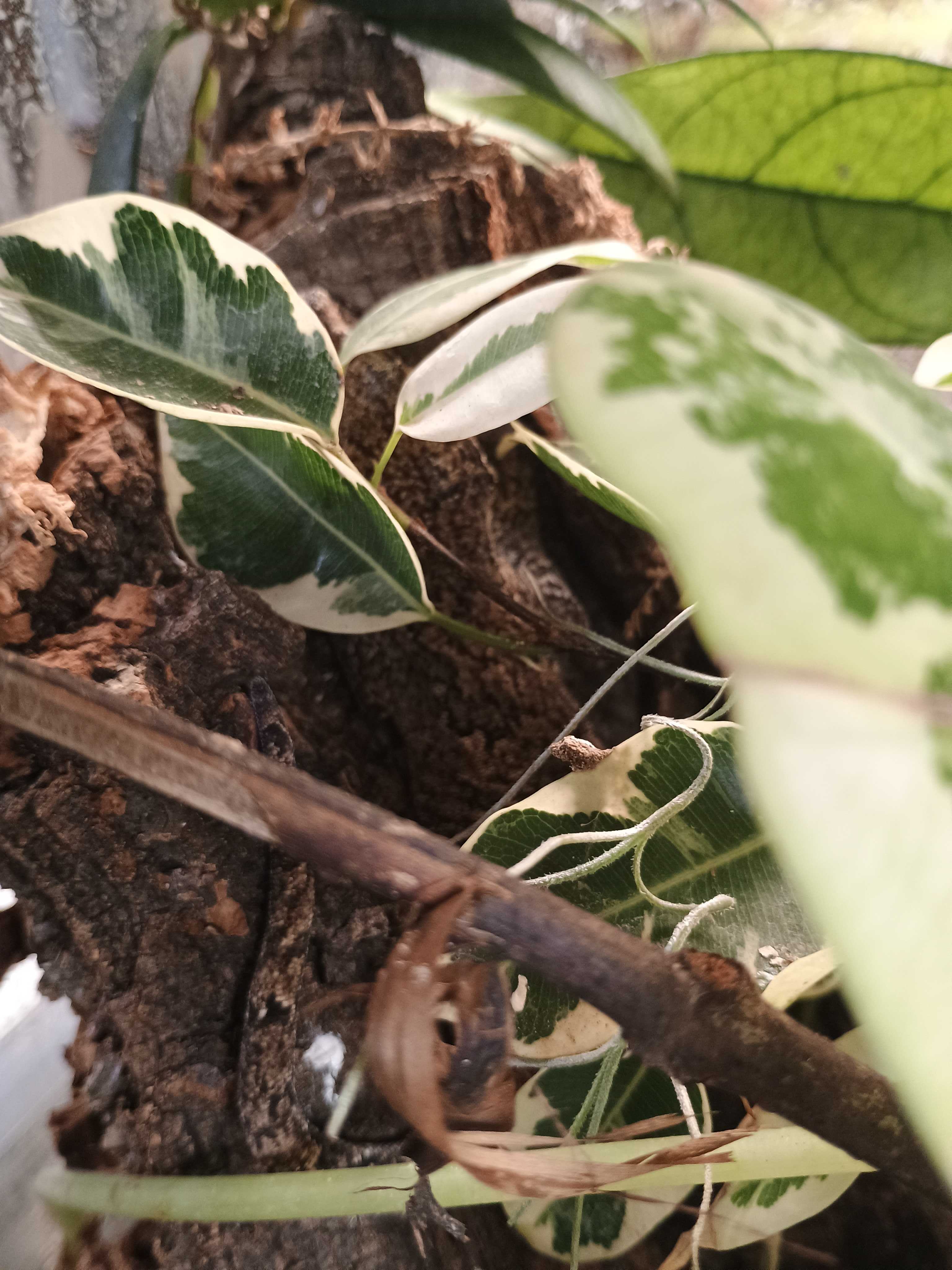
A few months later, I helped out with some folks who were undergoing a legal dispute over their housing situation by rehoming a few of their mourning geckos (Katana and Wheelbarrow, Fig. 4). At this point, there are 5 additional animals to take care of. Perhaps surprisingly to the reader, this takes about 3 – 5 minutes of my day most days. I would also argue that it can’t take much less, since fresh water is a necessity and its important to have a bowl of water readily available all the time. This can’t quite be replaced by an auto-mister unless I also add in a way to sterilize the water bowls. A “self-cleaning” water system wouldn’t work either, as it would have to be large enough that its presence would present a drowning risk or required some form of UV sterilization (impractical). Feeding has mostly moved from once every 2 days to once every 3 days for all but Spicy.
Figure 4. This one is most likely Wheelbarrow. I tell them apart by their tail thicknesses. She’s halfway to her maximum size!
Why am I listing all of this down? Mostly I think they’re cute, but I also wanted to note the care requirements. That is, they need to be interacted with ideally every 24 hours, with 48 hours somewhat pushing it.
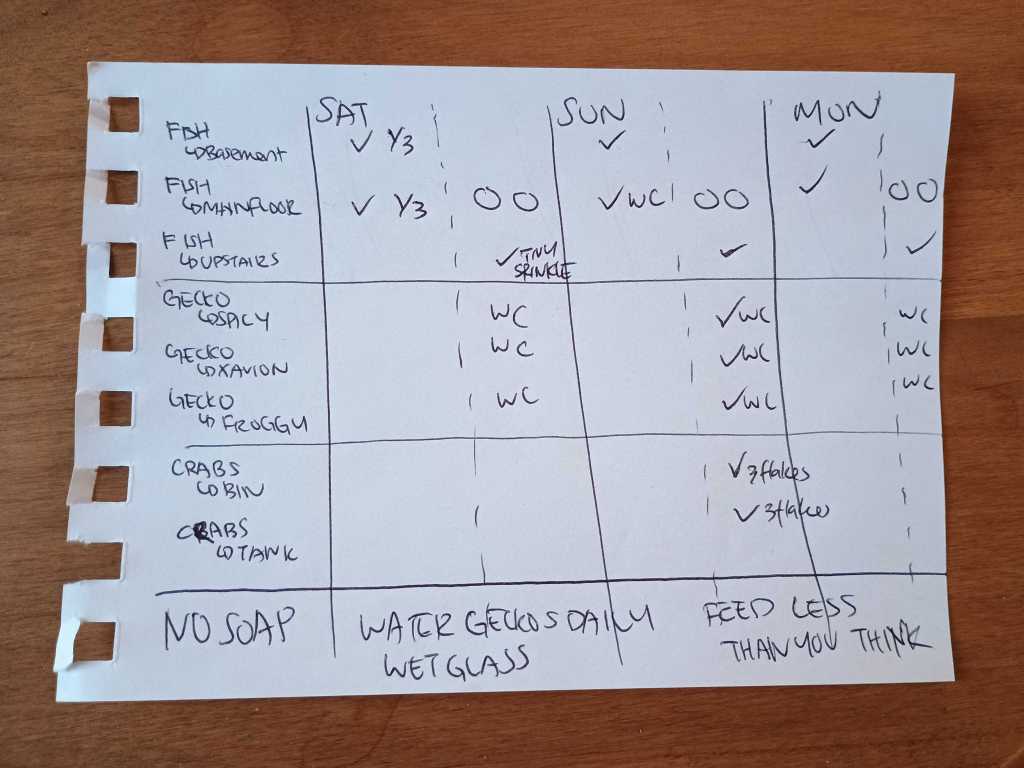
I listed all these details to make the point of: Do not acquire pets that require regular care unless you have a solution for their care when you are gone. For the less than 72 hours I was away, I had someone spray down the enclosures and change out the water bowls daily (Fig. 5). They were fed once during this time with food I had pre-made. The animals are well taken care of, and the chances that they are overfed or go without critical needs is negligible.
Figure 5. A cryptic list of instructions. The crabs are another story.
This was quite unlike my plants, which I left no instructions for other than to optionally water my carnivorous plant bowl with rain water if so desired, it is quite important to leave detailed care instructions and run them through the caretaker prior to departure.
The Circle of Life
Okay so, I mentioned feeding and watering, but what about bedding changes? and cleaning?
The short answer is, there is none to do! While there may be quite a few water stains that are unsightly, the enclosures are self-cleaning for the most part. During the daily watering and spray down, excess food and waste are washed to the base of the enclosure, where my secondary pets live. I have a full cleanup crew in each of the gecko enclosures. They breakdown waste to be further decomposed and eventually converted into fertilizer, and the plants in the enclosure take up the nutrients to keep growing. The more complex and the more layers and redundancies added to this cycle, the less something is likely to go drastically wrong in a short amount of time.
I use the same principle for my aquariums. Generally, I’ve set everything to be reasonably self-sustaining, with plants uptaking waste that might otherwise be toxic, and critters at the bottom level that break down food and waste into ammonia. Periodically, I check for signs of nutrient imbalance and correct them before the living standards decline. For my fish tanks, this might be as simple as a water change and removing some mulm from places that do not get a lot of water flow. If I were running more high-tech tanks, this might also mean dialling in the CO2 flow and light levels. As it is, I skip the use of aqua soils and opt for either an organic mix that is then topped heavily by sand to minimize leaching into the water, or a highly porous substrate mixed with sand. The denizens at the bottom of the tanks snuffle about looking for food, and push the small waste particles into the sand until they eventually breakdown further and get added to the base level. I have algae eaters to pick at spots that get a little too much light or have low water flow.
For terrariums, they operate similarly. There is a drainage layer that stays consistently damp so that plants have theoretically unlimited access to water should they need it. The substrate is designed to hold plants, moisture, and maintain some void space for oxygen. Isopods roam the lands, breaking up leaf litter and chunks of waste that make it to them. Springtails scrub up inaccessible corners to prevent mold from growing in high humidity and low airflow environments. The things I check in on are how often I spray the tank and water the plants directly, how much airflow the tank gets, and where things are placed with respect to lighting (and gecko trampling). Periodically I may need to supplement the soil layer with more organics and airy components to prevent it from compacting (which the isopods delay when they burrow).
There is an old adage that goes, “the bigger the better”. This is generally true to an extent. For example, I would go no smaller than 10 gallons for a fish tank as a “first fish tank” unless you are doing an exceptionally niche project such as caring for brackish shrimp or raising scuds and have quite a lot of time to commit to doing water changes as the tank stabilizes. For a terrarium that is meant to house an animal, 12x12x18 (inches, barbaric, I know) is the smallest I would consider if I want to have the full cycle of cleanup running, and only if the animal is very small and doesn’t move much in nature.
If you are just considering raising plants in either scenario, 1.5 gallons for a tank is excellent for plants, though you may need to manually remove a lot of algae and a fast growing plant will require a lot of trimming. Alternatively, go up a bit larger and you can include a few snails to help break the surface tension and get some movement into the tank to prevent stagnant sections. Similarly, for a terrestrial based terrarium, you can go much smaller, though you’ll ideally include a culture of spring tails to prevent mold, and ensure that you can give it periodic airflow. You will also likely want your plant looking nice, so that may mean quite a bit of light and heat. Less condensation will block your view if you do allow for airflow, which means finding the minimum size enclosure to maintain moisture in the system as well. I’d recommend at least a 2 L container for your first time if you want it to last a long time.
It’s still on my to-do list to put up a guide to set up a terrarium. But here’s a short version for now!
Beginner’s guide to a sub-tropical to tropical terrarium
Materials:
container, at least the minimum size for what you plan on housing.. Should have a lid with ventilation
mesh/drainage barrier. I like weed blocking fabric, but any synthetic material that will not decompose or rust when wet will work
drainage layer. LECA is my recommendation. Lightweight, relatively cheap, lots of surface area
growing media. Mix of peat OR coco coir, orchiata OR coco husk, spaghnum moss (dried, shredded), activated charcoal chips, perlite OR pumice OR vermiculite OR LECA OR your preferred highly porous, rocky material. Bark and husk are to provide aeration, but they degrade over time to your cleanup crew. Due to the elongated shape, they also provide some irregular sturcture in the media, unlike the more sperical inorganic components. Inorganic porous material also gives aeration, but can very in weight and expense. Perlite is also very ugly because it is a very bright white and tends to “float” towards the top with how light it is. Charcoal acts as a filter for smells, growing media for spring tails, and also acts as aeration. Spaghnum moss (dried, shredded) adds humidity to the mixture without being soaking. Lastly, leaf litter may or may not be optional depending on what you are planning on housing. Rainwater or distilled if you plan on misting the enclosure and don’t like water marks
lighting. Optional but highly useful if you can control the lighting since the enclosure walls will filter out most of the usable light spectrum as is
circulation. Can be a fan, regularly opening the enclosure, or built in fentilation. Remember that it is unlikely you will perfect the gas exchange processes in one shot, and plants produce carbon dioxide at night, so let fresh air in
slim pipette. Scale up depending on the size of the terrarium and how much water the drainage layer can hold.
Set up your drainage layer. 1 in minimum is a safe amount
Cover it with your drainage barrier
Place your growing media overtop to a thickness of at least 1 inch (likely want more depending on the growth pattern of your plants)
Plant in your plants!
Add springtails
Gently water in
Set in a place with light and provide air flow and top up water as needed. The growing media should not be sodden, and excess water should drain into the drainage layer. Under warm conditions, some of the water should recirculate upwards and never be entirely flooded. If it does become flooded, use the pipette to pull out some of the water from the bottom layer
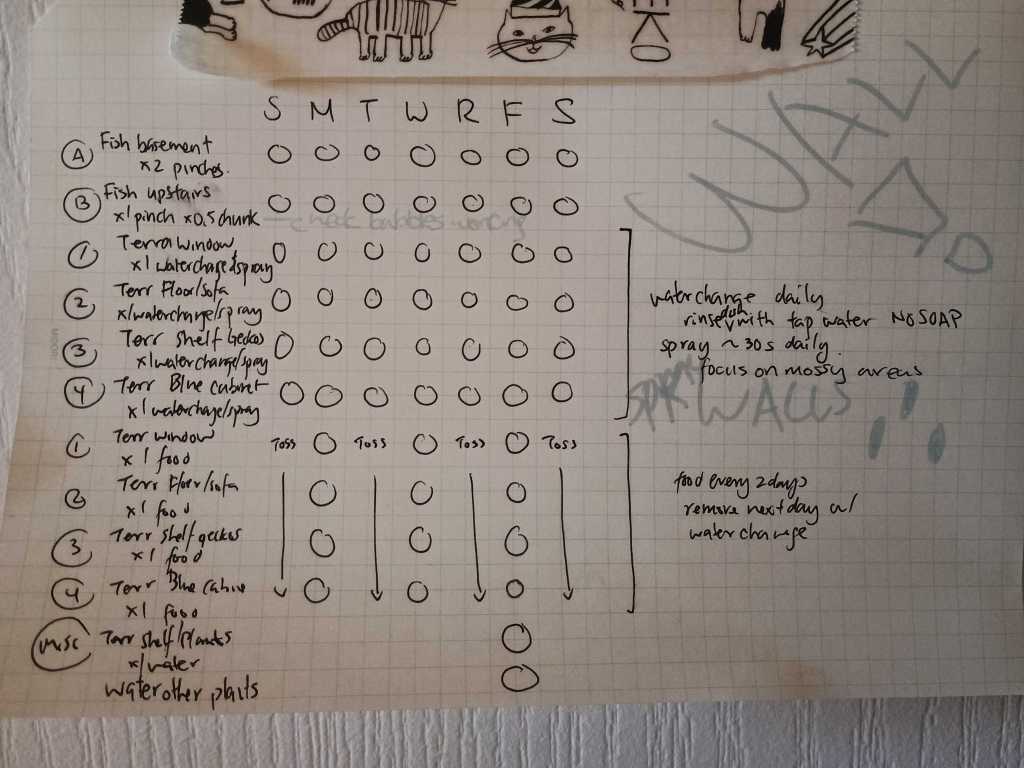
If you are opting for a more designed terrarium, add in a step 3b. Include hardscape that builds a story using either natural (e.g. rocks, wood, bones) or man made materials that will take a long time to degrade to create a framework. This can build up height and mounting places for plants. This can also create shaded areas that might allow for lower light plants to stay compact with minimal growth (and trimming). If you’re anything like me, the building many worlds process can kind of run away from you (Fig. 6), but eventually you’ll work out a good balance for the time you have and the commitment you can make to care for things.
Figure 6. A set of instructions back when I was gone for 8 days. This is the most complex care schedule I’ve ever had to give someone. I’ve since consolidated a lot of things and streamlined the process both for myself, and those taking care of things when I’m gone for more than 2 days at a time.
Sometimes life is stranger than fiction. Here I am, waiting on a phone call from IT after I found out that my access token has never been granted (despite using it for 3 years or so) and my account doesn’t have VPN access and never has. I wonder. Chances are I just punched in my new PIN wrong so many times that I got turfed out of the system and accidentally overwrote a few things. The extra fun part is when my password shows up as my username during the restoration process.
This week we were asked to reflect on the science portrayed in one of our favourite shows. Admittedly, I am not a huge consumer of classical media and often can’t remember the details (The Expanse is a great book, but I didn’t finish the show, and I didn’t enjoy The Martian enough to critique it). I thought I’d share about one of my favourite animes instead, an absolute classic of a time travel show: Steins;Gate (Fig. 1).
Figure 1. Steins;Gate game art. This was released as a visual novel at first before the anime adaptation. The main protagonists are shown on the cover with a falling phone and time travel evice.
Steins;Gate appears to be a comedy/slice-of-life anime that starts off with our male protagonist Hououin Kyouma/Rintaro Okabe who suffers from delusions of grandeur and believes himself to be a mad scientist. He is a high-school student attending a university during the summer. His close friends include Daru (a stereotypical, overweight, pervy nerd who salivates over a picture of the Large Hadron Collider from SERN on his laptop background) and Mayuri (a slightly younger female cosplay designer that is portrayed as airheaded). The anime takes place in Akihabara, a well known “techy pieces and odds and ends” sort of place in Tokyo that is very real (the equivalent of this in Osaka is Den-Den Town!) where they build weird gadgets and eventually…make a gellifying microwave that leads to time travel by the means of text. Oh, and in the meantime, Kyouma encounters Makise Kurisu outside of a summer lecture series by a famous scientist after he interrupts the theories on time travel.
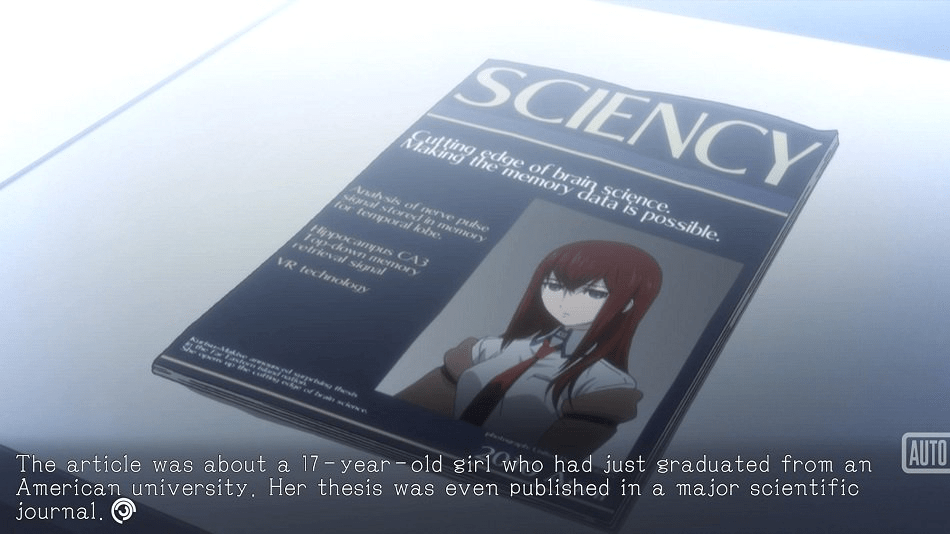
Here’s where the real-life and science really begin to blur. Kurisu is a prodigy in neuroscience research and has published in “Sciency” (Fig. 2). She gets roped into the antics of the other high-schoolers as they try to decipher the gel-formation and the mini-blackhole that is somehow forming within the microwave. Say what.
Figure 2. A screenshot from the translated game. Makise Kurisu on the front cover of the print magazine Sciency.
The show rapidly shifts towards existential crisis mode as the text-activated microwave sends texts into the past, resulting in subtle changes in the timeline and the group being hunted down by evil time travel aware people. Kurisu builds a device to send back memories into the past so Kyouma can download his thoughts each time from his phone while they try to restore the mistakes they’ve made and aim for a happier timeline. At some point they also need an ancient IBN (IBM) machine to hack into SERN to erase any data they had on the lab.
I really love this particular anime. It’s an incredible snapshot of the times and is littered with very specific jokes (many of which might cause pause today) and reminds me of my own high school experience in many ways. It convinced me to try Dr. Pepper (Fig. 3). Also quick shoutout to the translation team that actually broke down every single joke in the visual novel version! It’s still on my todo list to clock in the 80 or so hours to play through the entire game…
Figure 3. Dr. Pepper. Me despising Dr. Pepper is probably one of my biggest “failings” as an otaku in my school days.
Here are some fun tidbits that might be worth exploring!
Black Hole Theory – the crossing of event horizons results in time travel
Light Speed Theory – presumably moving faster than the speed of light leads to some sort of future travel. It is unclear what this actually means in the show
Tachyon Theory – particles that move faster than the speed of light and could be used to send messages by bouncing off a mirror and returning before it left
Wormhole Theory – this one is explained slightly more in-depth during a lecture. The show explains this as a hole where the time between the entry/exit is zero. If a wormhole is sufficiently long, then the arrival time is in the past. Returning to the entry, time travel occurs at the same location. One of the points made here is that exotic matter is required to stabilize the worm hole
Exotic Matter Theory – material with abnormal properties that behave the opposite to F = ma, now confirmed to exist! This would allow for physical movement of objects into the past
and so on and so forth
Without the requisite physics background, I can’t comment how accurate some of these descriptions were. The show uses what appears to be the tachyonic antitelephone where if a signal were sent sufficiently fast enough (greater than the speed of light), then the signal causes an effect before the signal is even sent. To send things faster than the speed of light, a mini Kerr-black hole is created in the microwave. This Kerr black hole is stable only during very specific hours of the day, someone directly by the activity of CRTs on the ground floor from the group’s landlord (Fig. 4). The particular frequencies of the components in perfect resonance are handwaved, and even the group is baffled. But repeated use and testing shows that this indeed is the situation. Science!
Figure 4. Mr. Braun with his I ❤ CRT apron. This is the video game art.
This is fine and dandy when the data limit is 36 bytes (this is shown by the cropping of text messages when long messages are sent), but really falls apart when they start sending entire human memories through the black hole through physical compression of the data (Fig. 5). In the show, the urgency is off the charts so no one stops to think whether or not this really works. We also see that the memory downloading when Okabe picks up the phone causes an immense amount of strain but is near instantaneous, uncompressing in his brain. I suppose this could happen if the compression was only during the blackhole time travel transfer moment, and it immediately pops up as is.
Figure 5. Ah yes. Let’s put on this cute little headset and pull out all of your memories while simultaneously beeping them through the microwave phone. Ding! Also check out that IBM keyboard!
We also see the arrival of a PHYSICAL craft towards the latter half of the show, when Daru’s daughter from the future resistance arrives, crash landing on a building that is shown both damaged, and undamaged in the very beginning of the show. This device somehow contains enough energy to simply jump in time, twice! The device was developed to prevent SERN (now clearly an evil research group vying for world domination) from discovering time travel at all by stealing the group’s research. We have still yet to see if this is at all possible, since the travel occurs in 2036. Unlike exotic matter, I’m not sure if we’ll suddenly see a satellite-like craft crashing into a high-rise building in 2010 retroactively.
Some other fun quirks in the show include:
the presence of maid cafes (very real)
@channel (a 2chan reference perhaps)
Rai-net tournaments (a play on the many card game tournaments in Japan, it reminds me of Digimon somewhat)
Akihabara as a whole (the show uses real locations and buildings)
and flip phones! What a time. The show does an excellent job showing everyone’s individual phones and phone charms. In the visual novel (the show is based off of a game), the choices are made all through text message! You can also choose to pick up or ignore phone calls! Its a throwback to see everyone in the show “text” to email addresses, which remains a baffling situation to me
In summer of 2024, I took a train from Seoul to Busan.
Prior to depearture, I was informed that there was a movie that was based almost entirely on this premise, so I went about watching it as self-assigned mandatory reading. Without spoiling the contents of the movie itself, it was a zombie movie that was focused on humanity and the reactions of individuals in high stakes environments. For me, this was a sneak peek into the trains and the potential luggage room available.
I confess, I was misled. Google and reddit supported the idea that there would be extremely limited luggage space, and rolling travel bags would be at risk of not fitting. As such, I opted to bring duffle bags to squish into the overhead compartments, which I knew from the movie could fit an adult human.
As it turns out, I was not the only one who took the train to Busan. Several COSPAR2024 (Committee on Space Research 2024 meeting) attendees I met also mentioned that they had opted to fly into Seoul from whatever country they had previously been in, and taken the train. Direct flights to Busan were about twice the price from Toronto at the time I was looking, and to me it made sense to stick around in Seoul a few days after the conference to get to know the city. I assumed that I would have gotten enough from Busan by the time the 8 day conference was over. I was very wrong on this point, Busan is THE coffee city in Korea, and I felt like I really missed out! Food and activities were also far cheaper in Busan than they were in Seoul, and it only became sunny after the conference had ended and I was on the train back to Seoul. That said, I really was there for work related matters.
Let’s talk about the conference. I spent most of it “live-slacking” interesting tidbits from all the talks I went through. This conference was heavily focused on the presentations, with the poster hall being fairly quiet. I personally had a talk during the ocean worlds session. Navigating the sections was interesting, there was a letter number system that broke down large topics (Space Studies of Earth, Space Studies of Small Bodies, Space Studies of Atmospheres, Space Plasmas, Astrophysics, Life Sciences, Materials Sciences, Fundamental Physics, etc.). For Scientific Commission B, small bodies, the numbers were labeled Bx.x, where the integer indicated the relative subpanel (my guesses are that B3 was exploration and the moon, B4 were the inner planets, B5 the outer) and the decimal indicating the specific name of the panel (B4.3 was Mars Science Results). Each subpanel was further divided into presentations and posters that were relevant to each subpanel.
One interesting aspect of COSPAR is the numerous “business meetings” that take place for each panel throughout the conference. Several representatives give reports, and explain their rational for how many quarter-days they would like in the next conference. During the one I attended, there was also quite a lot of discussion over cross-linking into different panels so that attendees would not miss talks that would be relevant to their work. There was also some discussion on how to revitalize the poster sessions which were relatively poorly attended despite the free alcohol and beverages on site. I was attending to comment on the relative lack of participation and attendance from early career scientists that were not exceptionally gung-ho about sharing their work and putting their names out there in this particular panel (the astrophysics and life sciences sections conversely appeared to have many early career scientists!). I found the overall discussion very interesting. Feedback and discussion for other conferences I’ve attended typically occurs after the conference ends, and this type of business meeting is not open to all attendees.
Despite the extended length of this conference (and extreme heat and humidity that found its way into the conference centre), I found that I was engaged for most of the time and there was less rushing about the building in comparison to some other conferences. It was easy to talk with people during downtime and a great way to meet folks who were doing relevant work, but you might normally not encounter in a more niche conference. There was time for coffee with my coauthors and dinner with my fellow Canadian delegates. Overall I’d say it was an excellent experience, and my main regret is not keeping my mouth shut a little more and doing a bit more active listening.
Some interesting things that happened during the conference that were not work related… A flight show happened! The Korean Space Agency opened in 2024! I found an alien themed coffee shop!
I also would like to shoutout the Canadian Space Agency for making attending COSPAR2024 possible in the first place. This is typically not a conference I would be attending without a thoughtful justification and clear goal in mind. I hear the next one will be 9 days long. As an aside, every single submitted abstract is still visible on the site and can be viewed.
A list of the planning and scheduling resources I use intermittently or all the time. I’ll update this periodically. Currently I use a mix of Google Calendar, a Weekly Planner, and a Daily Planner/large notebook.
Google Calendar
Nothing new here! I have several calendars that I’m subscribed to and use. The top three that I pay attention to are:
my lab calendar (x2). We update our extended out of office dates, shift dates, group meeting times, and events that may be of interest to others here. I usually use this to check when the next group meeting is, if I’m on the hook for anything to share at a meeting, and if anyone is out of town/busy
my personal calendar. I schedule things like game nights, personal meetings, and events I’d like to attend here
my personal work calendar. This is shared with my supervisors. When I need to get a lot of work done in a short amount of time, or I have huge swaths of work hours I can leverage, I plan out detailed tasks that help me accomplish larger goals with “Target” dates in which I send completed writing tasks to my supervisors/labmates/coauthors for review. I also put in major timeline checkmarks here
Weekly Planner
For those who have been subject to my love of the Hobonichi Weeks, let it be known that I moved into a Midori because their cat covers (and the price jump on the Weeks) convinced me. The weekly planner is a slim, vertical layout, with 2 pages per week. On the left side is M-S broken up vertically throughout the page, and on the right side is a blank graph page. I tend to carry this around all the time to mark in
3-5 tasks I want to complete for the day, and
any scheduled appointments/meetings I have that day.
The graph side is for notes, impromptu ideas, tracking granular details, etc. There are overflow pages at the end, but this isn’t suitable for taking many notes.
Daily Planner
This is where I log meeting notes, plan things in detail, and use as an adhoc planner for whatever it is I need at the moment. (Previously I did this in the Hobonichi Weeks, but I found that the slim format was actually a detriment and I needed more horizontal space). I’ve used everything from a blank notebook, gridded notebook, sticky notes, and tip-ins from scrap paper for this. This year I’m using a Hobonichi Cousin because there is a lot I want to get done and its nicely formatted for me. I use this to
set monthly goals/tasks on one page per month
take meeting minutes
use as scratch paper! Currently it’s arranged so that it’s one day a page. If I overflow the date, I just flip back to the last empty page and jot down the “date/page” I continue on. I often write down equations in these pages when I’m trying to do unit analysis and I need to get away from my code for a moment, scribble out plots and graphs that I think should appear and compare to what I see on a computer screen, or outline things such as my weekly plan, my thesis structure, jot down who I want to reach out to for whatever topic, write down short summaries of papers I’ve read, etc. This is also where those extra random stickers I accumulate throughout the year often end up…
My goal with this format is to actually develop an index this year. If there are key writings that I want to go back to, I don’t want them lost. Last year I just stuck in book marks, but it eventually got overwhelming. This year I want to take advantage of the “year at a glance” page and write down a brief header in those spots so I know where to go looking for when I want to check on the contents of a meeting I had.
This could easily be replicated in something likeOneNote or any other note taking software, but I’ve found I never really used those, and spending the extra few minutes to write down important things from a paper I want to remember works better than trying to dig up my highlights in my reference manager!
Bonus: Google Forms
Sometimes it’s just too much work to trawl through your calendar and fill out a tracker. To track things that take up my time, I use Google Forms! I write out a 3-4 question form for something I want to keep track of all in one place, and I know that I won’t want to do on paper/keep flipping to. The major use of this one is my Teaching Assistant duties. I keep track of my hours in 15-30 minute chunks and classify my tasks. This has come in helpful when discussing expectations and remaining hours in my contract. Its also useful for profs to know how to better assign hours to their TAs for the following year! I create one of these forms each year, and sometimes a more detailed one for certain courses I’m assigned to. I have my phone out all the time, so I might as well use it when I’m feeling guilty that I’m not doing work!
Questions in the form are:
What course is this for?
What tasks did you do? (eg. marking, proctoring, communications, prep work)
How many hours did it take?
Notes (more details, for example, noting that it was Assignment 1 that I was working on, or if it was an unexpected conversation that was course relevant)
Bonus: Check-ins
All of these tools are useless if you don’t use them. I typically review my calendar 2-3 times a day (and have noticed I’ve missed meetings because it’s muted, so I’m workig on a solution to that!), my weekly planner once in the morning and once at the end of work + whenever I need to jot down an appointment, and my daily planner daily-ish if I want to use all that extra space.
Back in the days when it was socially acceptable to admit to owning a Nintendo Wii (no U to be seen back then), I was a huge fan of playing Super Paper Mario when I could borrow it from a friend (Fig. 1). The storyline was typical, Mario and friends travel through a number of dangerous worlds, defeating baddies, collecting goodies, and facing off the final boss at the end. I confess I never defeated the game (but no spoilers here!), as the save system was in such a way that I would persistently load into the final play-through with minimal health and entirely forget the controls each time I tried. Perhaps the smart thing would have been to restart all over again. But this is not important.
Figure 1. Super Paper Mario game cover. Anyone else remember this game?
Super Paper Mario was a game that let you flip between 2D and 3D. This flipping ability let’s the player access an additional layer of the world that previously was hidden. You could make changes in the 3D world that affected the way the 2D world worked, by moving things in and out of the plane, and sometimes seeing passages that prevently didn’t exist. The 2D and 3D worlds were intimately related. This is my convoluted and off the cuff explanation for Fourier transforms (I’ll find out after this once I reread the Wikipedia entry for the umpteenth time).
Figure 2. Completely unrelated to this post, but I once made some fanart of this scene in highschool for an art project. I found the art style to be very charming. I want to say it was for an illustration class, but had I done it again, I think I would have done a 3D installation for this recreation.
Imagine you’re dealing with this convoluted passage way, trying to navigate your way to a Pure Heart. You flip into the 3D space and you see that there is a frequency, a regularity, or perhaps everything is just a little lower than you’d like. You bonk some blocks with your head, dodge some goombas, and flip back into 2D. There it is! A straight path to the exit. It was there all along, but you had to move things in the 3D world to access it.
In my world, this is exactly what Fourier transforms are for. You take a signal that seems rather confusing, and want to see some of it’s characteristics in the frequency domain. Once you’ve flipped into frequency space, you can see all the details that make up your time signal. This might give you some clues to your final destination. But you also might need to tweak a few things to clean up the interpretation. By applying a function that can only be done in the frequency space, you have affected your time domain as well. You can see the results of your work by flipping back into the time domain.
Fourier transforms can be applied to more than time signals, and work for any sort of complicated situation you have. Say you want to recreate a complex squiggle in 2D, but want to make it exclusively out of single curves in 3D, you can do that. There’s more to it, but let’s say I have a strong itch to find a second-hand Wii and give Super Paper Mario another shot. Bleck!

Some time ago last year, I wrote up a blogpost on how to increase the likelihood of having your plants mostly survive when you’re out of town for an extended period of time. Whether that’s conferences, or field work. Things have changed a little since then, and my environment is now different. The room where my plants mostly reside is hot, very hot during summer months. This means watering some of my plants nearly every day to keep up with their requirements and the methods I had come up with in the past wouldn’t quite cut it. If I was gone for more than a week, I was sure to have casualties with the way things were currently set up. What was the solution?
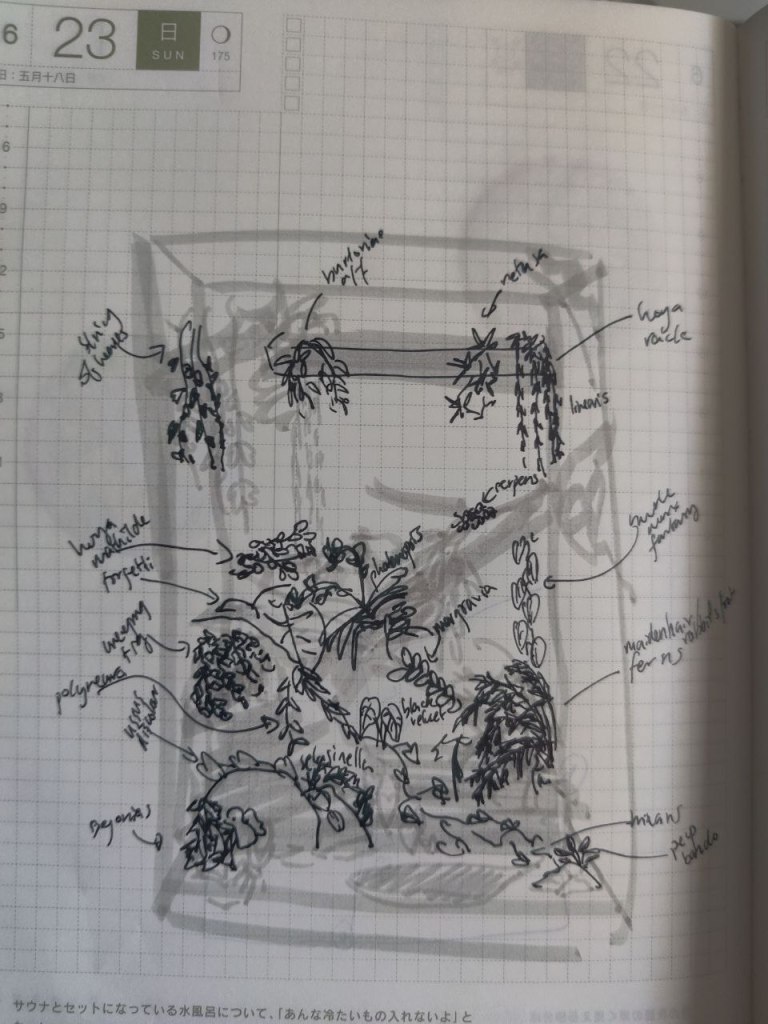
Figure 1. My grand plan for where all my plants would go, with some hopeful new plants to add in!
Rising Action
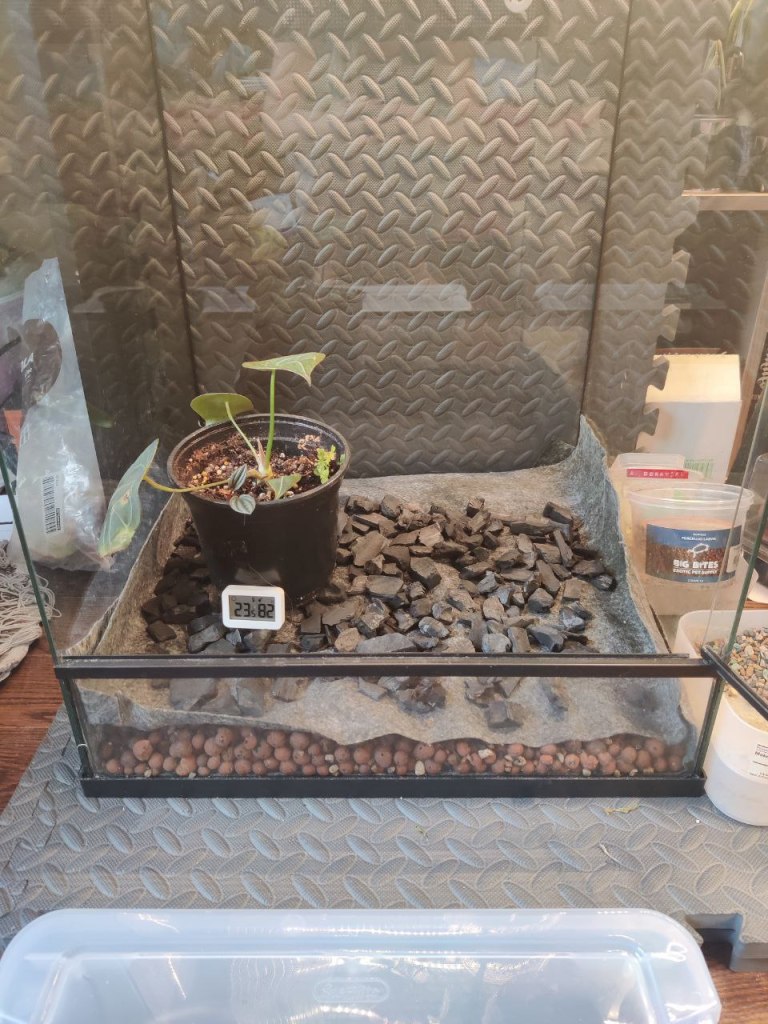
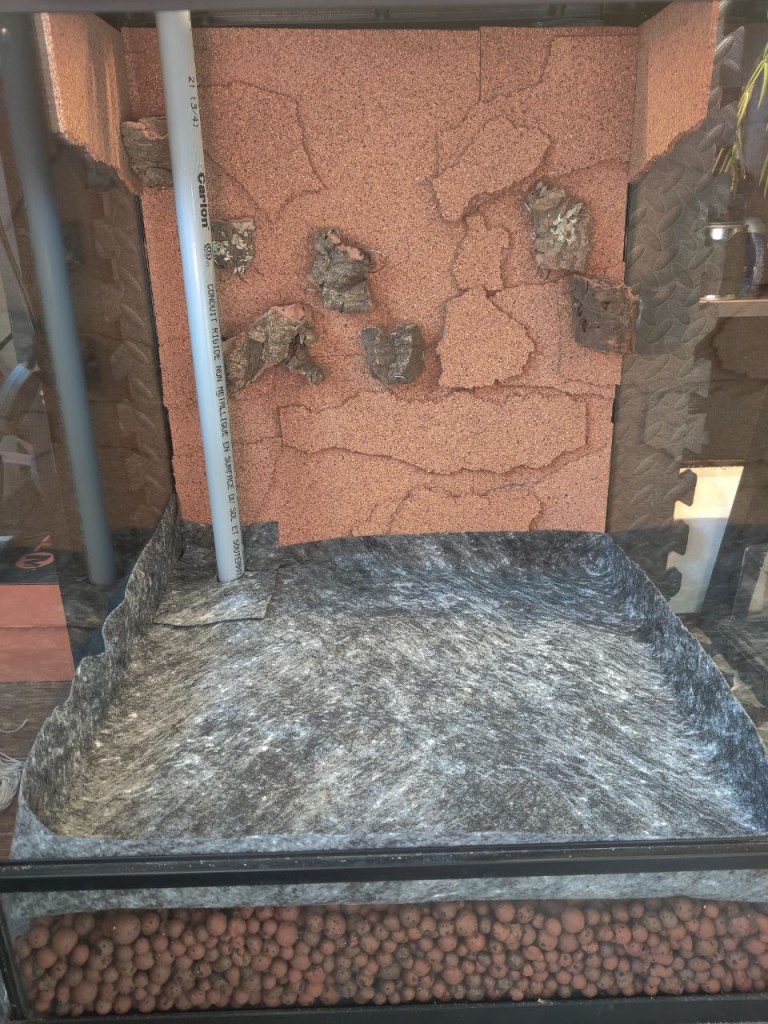
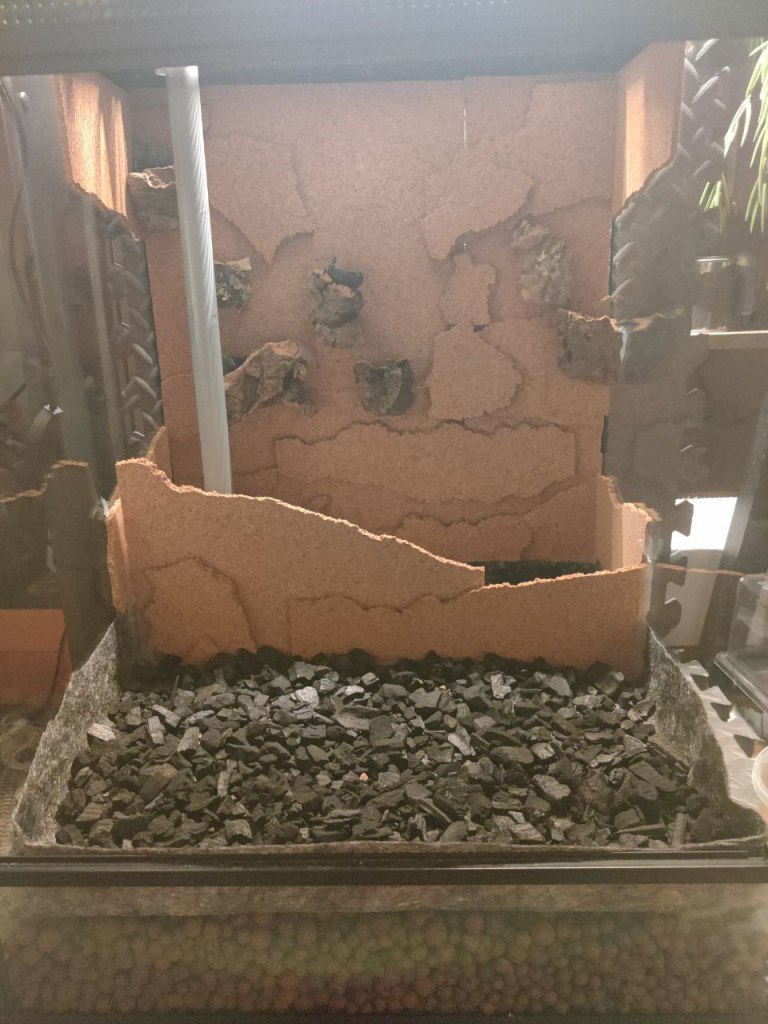
Apparently, it was to purchase a large glass box and build a terrarium. I also wanted to make it bio-active, with little critters eating all the mold and decay that was sure to happen in a partly enclosed, high humidity environment. Some of the materials I had already, which is why I felt it was perfectly reasonable to go ahead with the idea with a little over a week to spare. I was able to put together all the components together in a couple of hours, and the next day after the silicone had cured, I dumped in my drainage layer, added some weed blocking fabric, sprinkled some charcoal, and topped it all off with the weirdest soil mix I have ever put together. It didn’t actually work out exactly this way, as I vaguely remember digging up parts and trying to stuff in more drainage a few days later after purchasing some additional parts after I had already set up part of it (see Figs. 2 and 3).
Figure 2. A quick test run to see how humidity would hold up. I was about to start dumping soil in when I decided that I didn’t have enough of a drainage layer. This was addressed by a trip to Provision Garden Supply, a store that sells lightweight expandable clay aggregate (LECA) in bulk, and has a huge variety of soil bases available.
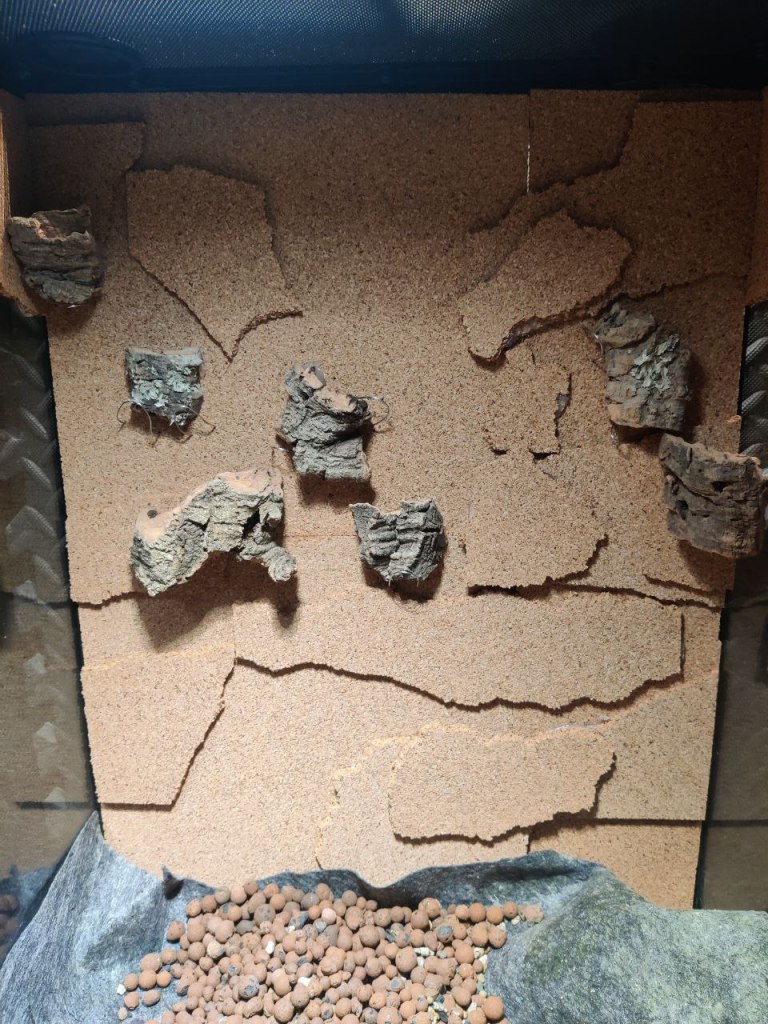
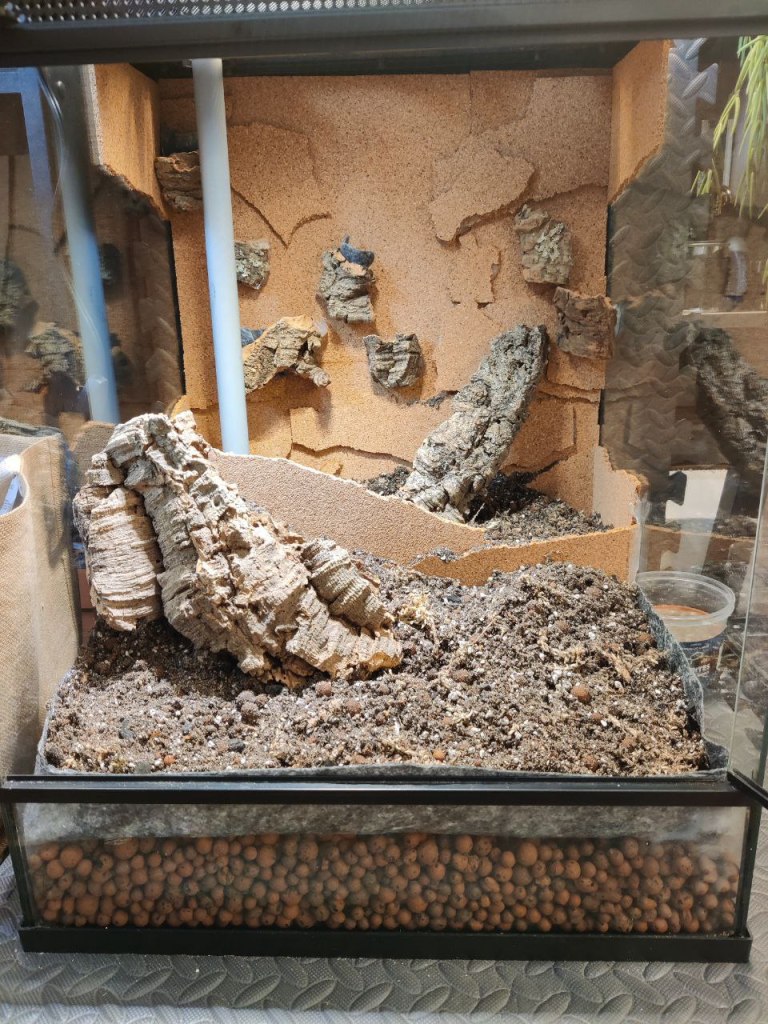
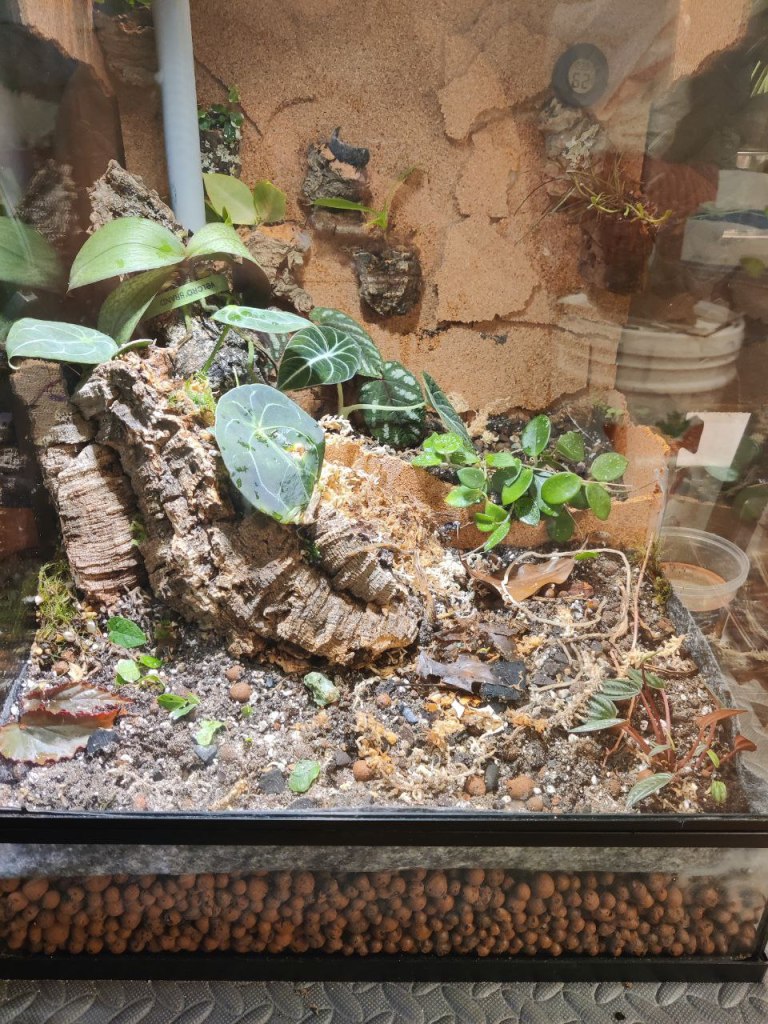
After the structure and soil had been put in, it was time to add some “hardscape” (Fig. 3). That is what “scapers” refer to as the chunky elements that guide the overall composition of a scene (scape). In this case, I had a pile of miscellaneous rocks I had collected over several years, and some corkbark flats that I had purchased by the pound. Then I stuck in all the plants and fussed over their placement in proximity to the light source and soil depth over the next few days while figuring out precisely how frequently they needed to be watered.
Figure 3. Build progression over a few days after I aquired the materials. This PVC pipe was taken from my previous aquarium living wall. In retrospect, I didn’t need one that spanned the whole length and out of the exit hole in the top of the frame. I later found that it also impeded opening of the top frame because it was a hinged mechanism.
Things were going well, I knew the watering schedule, and I knew that there would be family members who could check in fairly regularly rather than leaving everything in darkness for 2 weeks.
Climax
I came back and… not too bad. There were only a few casualties, a spider mite boom, and some very happy isopod colonies. I spent my first full day back cleaning and inspecting the plants in between unpacking and seeing what I had missed while I had been gone.
Figure 4. You may be able to spot a very yellowed alocasia black velvet kicking around in the back there. Also my attempt at fungas gnat control with carnivorous plants did not take. Fortunately this hasn’t been a real issue. In the foreground is a mix of scattered dead leaves and some algae from my fish tanks that act as food sources for the little critters when I’m not feeding them something fancier.
Falling Action
Life moved on, I had work to catch up on, and I was happy that most of my plants were stable. It was highly convenient to be able to water the vast majority of them all at once! Naturally, I also purchased some terrarium specific plants to add in once I saw that everything had been established and was growing in (Appendix, section B). I felt like things were about wrapping up in this terrarium, and as time progressed, I relocated some of my remaining shelf plants into the terrarium.
Then, just this weekend, I went to a plant swap in Toronto. The event has been on my radar for the last couple of months, and I even had a hopeful wishlist of things I would love to find. I brought 8 plants with me to give away, and took home 10 or so. While I did side-eye the health of a few of the plants, I gave everything an intense blast with water and stripped most of them down to the root. No obvious pests. So… I recklessly placed some of them inside as well (Fig. 5). I was feeling pretty comfortable about the whole situation.
Figure 5. New plants acquired and added! The big red one is a cryptanthus that I actually purchased, The extra branch was something I picked up on my way back as well. You may notice some popsicle sticks added in, those are for support in case I get a sudden tumbling of material from all the new added weight. The second image shows my usual view when I swing around my desk chair looking for a distraction.
Denouement
Is the plant care optimization and acquisition adventure over? Probably not. I’m planning on going to a Plant Expo later this year, so chances are I may come across something that I fancy. I might also be able to harvest some of the alyssum seeds out of my potted plant container from outside and see how they fare indoors. This also means, I probably need to look into building more enclosures. The current set up is almost a little too easy to take care of, and its been taking out some of the fun and enjoyment out of plant care and maintenance. I’ll be looking into building an automated watering system, which sounds like it could be the next big adventure. Depending on how things progress, I may also need to look into adding some mini fans to help circulate air and dry out the terrarium faster.
Reflections Upon Return
Despite some losses while I was away, having a main set up has definitely a time saver when it comes to watering and general care. I’d argue that I’ve already earned back the time spent sourcing parts and constructing the entire enclosure. Plus its nice to see all the plants placed so closely together, in comparison to pots dotted about.
While I still like watering my potted plants at weird intervals, daily spraying is a far easier task. It usually ranges between 70 – 90% humidity in there if I’m watering twice a day (trying to get into the habit in case I go forward with the plan of acquiring a gecko, though I would open up the ventilation more for it to drop quite a bit before adding more water!). I also happen to have a pressure sprayer that holds 4 L of water from a whiles back when I was doing preventative spray downs of my plants so watering is extremely quick. I’ve been filling it up with rain water and using it for just about everything.
Mind you, it’s not just watering I have to do. Since it’s a bio-active setup, I still have to feed the critters from time to time. They get any of the following: crushed egg shells for extra calcium, special Soilent Green from Repashy, select dried leaves from elsewhere in my room, and piles of algae and duckweed from my aquariums. So much duckweed. I don’t think they’re big fans to be honest, but it is very nutritious, so they’ll just have to deal. Definitely one of the more fun projects for the summer though. As for the other “worlds”, I’m waiting on them to establish well enough to share any successes and failures.
Figure 6. A little spoiler of the new occupant in this world! He’ll be joining a squad of springtails and isopods. Depending on his activity levels and whether he continues sizing up, this may only be a temporary home while I set up something a little more suitable for him. Only time will tell.
Appendix!
A – Initial Setup
Approximate cost breakdown of the terrarium (initial setup) in CAD:
$100 tank (second hand, 18”x18”x24”)
$20 cork bark (by the pound)
$11 wood
$15 silicone (caulking gun was borrowed)
$10 spring tails (culture from much earlier in the year)
$15 isopods (dairy cow isopods on sale, it’s possible to get them for cheaper and much more)
$0/$50 weed fabric barrier (from a previous project)
$2/$60 spaghnum moss (I’ve been using the same bale for nearly 2 years! I’m finally running out)
$10 lamp (this is the cost of the LED bulb, the lampshade came as part of a store display set)
$10 peat moss/perlite mix (wrong choice by the way, I later topped this off with $5 of coco coir bits)
$3/14 biochar
$5/$60 LECA
$3/$15 mineral magic (pon-like blend)
$5 perlite
Plants that I jammed in there (some of these were added much later when I returned though!):
plant species (personal):
alocasia black velvet (melted away, this sucked since my backup plant dried out while I was gone)
anthurium forgetii
anthurium dorayaki
begonia lynda dawn
cissus discolor (pinky leaves! Though most of it melted away)
davallia fajeensis (rabbit’s foot fern)
ficus pumila green (dried to a crisp!)
hoya crassipetiolata
hoya GPS 7240
hoya mathilde
hoya retusa (finally growing!)
pepperomia bando
phalenopsis (of some spotted leaf variety)
philodendron florida ghost
philodendron micans
pothos manjula
Added after I got back:
begonia fannie moser
begonia escargot
hoya burtoniae aff
hoya coroniae (red)
hoya fitchii
hoya memoria
hoya polyneura
hoya rebecca
hoya sigillatis
maranta var
philodendron white princess (ish)
pothos global green
B – Additions to the Terrarium
Plant species (purchased for terrarium):
begonia burkilii
biophytum sensitivum (I don’t recommend purchasing this one, it seems to just pop up on its own if you purchase other terrarium plants!)
cryptanthus (very pink!)
ficus pumila quercifolia
selaginella sp “Pachitea Dark” (I’m not sure if this is alive and growing or totally dried out)
selaginella uncinata (sold as peacock club moss)
Plant species (plant swap/gifted):
ludisia discolor var. nigrescens (jewel orchid)
monstera lechleriana
syngonium pink spot
hoya nova ghost
dischidia hirsuta (?)
Crested gecko:
2 year old male crested gecko with minor spinal deformity
C – Reviews
Provision Garden Supply – I went to the one in Newmarket and have gone a few times in the past. Usually I’m looking for something specific, like fertilizer or a soil replacement. This time I was looking for a few types of soil, biochar, and LECA. The staff was really helpful in narrowing down the best base “soil” for a terarrium that might one day host a live creature. He pointed me to Lamberts since they had a claim about being entirely organic, though wasn’t convinced it meant all that much. I appreciate the candor though!
JOMO Plant Studio – I’ve shopped from JOMO a few times in the past, and attended one previous plant swap event. It is a store that targets people interested in plants for aesthetic, but has been slowly moving into trendy plants that are often priced pretty high in comparison to their older pricing that was mostly scaled on the size of the plant. The swap event itself was fairly well organized, with drinks and 3D printed freebies as well. It also stayed remarkably on schedule. I have mixed thoughts on the health of their plants, but I have never once seen pests upon arrival. I seem to have bad luck with the few things I’ve gotten from them though.
Understory Enterprises – the source of my terrarium plants (and an ill-advised decision on fruit flies, my fault, not theirs). They were quick to email back on an inquiry for local pickup, it was easy to organize, and the plants were healthy. All are still doing well at this moment!
The Gecko Hub – April at The Gecko Hub responded to my immensely sketchy Instagram message with a lot of grace and let me visit her residence to interview the geckos. She selected 5 based on what she thought I was looking for, and also let me look around the breeding room while chatting about general gecko care and husbandry (and pointing out other geckos that I might be interested in! She was right). I was pretty impressed by her professionalism and knowledge base, as well as her firmness on which animals would be “pet only” due to concerns over passing on unhealthy traits.
This was a late night (4 am) writing exercise inspired by some online discussion I had been privy to. All mistakes are my own. Math is likely incorrect. There are MANY ways in which to improve upon this work, only some of which are addressed below. Please excuse the lack of equation formatting, turns out LaTeX plug-ins require upgrades! Minor edits may be ongoing!
Abstract
I investigate the effects of shockwaves and in light of aquarium hobbyists concerns regarding impulses potentially damaging glass tank walls. I compare the potential peak pressure experienced by the aquarium walls in the case of a manmade object travelling at 3 km/s at 0.1 km altitude to the theoretical strength of the glass walls and find that failure is unlikely to occur if the glass ratings are reliable. However, the silicone seams may be a point of weakness. Additionally, I did not evaluate the compound effects on glass strength from other damaging sources such as scratches, casual impacts, and long-term use. Suggestions to minimize the impact include the use of diffusion (reflecting barriers) and absorption (highly porous material converting kinetic energy to heat), though their efficiency is not evaluated. Lastly, I note some of the short-comings of this work.
Introduction
Impulsive events occur on a daily basis, of which the common aquarium is hopefully designed to withstand these bumps and knocks. For larger events such as meteor impacts and the passing of fighter jets, it is difficult to believe that the various aquarium manufacturers take these factors into account when setting out safety standards and designing their warranties. Recently, an innocent question was asked online, “How to protect my aquarium from shock waves caused by sonic booms?” (u/WassufWonka, 2024). This sparked a brief discussion that was rapidly quelled, though subsequent posts were made (u/memerobbin, 2024; u/laced1, 2024) and others discussing moderation. Before it concluded, some points were brought up, including the relative pressure caused by shockwaves from passing fighter jets, equilibrium pressure inside and outside of the aquarium, and whether aquarium glass was sufficiently strong enough against said pressures. Suggestions for limiting the impact including foam mats as padding, tape in cross designs, and transferring fish to buckets for the time being. A brief reassuring post from u/sldomingo (2024) appeared explaining how the shockwaves would be absorbed by water and not to worry before promptly being removed.
In this article, I briefly investigate the potential source of impulse, describe the range of pressures from the shockwave as it encounters the aquarium glass, and consider whether standard aquarium glass is sufficient to withstand these impulsive events. I also discuss the various ways in which an aquarium can fail from other events, and how one can mitigate the effect of shockwaves on glass with a brief note on the strength of silicone seals.
Methods
Source Impulsive sources impacting aquariums can vary, including repeated finger tapping on the glass, a young toddler wrecklessly scratching glass with a set of keys while an absent-minded parent looks on, to the sonic booms from fighter jets overhead. Sonic booms are generated when an object moves faster than the speed of sound, causing a stacking of pressure waves “breaking the sound barrier”, a shockwave. This shockwave and can come from natural sources, such as incoming meteors, and manmade sources, such as space shuttle return or fighter jets.
The shockwave that is released travels at speeds higher than the speed of sound for several wavelengths, before relaxing and continuing to travel at the local speed of sound (ReVelle et al, 1976). The shockwave can be approximated as a cylindrical source. At sufficiently far distances, it can be approximated as a line source with one main overpressure event. We can estimate the range of overpressures from the shockwave using the generalized steps:
Estimate the source energy available for sonic boom
Convert source energy to overpressure at the surface
For expediency, I will use existing data on manmade hypervelocity objects. The return of Stardust suggests maximum overpressures of 1.153 +/- 0.096 Pa including several delayed infrasonic arrivals with equipment sampling frequency of 100 Hz (ReVelle and Edwards, 2007). Estimates of source energy range from 1.557E-6 to 2.437E-5 ktTNT (1 ktTNT = 4.185E12 J) for the first instance of infrasound arrivals with a distance of 32.6 km and height of 42.7 km. Secondary arrivals have a maximum overpressure of 0.207 Pa with around a 10 s delay, and estimated energies of 6.275E-7 to 1.206E-5 ktTNT when Stardust was at a distance of 26.1 km and a height of 32.07 km. Stardust had an initial return velocity of 12.9 km/s with simulations estimating a mean velocity of 3.0 km/s (ReVelle and Edwards, 2007).
Siber et al. (2024) also provided data on the OSIRIS-REx capsule return. For a point of reference, station A05 from the Gems station was located closest (~13 km away, height unknown), with a maximum amplitude recorded at around 1.5 Pa (Fig. 7). They found that the shuttle was travelling at approximately 2.9 km/s based on the seismic data. Notably, the shuttle achieved a theoretical maximum of Mach 45.6 at 95 km altitude, and the shockwave was estimated to be produced at 80 km altitude.
Theoretical Fighter Jet Let us consider a theoretical fighter jet, capped at Mach 9.6 (3.3 km/s) per a google investigation. This is sufficiently close to the case of the estimated Stardust return. We now estimate the potential distance of a fighter jet passing by over a home in Beirut, Lebanon, let’s say 0.1 km (or 100 m). Considering the mountainous environment, lower flying does not seem particularly sensible, though certainly feasible. Let us also consider this the slant distance, as it is possible a plane would be flying directly overhead.
Scaling Laws We can now use some of the existing scaling laws to estimate the total overpressure that may be experienced 0.1 km below a passing jet if we can assume scaling laws apply (I should probably find references for this, but I’ve been reasonably assured below 100 km this is not too silly to do), then del(p_1)/d_1=del(p_2)/d_2, which can be rewritten as del(p_2) = del(p_1)*(d_1/d_2)
For the first arrival, I found an overpressure of 619.2 Pa, and for the secondary arrivals, 85.6 Pa. For a point of reference, atmospheric pressure is 101325 Pa. The pressure exerted by water in a full tank can be estimated using an example of a 33 gal standard aquarium with dimensions of 48’’ x 13’’ x 12’’. Assuming the 12’’ dimension is the base, the area of the outwards facing walls are approximately 0.4 m2 and 0.1 m2 respectively. The pressure in the tank can be calculated using force, F=rho*g, with rho=1000 kg/m3 as the density of water, and g=9.8 m/s2, gravitational acceleration on Earth. For the respective faces, the pressure exerted by the water in the tank is 24500 Pa (24.5 kPa) and 98000 Pa (98.0 kPa, or 0.098 MPa) respectively. Thus, the arguments that the pressure within the tank are greater than the impulsive events appears to hold.
Note that the pressure from the sonic boom in this case is within the blast radius, before viscous relaxation. The blast radius is ~3.0*R_0 (Ceplecha et al., 1998), where the characteristic blast radius R_0=1.05*M*d_m where M is the Mach number, and d_m is the diameter (ReVelle, 1976). Let’s say the blast radius is then 3*1.05*9.6*13.7 m = 414.3 m, greater than our hypothetical case of 100 m altitude. At a more realistic Mach number 3, the blast radius is 129.5 m. This suggests that our pressure estimations may be underestimations for this particular case.
Let us assume that the source of the shockwave from the OSIRIS-REx return was at a distance of ~81 km (assuming 80 km altitude), this corresponds with 1215 Pa at a distance of 0.1 km. Thus, we have a general range of overpressures, between 85.6 Pa and 1215 Pa from a shockwave. On the higher end of the estimated overpressures, this is about 8% of the pressure of water exerted on the long face of the tank.
For a 5 mm thick tempered glass pane, I found an average of 19800 psi compressive strength (I have misplaced this reference, Wikipedia suggests 10000 psi for a 6 mm pane), with Wikipedia giving glass a tensile strength of 1000 psi (Tempered Glass, n.d.; Strength of Glass, n.d.). Say the average tempered glass is 4x stronger than regular glass, this gives us a tensile strength of 1000 psi (6.8 MPa), several times stronger than the overpressure effect from a sonic boom (though later Wikipediaing suggests tempered gl. This suggests that there is no immediate concern that a single sonic boom from a nearby fighter jet travelling at Mach 3 will be of immediate concern.
Discussion
Contradictions This is odd, many horror stories abound about surprise aquarium blowouts, or an accidental hit from a bb gun might be up to 0.5 kg of force over a 4 mm diameter pellet at 20 ft is actually around 3 MPa, half the compressive force glass can withstand. It’s not like we’re tearing around our aquariums either so tensile force doesn’t necessarily come into play. One consideration might be the strength of the silicone seals. Tensile strength of silicone sealant is around 0.5 MPa. Oh.
Now lets assume the glass may have some imperfections. A quick google shows that nickel-sulfide inclusions can be found in 1-2/100,000 6 mm tempered glass panes. An inclusion can result in localized tensile stress as high as 860 MPa (Glass Breakage – Nickel Sulfide Inclusions, n.d.), resulting in microfractures that are easily recognizable. These are primarily a concern in tension zones (say, the center of a pane for a long, starting to bow out aquarium).
Repeated microfractures can cause the weakening of a pane of glass. While I was unable to find the values of strength drop, a microfracture review with repeated loads found that cracks in glass follow progressive stages, with cracks formed by the procedure continuing to produce lateral cracks for hours afterwards (Zakiev et al., 2020). Overall, initiation and propagation of cracks are accelerated by the presence of water (a concern for those of us who scratch up glass with hardscape from the inside).
Minimizing the impacts of sound waves Outside the blast radius, one can assume that waves propagate at the speed of sound, approximately 343 m/s. One can think of either reflecting the wave, or diffusing it rapidly over a short distance prior to the delicate glass. To destroy the incoming waves, it would be necessary generate acoustic waves constantly, in hopes that they would cancel out the incoming waves by means of perfect destruction. Alternatively, one can apply an acoustic panel, which purportedly absorbs sound by conversion into heat energy. I found that a 1-inch foam acoustic panel has a noise reduction coefficient of 0.4 on average (where 0.0 represents a surface that completely reflects sound), though I have not read the ASTM to review the power levels they evaluate (ASTM C423-23). Generally, the more porosity for a given area, the more reflections can take place in a short amount of time. Alternatively, one can diffuse the sound waves by strategically placing a number of flat panels in an attempt to reflect and stagger the effects. An interesting thought would be to place a curved reflector surrounding the aquarium, such that sound waves coming in from every direction would be reflected as evenly as possible.
Conclusions
Despite the very real threat of sonic booms occurring in certain places in the world, preliminary work shows that the failure of aquarium glass for hobbyists is likely to come from pre-existing damage, or repeated events. A single blowout for a relatively new, unstressed aquarium from a passing fighter jet appears unlikely (note that this is not advocating lack of caution!). However, points of failure include the silicone seams, and the aquarium is at greater risk if it has been exposed to prior stressors, thus unquantified. Diffusing or absorbing shockwaves may be possible, though the specific reductions in terms of energy translation and thereby impulsive pressure waves are not quantified in this work. Subsequent studies modelling these specific effects are under consideration, as is generating the impulsive source directly, rather than use of a scaling law, and accounting for cumulative effects such as secondary shockwaves, and ground shaking.
ReVelle, D. O and Edwards, W. (2007). Stardust—An artificial, low-velocity “meteor” fall and recovery: 15 January 2006. Meteoritics & Planetary Science 42(2). pp. 271-299. DOI: 10.1111/J.1945-5100.2007.TB00232.X
Silber, E. A., Bowman, D. C., Carr, C. G., … (2024). Geophysical Observations of the 24 September 2023 OSIRIS-REx Sample Return Capsule Re-Entry. Accepted for publication in the Planetary Science Journal. DOI: 10.3847/PSJ/ad5b5e. arXiv: https://doi.org/10.48550/arXiv.2407.02420
Ceplecha, Z., Borovička, J., Graham, E. W. (1998). Meteor phenomena and bodies. Space Science Reviews 84(3-4). pp 327-471. DOI: 10.1023/A:1005069928850
ReVelle, D. O. (1976). On Meteor-Generated Infrasound. Journal of Geophysical Research 81(7). pp 1217-1230. DOI: 10.1029/JA081I007P01217
Zakiev, I., Gogotsi, G. A., Storchak, M., and Zakiev, V. (2020). Glass Fracture during Micro-Scratching. Surfaces 3(2). pp. 211-224. DOI: 10.3390/surfaces3020016
Standard Test Method for Sound Absorption and Sound Absorption Coefficients by the Reverberation Room Method – ASTM C423-23 (2023). https://www.astm.org/c0423-23.html. Retrieved Aug 9, 2024.