There is a science to guessing at the game, Two Truths and a Lie. Last week, the Neish lab got together and shared 3 things about themselves. As per the name, two of the three things were true, and one was a lie. The goal of this exercise was to get to know each other a bit better, especially as we had a few additions to the lab. The method, or at least my method, was to rank them in order of likelihood based on all the additional information I knew about each person. Extra insight could be gained by comparing the level of detail in each statement. In instances where I had no idea where to begin evaluating the statement, I assumed they were true. This method wasn’t the greatest considering I got two wrong! Fortunately, there are no stakes in the game, and we all learned quite a bit. For example, the lab could probably start up a band together.
Here are my preamble and statements (everyone “won” this round, though the reasoning was wrong).
Hello new lab members and stray huamns! This week in the Neish lab, we’re welcoming new folks into the fold and getting to know each other. Here’s to hoping these two truths and a lie aren’t ones I’ve used in the past!
Two truths and a lie:
I drink three cups of coffee a day
My post popular blog post is on plants
My number one food request is, “no bell peppers!”
Without hesitation, I heard a couple voices coming through the screen saying something along the lines of, “There’s no way you only drink three cups of coffee!” and “It’s definitely one.”
Reader, they were right. I drink one cup of coffee a day now. At some point in my life, I was probably imbing 5-7 cups a day (350 ml+ cups, mind you), and it probably did show in the way I interacted with the world. It seems I still behave very caffeinated! That day in particular, I had finally hit the robusta beans in my grinder, and I was a few notches perkier and more speed talkier than usual. Here was my prepared response.
Alas, no more. For the past three or so years, (Note: this might be a lie, it might only have been for two years) I’ve been sticking to one cup of coffee a day, with the rare foray into two. While I’m still not convinced caffeine does particularly much for me, it’s clear that I can experience caffeine withdrawal symptoms (so I suppose that it must do something after all). I’m a big fan of coffee in general, so it saddens me a bit to restrict myself from the diversity of flavours and roast profiles. However, I can’t deny that I have been sleeping better since I cut any form of caffeine intake after 2 pm. I’ve not come across a decaf coffee so far that is more enjoyable than just plain tap water, though I do try it from time to time and it can be an enjoyable experience on its own (Note: my attempt at pre-empting the question). It remains on my to-do list to try and seriously roast my own small batch coffee beans at some point, so I want to keep trying to find my perfect coffee and then one day replicating it at home from scratch.
As for the plant pollination?
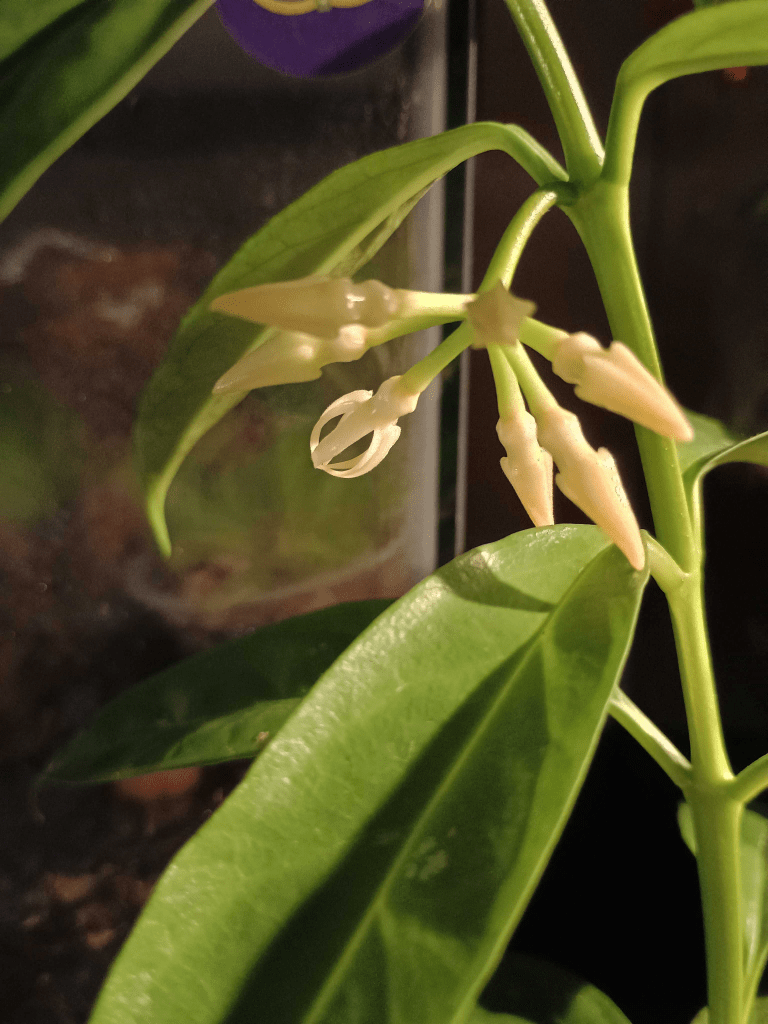
Surpising, but true! My sketchy illustration of how to transfer pollen between awkwardly shaped hoya flowers and masquerading as a moth makes up a disproportionate number of my blog views. While not many to begin with, I assume it is due to the increase in hoya hybridization interest that has taken place in the past few years. I’ve recently noticed several imbricata hybrids become available if one prefers a less shingly and ant hiding type of hoya. Unfortunately my hoya linearis blasted its blooms this year when I was away at an inopportune time, so I did not get a chance to try it out again. The other hoya I currently have in bloom is shaped so oddly that I haven’t given much thought as to how I would conduct the pollination! The hoya decipulae (Fig. 1) is a prolific bloomer however, so I assume I shall have chances in the near future once the propagations I took become established.
Figure 1. My first ever (I think) hoya decipulae bloom. The full flower becomes a spinning wheel of egg beaters with a near spherical whisk end on each one.
For my food preferences, I figured it would be interesting to hear how others felt as well. I heard at least one person say this wasn’t the first time they had heard about a strong disliking for bell peppers. I also snuck in some random tidbits about flavour and scent profiles.
And it is! Followed by no cilantro. Celery can be rough as well, though has become more tolerable over the years. I have a scale for bell peppers as well. Green bell peppers are the worst. Then red. Then yellow. They’re all terrible to me though (spicy peppers are oddly fine, though non pickled jalapenos can be a bit too green bell pepper adjacent). Green bell peppers are unsalvageable and are awful raw, cooked, baked, or blended in a sneaky fashion (Note: I mentioned during the meeting that the two exceptions I could think of were: BBQ skewers and in sweet and sour pork. Presumably because the bell pepper chunks have minimal contact with the other elements of the food, but I can still taste it! It’s just less horrifically potent). I have never figured out why I dislike bell peppers so much, but the scent of them makes my stomach turn, and eating them is an exercise in suffering. On the other hand, I tend to find baked or stir-fried yellow bell peppers mildly sweet, and even on occassion, pleasant. Red bell peppers fall in between. I typically dislike them. However, in extremely small quantities (and typically sweated down and charred!) I can enjoy them if sandwiched between other strong flavours. Interestingly, the scent of “dead leaves” and “bell peppers” have a large overlap in vegetal aspects. Much like with almonds overlapping with cherries, something very pleasant (such as dead leaves) can suddenly veer into ick and headache territory for me. One must be ever vigilant when sniffing away!
I can’t remember what three “facts” I came up with last time. Perhaps I’ll have successfully pollinated a few plants or have quit caffeine altogether by then!
Figure 1. Elisa’s face when thinking about her future. Also just her general face when going through life and realizing she’s late for yet another meeting or made some sort of really silly mistake.
Figure 1 is how I often feel. A deer caught in headlights and looking slightly guilty. Up until a few years ago, it’s how I felt when thinking about my future. Now I think I have a pretty clear path of things to try, and reasonable fall backs. Figure 1 is still me when I’m late to my own meetings though… and when I’m writing last minute blog posts.
This week we were encouraged to write about the future career we wanted, and some of the steps to reach said career. I thought it’d be a fun to take a romp through my history of jobs I was interested in before we come to the sobering conclusion that it may just be a simple matter of timing and persistence.
Here’s my list of jobs that I wanted when I was in elementary school:
lawyer
psychologist
In highschool, this shifted towards:
interior designer
animator (I specifically wanted to work for pixar at the time, I do recommend looking into their work practices for anyone considering this!)
architect
professional musician (I knew this wasn’t going to happen. I didn’t have the discipline to practice enough and I wasn’t a born virtuoso. It was still nice to dream about from time to time)
Naturally, I promised my folks that I would try applying to university as well. Since I was going to be paying money to apply, I figured I should be strategic about it since there was no guarantee in the acceptance process. So, I took a few quizzes on what the best programs would be for me. (I love taking the type of quizzes that point you towards a match, even though they’re often absolute bogus). I was consistently finding out that I probably wanted to be applying to science programs as a whole. I knew I didn’t want to do biology, physics was too hard, and chemistry seemed alright. As part of my browsing, I discovered Earth Sciences was also a science. The name itself really resonated with me, and it seemed like it would result in time outside. I also looked into engineering because I had grown up with the impression that engineers made a lot of money and were super smart and cool.
Eventually I found myself in the counsellor’s office several times trying to narrow down the number of applications I was considering. The Ontario system had a single cost for applying to 3 different programs and an additional cost for each program onwards. I recall the applications being something like, Western University for Linguistics and Pyschology; maybe McMaster for one Science program; Waterloo for Psychology (Science stream), Earth Sciences (Geophysics), and Mechanical Engineering; and University of Toronto for Engineering (general first year). The University of Toronto portal annoyed me so much that I ended up moving that “program” to Waterloo for engineering. I’ve been told it’s still pretty inaccessible.
No (Visual) Art for Me
All during this time I was slowly planning on what I wanted to showcase in my sketchbook for my portfolio as part of an application to Sheridan College for animation. As life would have it, I received acceptances two months before the Ontario college applications were even due. That immediately cut short any motivation I had for developing a portfolio. After all, I told my parents, if I get accepted to university, I will go. When I had declared that, I really hadn’t been expecting to receive any acceptances at all.
I was also invited to visit Western as I had applied for a specific program that was just starting that year, and I was concerned about the requirement to spend one year abroad. It sounded great, but would there be funding to support this? This is probably when my pay negotiating habits started. I informed the director of the program directly how much Waterloo had offered to me for their entry scholarship, and I asked if Western was able to match this if they were requiring me to live in a specific residence and do that year abroad. They later emailed me confirming they would be able to increase my entry scholarship, but it still didn’t match up. So off to the program that offered me the most money. As an aside, I decided not to take up the engineering offer because when I reviewed the course breakdowns, the Geophysics program12really didn’t look all that different than Geological Engineering, and the cost of tuition was a fraction of a science degree3. Plus, Science offered me a much larger entry scholarship. I also knew there was a possibility of switching degrees once I started, so I intended on switching into Mechanical Engineering as soon as possible. As it turns out, I was having such a great time in Earth Science that I completely forgot to. Oops. I did, however, managed to remember to enroll myself in the co-op program as I had clicked the wrong button during the initial application process (see Figure 1).
As an aside, I picked Geophysics because it sounded the hardest, and I figured I could just switch into Hydrogeology and then Geology. This of course is not how the specializations worked, but it is the only reason I ended up in Geophysics. ↩︎
An interesting note is that Atmospheric Science was still listed on the website at the time, and I wanted to apply for that instead. I had missed the deadline for the singular out of province university (UBC) that had this program (Fig. 1) ↩︎
Notably, I was not accepted into Mechanical Engineering at Waterloo, but they offered a position in Geological Engineering instead. ↩︎
Part way through my undergraduate degree, I was at a bit of a loss as to what my future career would look like. I had been convinced by a few math and computer science friends it was worth taking a computer science course, and I kept getting rejected from geology related co-op positions and landing computer science ones instead. I had acquired a joking version of “Cali or bust” that actually led me do doing a term in San Francisco and it was really looking like a bad time for me in mining or any sort of field work because I didn’t have my complete driver’s license (city girl thought she could take public transport for her entire life and realized that this doesn’t hold up when accidentally ending up in an Earth Science track). So I was veering towards, perhaps I should seriously take up programming and see if I can take advantage of the tech boom and somehow landing positions. I still think about this these days, though we’re currently in the bust phase.
As part of this, I always asked my supervisors and hiring managers, why did they pick me? The short answer is that they often found that they wanted communication skills from their co-op students and a diverse background often helped with that. If my bear stories resonated with the folks on the call, and my transcript showed I had some basic competencies, then I got the job.
A Research Experience!
Things changed slightly when I got my final co-op position (I quit the program out of protest when they increased the co-op fees) where I spent a term at Environment and Climate Change Canada. I worked on tools for understanding wildfire smoke transport and finally had interesting real life problems to solve via code. I had a great time there, and a government job sounds like it should be stable. However, my boss was very clear that I would likely need another degree to do similar types of research and modelling work at the government, and research positions are often not permanent anyhow. Nonetheless, I figured I should probably continue my education and try doing some research. A Master’s degree felt appropriate. I ran the idea through a good friend of mine and she suggested I come hang out with her at Western. I took a look through the professors that were currently active, reached out, and ended up meeting my future MSc co-supervisor there. I did also apply to work with my fourth year final project supervisor, but I opted for a change of scenery and to give Western another shot. Also, I really like Western purple.
My Master’s was…complicated. While the work I was doing was interesting and impactful, I didn’t feel like it was a good fit for me. I also had convinced Western Space to let me take their Planetary Science specialization because Earth was obviously a planet, and therefore I was doing planetary science! Originally I just thought it would be a cool add on, but I ended up enjoying the atmosphere of the folks doing planetary science. Towards the end I figured, it was worth a shot trying to do a PhD in it. If it didn’t shake out, I could always just try and find a regular gig doing some sort of data analysis or QA work like I had done in my co-ops that used some basic programming skills. The one person I asked (upon excellent reviews from her current and past students) ended up working out a co-supervision situation. I’ve been doing that ever since.
The (Not So) Nebulous Future
What does that leave me with? Well, I still want to do some sort of art, the kind that resonates with people and changes their outlook on life, even for a moment. I do think I’m alright at connecting different groups (my first co-op position they ended up putting me on internal business calls to facilitate communication between the software developers and the end users, which in retrospect was a really interesting opportunity my boss provided). And I really do enjoy research. There’s nothing more fun than encountering a problem or a question, and working out the tools to solve it. I also like sharing the cool results I get, whether positive or negative. With that, I’ve come up with a few more potential career options:
Science Communicator
Museum Curator
Science policy advisor
Researcher (industry, government, etc)
Professor
High school teacher
Some brief thoughts on these and how I decided I should try and be a professor at a research institution:
Science communicator and researcher fall too much on the communication/art and the research heavy side respectively. In an ideal world, I could continue to do both
Museum curator and Science Policy Advisor, there are simply too few of these positions out there. Perhaps one day this will line up, but at this time it will be very hard to get my foot in the door. That said, I’ve reached out to see if there are opportunities to do so by working at a museum. I’ve also been put in touch with someone who does work on policy advice and received some interesting advice and frank assessment of the potential toll that the work may cause if I cannot detach myself from the strong recommendations I might give and have it be subsequently ignored
High school teacher. Underpaid if I stay in Canada in the public school system. Limited time, energy, and resources for personal research. While I don’t mind having an “unnecessary PhD”, I do feel like I would struggle working in this environment long-term
This leaves me with trying the hard route of becoming a professor at a research institution with teaching duties. In teaching, I would get to share cool science and encourage good research practices. As part of the expected department participation and “service”, there is likely plenty of opportunity to support outreach activties. And, of course, I will also continue to do research.
However, I see several challenges to achieving this particular career path. The most obvious is that there are also very few of these positions in the first place. The second is that I have limited experience in applying for funding to support a research group (a typical expectation of this roll is to have a lab and lab members). The third is that I also lack experience as an independent researcher. The latter two can be resolved by following the traditional path: do some work as a postdoctoral fellow for a few years at different institutions and get a collaborative network going, apply and win some grants, and gain experience with additional responsbilities such as mentoring students or sitting on committees. Unfortunately, the ability to teach in a university setting is not always something institutions look to, but it is something I care about and will also be seeking out opportunities on.
Try to apply, work in different settings, gain experience, and see how it goes! That’s really all I’ve got except for one final thing, which is seeking out mentorship from those who are in the position I’m interested in, and at different stages of the same career. How did they do it?
Parting Thoughts
An old mentor of mine I ran into the other day described what I was doing as, “planning one year at a time and figuring it out”. I’d say that’s pretty accurate! While I do think about what the future might hold for me, there are many things that can change so I try not to set any specific expectations too far in advance. What I do know is that in my future personal life, I want to have a personal library, a comfy couch, and cats. I think I can do that.
A while back I was invited to give a talk at Nicolas Cowan’s lab group meeting. The meeting was slated for November 5, 2025 at 11:00 am. The plan was for me to give an overview of some of my thesis work (time allowance between 20 – 40 minutes), entertain some Q&A, then head out to lunch with the group. Here’s how it played out in chronological order with approximate time stamps.
Days before departure. I work on my presentation, get feedback from the PVL lab, and confirm people would be interested in Montreal style bagels upon my return.
Night before deparature. I decided to downsize my small duffle into an even smaller messenger bag. I would be travelling by bus and I prefer to have my gear with me at all times if possible. I had already purchased my travel tickets and booked a room to stay. The only things I needed to prep were a change of clothes, electronics, a notebook, and some hygiene items. I set an alarm clock for 7:15 am.
7:15 am. Groggily wake up and roll back into bed.
7:45 am. Force myself up and crack open a new container of toothpaste (the previous one had been packed away since I couldn’t find any travel sized ones).
8:00 am. Make coffee. Get dressed. Wonder where my keys are. Search for keys. Fill up water bottles (3 L, who knows!).
8:30 am. Out the door…and into the car. It’s about an hour drive from where I live to Black Creek Pioneer Village where I was planning on parking.
9:45 am. I arrive later than planned. I had accounted for traffic, but it still made me nervous. As someone who regularly gets lost walking around campus, I pulled out my phone and triple check I’m actually headed towards the subway station.
9:55 am. Quick bathroom stop at the Chemistry building! I knew the bus would have one, but… well.
10:00 am. I reach the subway station, slightly wheezing and wondering why I brought such heavy bags and why my laptop has to weigh 5 lbs and my preferred notebook is of prodigious size (I looked it up, it weighs around 480 g). I need to add money to my Presto card. I catch the subway just as I reach the bottom of the Pioneer Village station terminal.
10:20 am. I’ve sent a message that says, “tba if I catch my bus”
10:30 am. We’re stopped. Why are we stopped.
10:40 am. I think we arrive at Union. It is now time for me to figure out where the bus station actually is. Has anyone seen Union station? It is a big station. At least construction is done.
10:58 am. My phone messages indicate that I made it onto the bus. I recall arriving around 10:45 am, scarfing down some food, and watching as someone got their bag stuck in an escalator. Instead of trying to remove their bag from the escalator, their immediate first thought was to call someone on the phone. Meanwhile 2 other kind passerbys were trying to help disentagle the person’s bag while a third person pretended to help but was actually just waving their hands around.
11:00 am. Departure. I message the friend I’m meeting for dinner and let them know I’ll be in touch. On the bus, we stop twice. Once at the Scarborough pickup location and once in Kingston (1:59 pm). The Tim Hortons near the Kingston stop had shockingly palatable food. We also did a strange bus change up that was unexpected and I ended up on the second level of a double decker. I think the first half I was more frustrated at the passengers nearby. One person purposely sprawled out over two seats so no one boarding at Scarborough could sit down next to him. In the second leg, an influencer family managed to take up 6 seats while snapping at each other and the person behind me yawned very loudly every other minute. Earplugs were insufficient.
3:48 pm. I give my friend a heads up that the bus may be running a bit later than expected and schedule dinner for 7.
6:05 pm. “j’arrive! in montreal traffic that is. shall report in when I check into the hotel”. My plan was to go to the hotel (15 minutes away by transit), drop off bags, and head out to dinner.
6:22 pm. The bus seems to have stopped moving, but nothing is happening. No one moved. A few minutes passed and we started looking at each other.
6:26 pm. I finally decide to go downstairs and find that everyone on the first level has already disembarked. I guess they just didn’t feel like announcing anything to the folks upstairs. I start trekking to the subway station. I was prepared! I had looked up how transit would work and I knew I could buy a ticket there.
6:30 pm. I finally find the metro and I am met with someone that says, “it’s closed”. Oh, okay, I guess there’s an issue with the subway. That happens back home too. I purchase a bus ticket for 24 hours instead. There are many options to purchase. I notify my friend I will be late for dinner, and I get back the following message “um, transit is about to not be working”. Why yes! How did they know? “the stm is striking”. Oh. OH. (STM = Société de transport de Montréal)
6:33 pm. So much for going to my hotel to drop stuff off first, I’m off to dinner directly!
6:43 pm. I can’t find my friend 😦 Is it possible I’ve forgotten what they look like? He sends me a location pin. Oops. He’s next door and definitely not in the extremely rowdy pub. We have dinner with him and his wife, catch up, and I eat some Montreal smoked meat poutine. It might have been the wrong choice, but it was the choice I made. I saw videos of Gwen (their cat) pretending to chew plants to get attention. It was an excellent dinner, though we did try for 5 minutes to get a waiter’s attention.
8:30 pm. We head out and my friends walk me to my hotel over 20 minutes away since it was on their way, and well, the STM is on strike.
9:00 pm. I get settled in, do a requisite check for any critters hiding in the sheets, and pull out the 5 lb laptop. It’s time to do work.
11:00 pm. I close my laptop and set an alarm. I think I’ll try taking transit tomorrow morning if I can figure it out! If it doesn’t work out, McGill is about a 35 minute walk away.
8:30 am. Continental breakfast. They were playing American television I think. Check out.
9:10 am. I have reached the metro and… I got the wrong ticket. Walking to McGill it is.
9:45 am. I arrive in front of the Trottier building. I go inside and look around. The building is quite large, and I wasn’t told where people would be. I check my email again. Wrong building.
9:48 am. I’ve made it to the Trottier Space Institute. The front entrance is up a set of metal stairs and the building seems like it could have been an older house. The first floor has a few meeting rooms. I am looking for a graduate student who typically starts work around 10. I trek up to the second floor to look around. At last! A familiar face! Nic welcomes me and we chat for a bit about McGill, though he indicates he has a meeting at 10. I had been invited to come a bit early to meet folks, but it seemed that he was the only person around. We discuss how bikable Montreal is, and I reveal that my biking skills are mediocre. I also get a better understanding of how the two different Trottier fellowships work. I admire his adansonii hanging in the window quietly.
9:59 am. Nic unlocks the grad offices for me and indicates that if I sit on the couch, I might just get a squirrel come sit with me.
10:21 am. I am a little stressed about the upcoming meeting. I message a friend who used to go to McGill and ask about his bagel recommendations, I had missed what Nic suggested. We discuss how reasonable it is to go for a two hour walk for bagels. It seems reasonable if I leave my items at the office. I think about getting a tote bag to carry bagels (as my bags are full) from St. Viateur. It is threatening to rain. I am informed there are albino squirrels in Parc lafontaine. I nearly fall asleep staring at the tradescantias on the window sill.
10:45 am. One of the grad students comes in, I introduce myself and ask about the squirrels since I had yet to see one. I note that the promised construction noises had appeared.
10:55 am. We head off to the Rutherford building for the group meeting.
11:00 am. The meeting starts! I get brief introductions from each one of the group members present, and hear short summaries about their interests. A few folks aren’t present due to injury or travel. it seems the STM strike did throw off a few schedules. We are astounded that the projector worsk immediately when I plug the HDMI cable it into my laptop. I deliver my presentation (around 35 minutes running time) and periodically get questions throughout.
12:05 pm. We head out to our reservation for lunch (about 8 of us). The menu comes as a surprise, it seems the restaurant has refreshed it! The rosemary lemonade was excellent. I receive a few more questions about my work and consider whether or not planetary defense might be a good angle for relevance when writing up proposals. I explain the concept of semi-hydro for growing office plants when away for long periods of time.
1:30 pm. Nic offers to take another look at my application and we review for ‘WTF’ sections. This version is much better. We discuss what specific contributions I might have for exoplanetary science investigations and illustrate a few different phenomena that affect lava planets. He suggests I chat with one of his PhD students who has been working on the problem from a different perspective.
2:00 pm. We’re cutting it a bit tight to go get bagels, but I swing by to see the grad student (we had met earlier this year at DPS-EPSC, so it was good to catch up!) while he’s prepping coffee for some sort of daily meeting. We chat phase curves and transit methods, and start thinking about the implications for observations of lava planet atmospheres.
3:06 pm. I inform my friend that I may not acquire St. Viateur’s.
3:10 pm. We had forgotten the coffee. Fortunately all was good and we got cookies ready for the coffee and cookie hangout the folks in the building did on the daily. I heard about designs for telescopes. I explained what I was up to and why I was around. People were interested in whether or not we would get explosions on Titan. We get turfed out when they start the astro journal club.
3:45 pm. There is no way I am going to St. Viateur’s at this point. I might as well stick around and write down a few of the ideas we had come up with. We look at a few proposals and I think about how infrared is really not going to get what I want, which is atmospheric composition. I get an alternate bagel shop recommendation and info on the bus station. I am told there is an overhang area. It is still raining. No squirrels have come to say hello thus far.
4:05 pm. I’m pushing it real last minute. I speed walk to a bagel shop, get a pack of 6 and order a buttered one to eat.
4:40 pm. I’ve arrived at the bus station and investigate the public bathroom.
4:50 pm. We start to board. Traffic is bad as you might expect. Rush hour, rain, and Montreal. I complain about the early sunset. I attempt to sleep on the bus. This goes poorly and my shoulder hurts.
8:30 pm. We arrive at Kingston and the bus driver informs us to return at 8:40 pm on the dot.
9:06 pm. We are still in the parking lot. The driver is walking to and from the bus. I am considering alternative plans if the bus does not return to Toronto in time, and calculating at what point the subway would shutdown before I reached Pioneer Village station. I contemplate staying the night in Kingston as I’m likely too tired to drive safely when I do get back.
9:11 pm. A cryptic message about not using the front stairs plays over the intercom, and we’re off.
12:05 am. We reach the terminal station.
12:08 am. We finally begin to disembark. A friend greets me (I promised bagels in exchange for crashing the night). We go get late night coffee and try out robo coffee. There is a lid dispensing button that is very delightful.
3:00 am. We continue to discuss various game systems and a boardgame design I’m working on. It is far too late to be awake.
8:30 am. I get on the subway.
9:30 am. I make a slight detour to drop off a bagel for our undergraduate administrator and transfer the remainder of the bag to one of my labmates.
9:45 am. I’m in the car, on my way home. Phew.
It was a very long and fun two days. It is unfortunate that it was raining on the second day, but the day I arrived the city was quite beautiful. The strike had thrown me off a bit, but I had intentionally planned my travel so that it was walkable if I wanted that option. The second day was quite a blur, so the timeline around coffee might not be quite right. Much thanks to the folks who made this all possible.
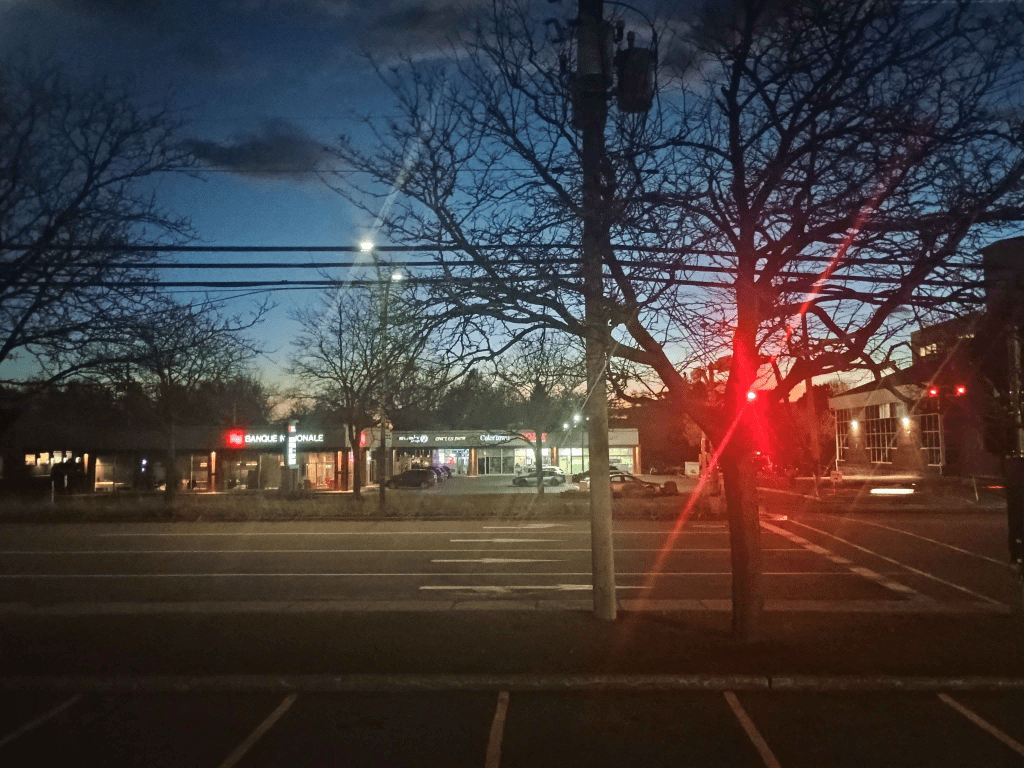
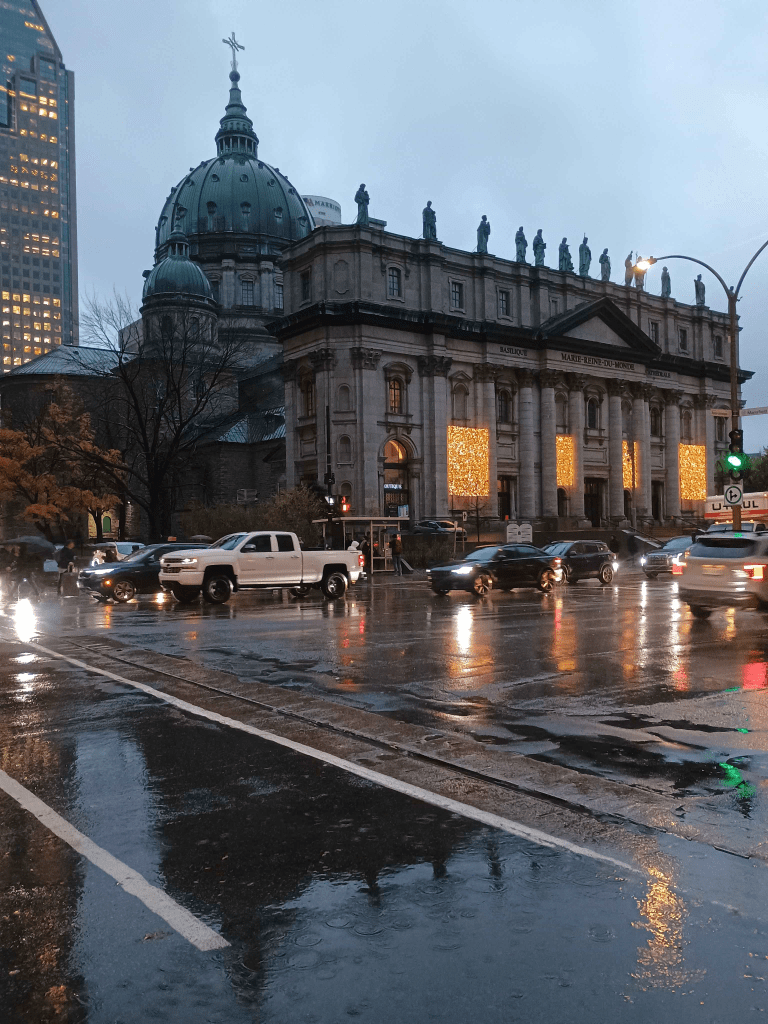
I managed to take 3 whole photos while I was physically in Montreal.
Figure 1. Nov 4, 2025. 5:15 pm. A mysterious stop location in Kirkland, right before my final stop in Montreal.Figure 2. Nov 5, 2025. 2:05 pm. A detailed image of my upcoming exoplanetary project proposal taken as I was dashing out of Nic’s office since I was delaying someone from their meeting!Figure 3. Nov 5, 2025. 4:27 pm. I realize I haven’t taken any nice photos of the city while I’m waiting for the light to change from red to green.
September has been…a month. Conference! Travel! 15 meetings in a week! TA squabbles! Getting towed home for the first time! and wrapping it up with a good dose of houseplants and paper and proposal submissions.
We’ve been using the following format on a shared Google Slides document in the PVL group meetings for the past few months, and it’s been working quite well! It goes: list one accomplishment and one challenge you’ve experience since the last group meeting, and put down your goal to complete by next meeting. Most folks end up putting more than one item, and it functions as a quick status update for everyone. Occasionally we linger longer on certain slides to discuss a figure someone has chosen to represent their week, or we chime in to help out with the challenge or offer support for the goal. My list is rather long since it’s been a while.
Accomplishment(s):
finished putting together animated slides for a presentation I gave at EPSC-DPS! I think the audience enjoyed it
Met a potential postdoc supervisor or two (networking things)
conducted two health and safety inspections (and described 150+ photos as part of the recommendations)
Convinced people to help me with 3 separate Global Climate Models! Yay data!
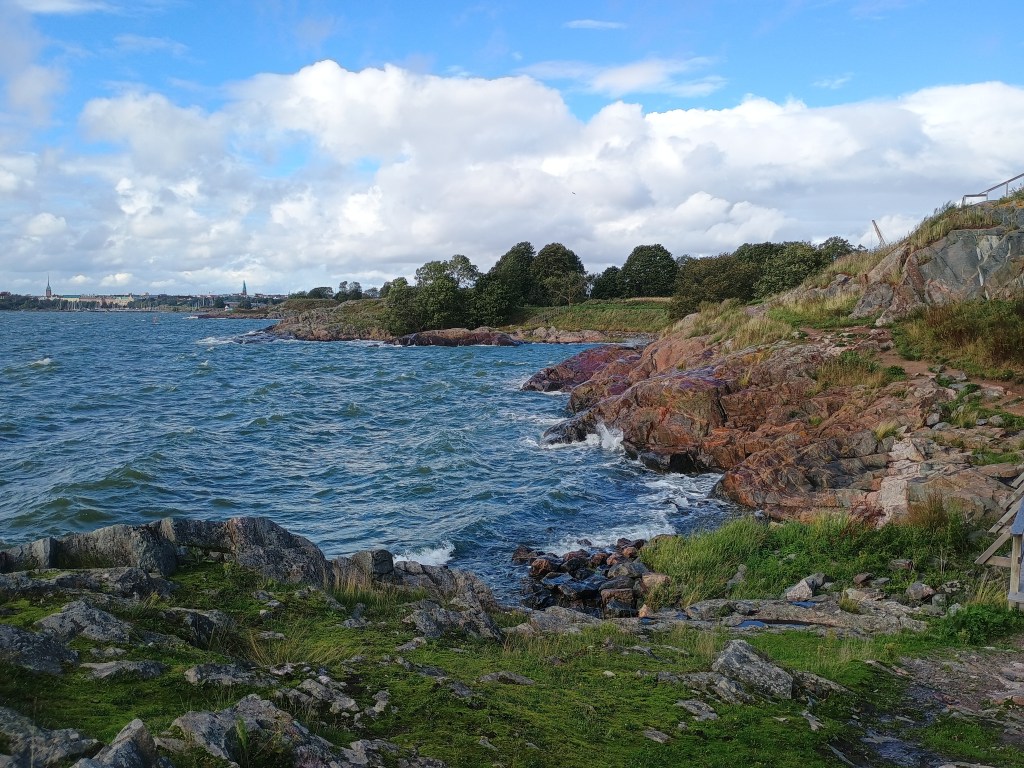
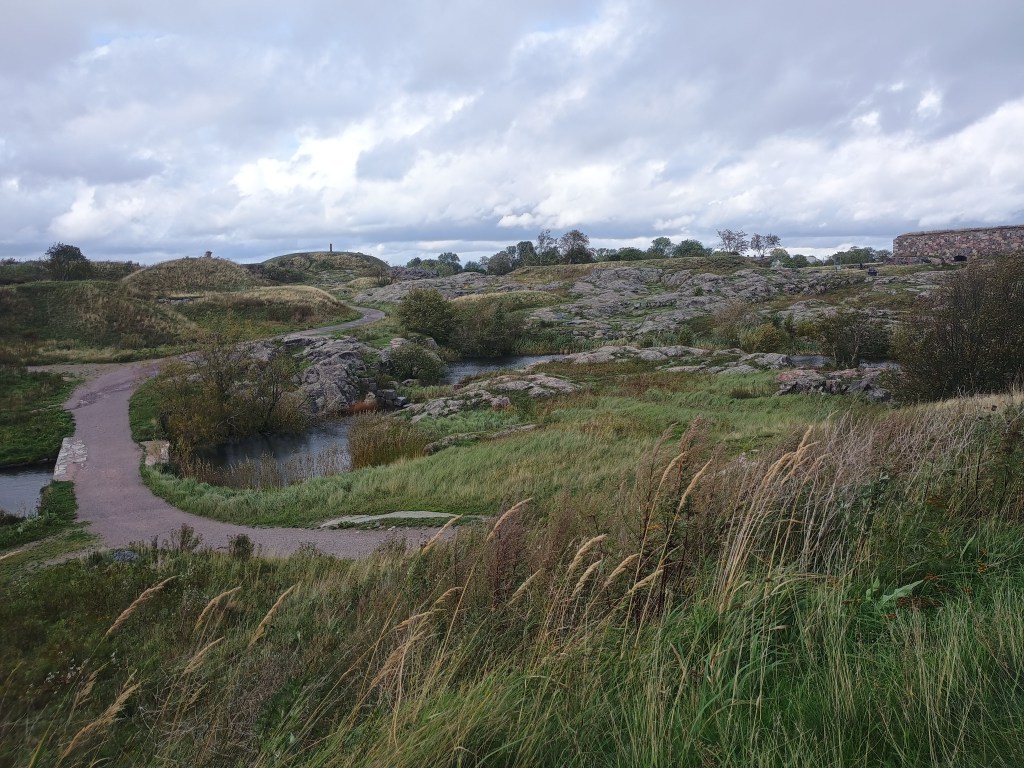
Stayed a few extra days to get to know Finland a little better, meet some friends, and trek around the country! Figures 1 and 2 highlight a couple of easily accessible landscapes
Figure 1. A photo of the southern side of Suomenlinna, the Fortress Island a 15 minute ferry ride south of a Helsinki port. This island has seen three different sets of wartime preparations. The southern coast has numerous cannons, a King’s Gate, and really slippery rocks! Towards the north it looks more like a park. Figure 2. Slightly more inland photo of Suomenlinna. Here you can see the smoothed out rocky features that likely experienced glaciers moving over them. You can also see how different the weather was! Finnish clouds move fast, though we were told this year was abnormally humid at this time of year.
Challenge(s):
Time. It’s always time. I managed to schedule 3 weeks worth of meetings into one week on my return. Ouch.
I might also be feeling a little bit sick!
Goal(s):
Clean up my inbox. There are at least 10 emails I should really get around to responding!
Send in three papery things. A revised manuscript (done!), a fellowship application, and a travel grant. Maybe another fellowship application if time permits
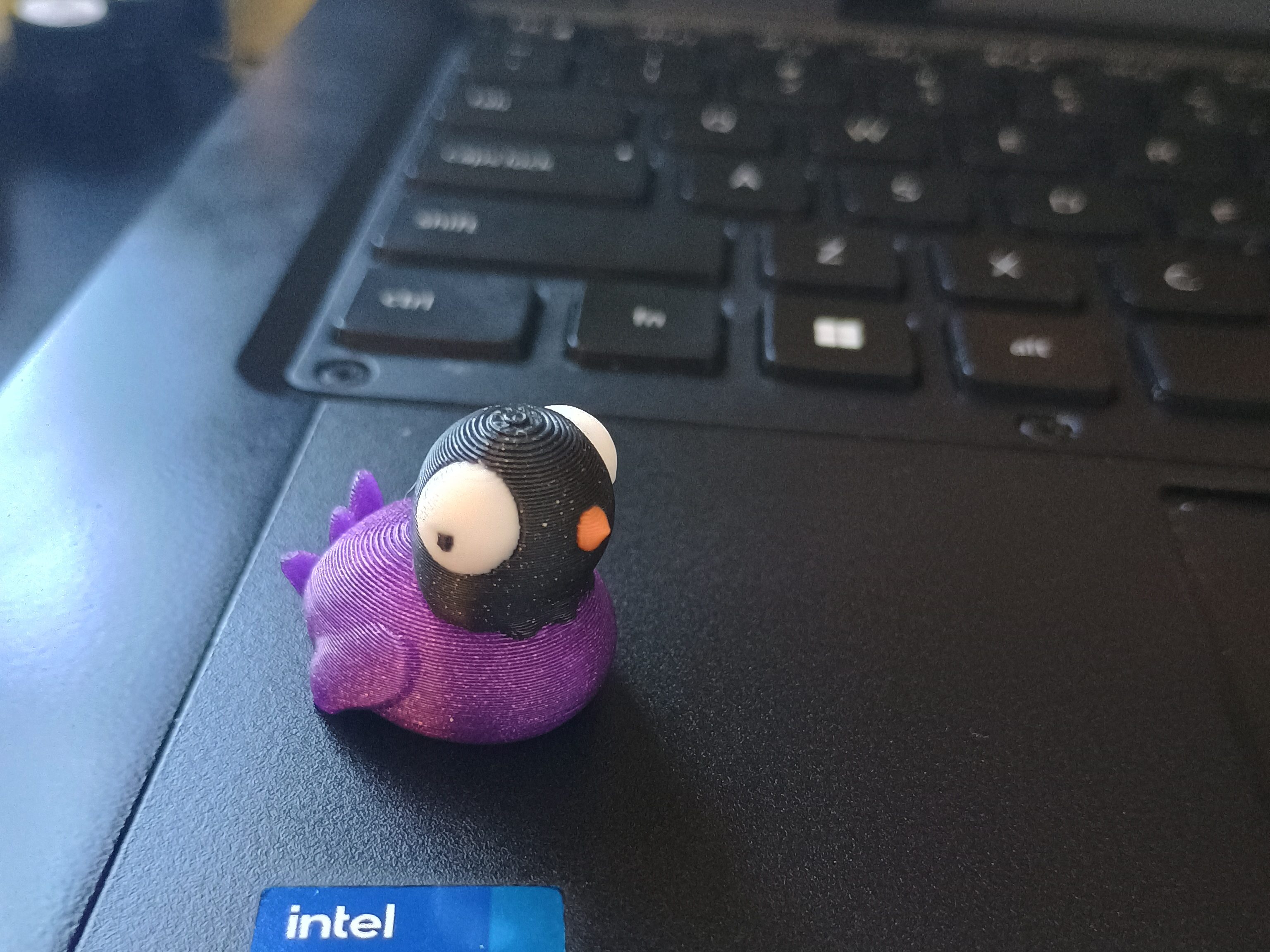
Upload my code already. Xml the pidgeon has thoughts (Fig. 3)
Figure 3. Xml! The judgey pidgeon from the PDS looking at you for not formatting to standard.
Normally I’d be all like, I need to take the weekend and do more work! Squeeze in some extra hours! When I’ve done this in the past, what it really means is I lounge about and feel guilty about not typing away. This time around, I had a few scheduled social events already in my calendar and I simply didn’t have the time to do too much weekend work because I was busy sleeping to have energy to do social things!
Looking Forward into October
Things have relaxed a bit since the hectic go go go upon my immediate return. I’ve pushed back my optimistic (and slightly unrealistic) goal of defending my dissertation super early since all the postdoc positions I’m applying to have a tentative start date in September 2026. Sleep has been caught up on. And I’ve received some excellent feedback on the structure and delivery of some of the proposals and statements I was working on. I did commit to several boardgame and table top RPG sessions this month, so we’ll see if packing in social events bites me in the butt in October.
Personal Updates
Accomplishment(s):
plants are growing! Here’s a list of highlights on blooms
Hoya linearis – these peduncles have been around for months. Will they ever expand? Only time will tell
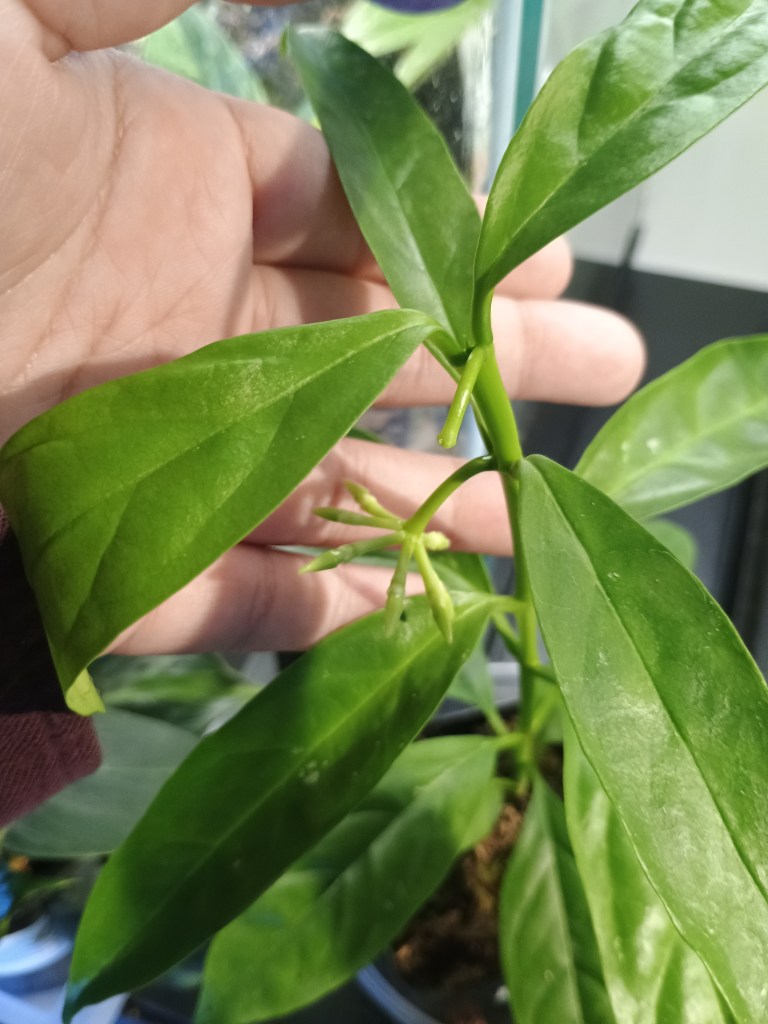
Hoya decipulae – I bought this plant for the blooms, and it looks like I might have two soon! (Fig. 4)
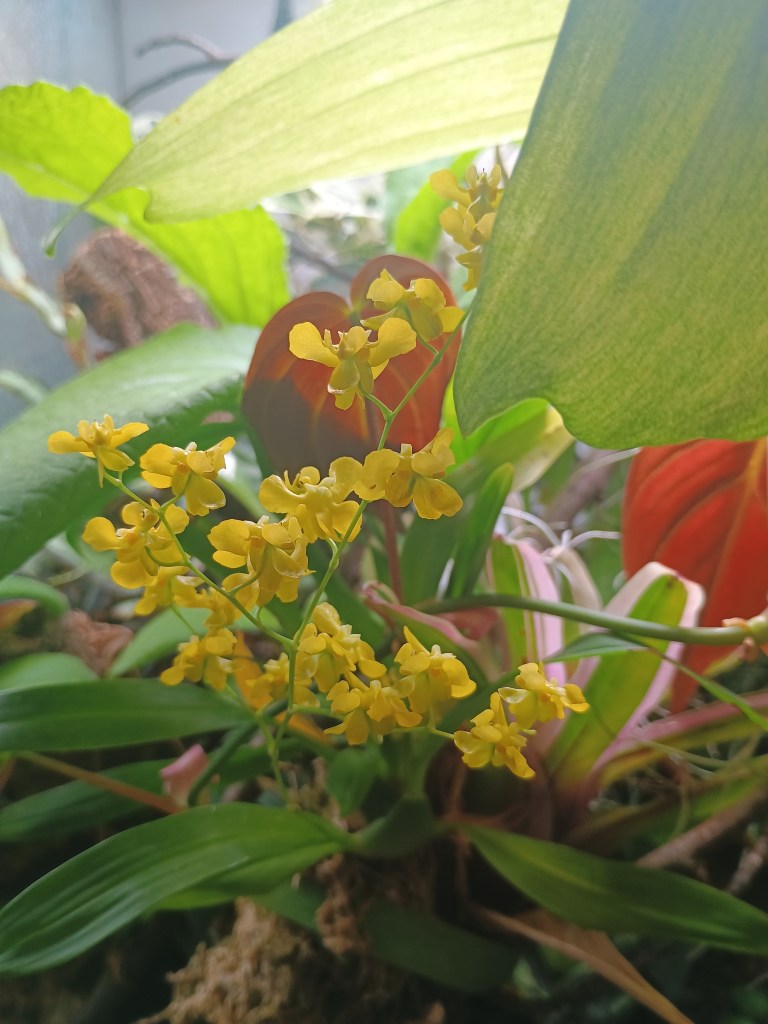
Oncidium cheirophorum- already in bloom, I caught these opening up right before I left the country, so the first stalk has been around for just under a month and the blossoms are starting to dry up. These smell… for lack of better words, clean floral. There’s a faint herbaceousness to it, and damp, but that could be the terrarium it lives in. Figure 5 shows the blooms on the day I got back!
90% unpacked from the previous trip
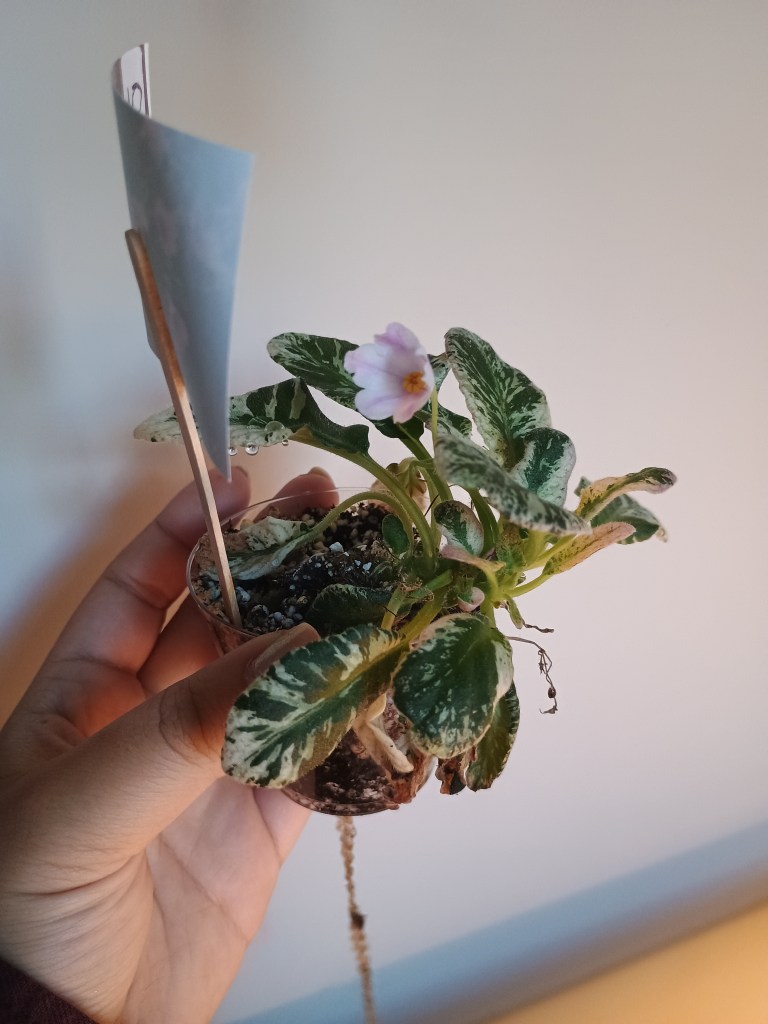
successfully purchased things at the african violet show for a remote friend! Example in Figure 6 of a plant we’re going to split
Figure 4. Hoya decipulae peduncle and flowers on the way! They’re supposed to look like eggbeaters…Figure 5. Oncidium cheirophorum. I bought this in bloom last year as a gift, took a small setion as a backup, and here we are today! It lives in a terrarium mounted in dried sphagnum moss next to a NoID bromeliad, philodendron micans trying to craw over everything, and a philodendron florida ghost casually flopped over it.Figure 6. LE Erika! We’re both excited for this one. It’s a trailing type african violet that seems to be difficult to grow. The white variegation blushes pink with enough light, and it should self-propagate given enough horizontal space to grow into.
Challenge(s):
anthuriums are starting to rot and look uphappy left and right!
Froggy still hasn’t received her upgraded tank
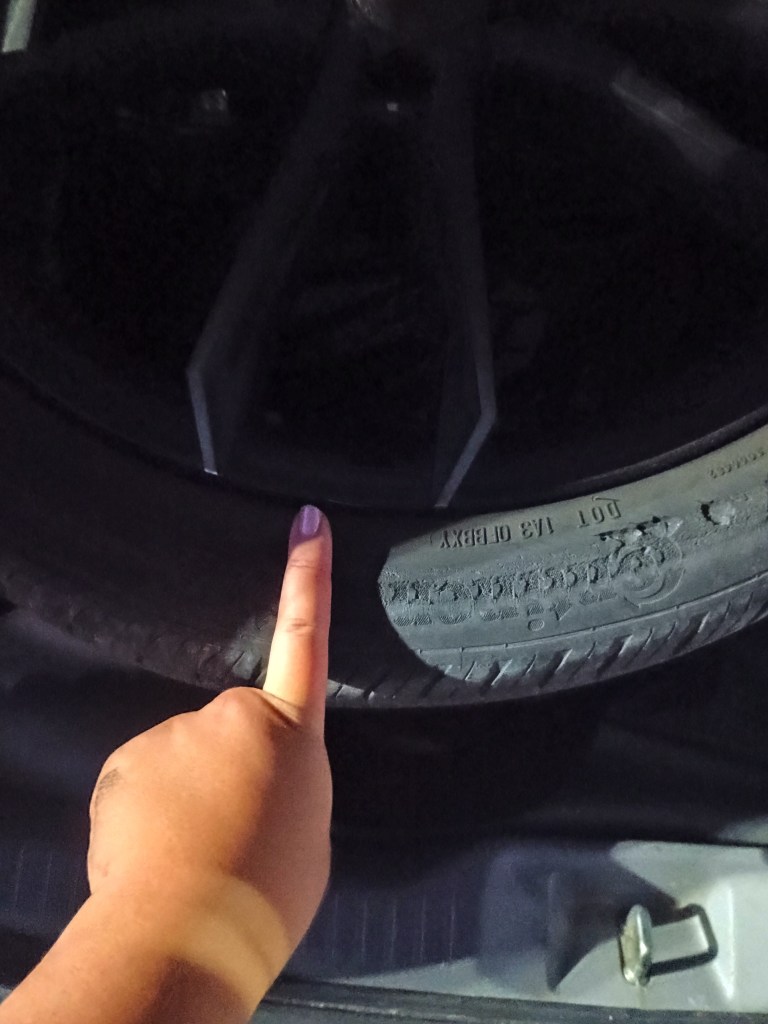
getting towed home was a thing, but this was a surprisingly quick situation to deal with. The major consequence is my wallet being $250 lighter (tire change and then some) and getting bruised on my knee for hauling aroud my previously oversized tires. See Figure 7 for the culprit.
ruined two pairs of pants! I dropped candle wax all over my favourite sweat pants, and had a ballpoint explode on another pair of pants (this one is partially addressed, but still hanging on a rack for me to deal with)
Time, of course
Figure 7. Check out the thickness of that tire post deflation.
Goal(s):
build or find a stand for the custom tank (Figure 8 is an image of the future resident!)
This leads to finally clearing my floor of all the plant propagations I have stacked in bins meant to fill said tank
fully unpack from last trip
finish writing the draft for an RPG module that I wanted to use as an outreach tool (and fun times) that I was hoping to get done in Summer!
take a look at all the moss photos I took in Finland and distribute them as need be!
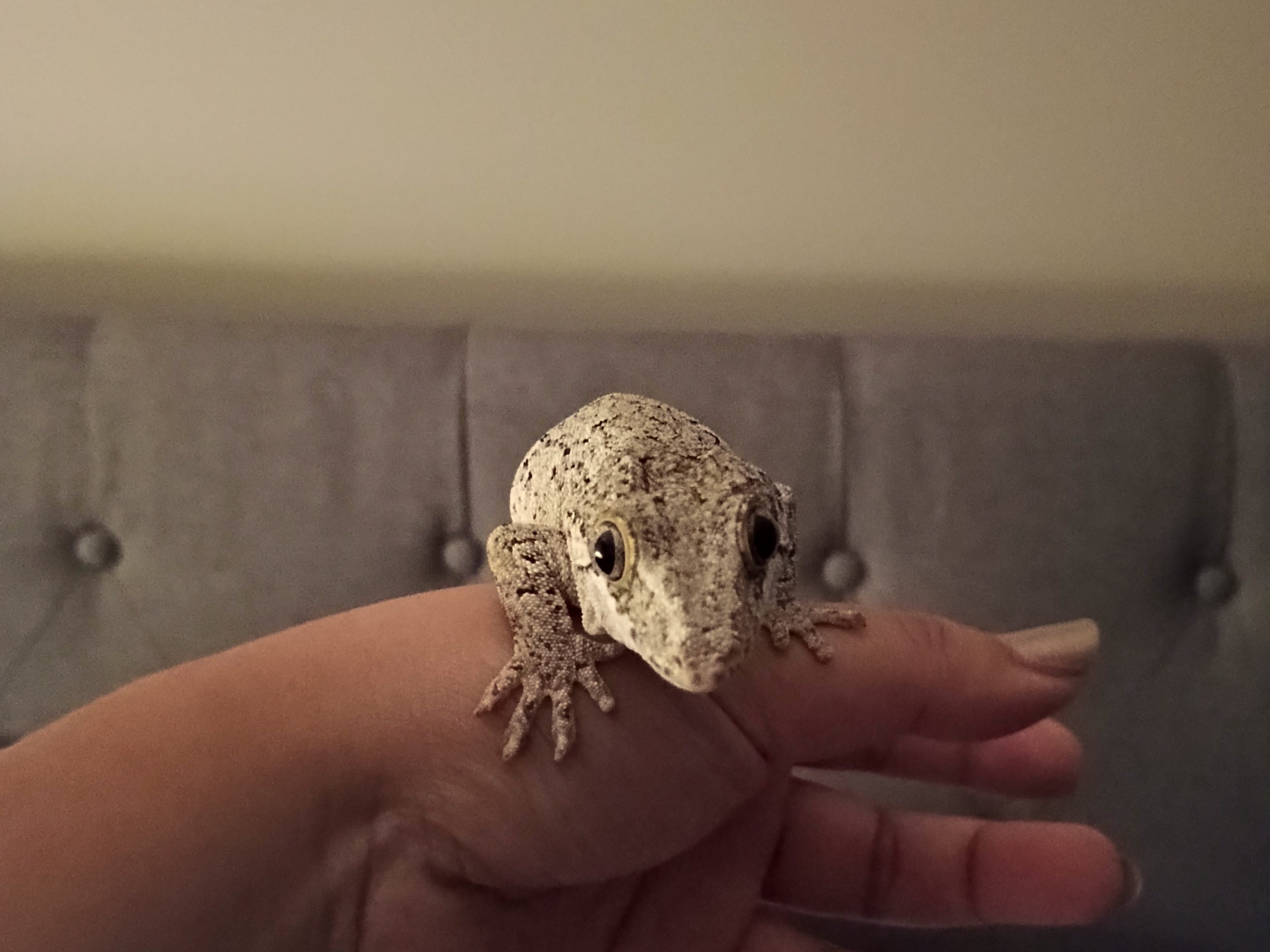
Figure 8. Frogfoot Meteor awaits her upgrade patiently and not at all threateningly.
Truthfully, my personal life usually is about this chaotic, if not more so. Things are always in motion and mechanical items have limited lifespans. Having hobbies that involve living things also means that sometimes things happen outside of my control. One thing that’s been weighing on my mind is how to pass along all my plants if I move out of the country. Or what to do with my geckos if I move to a place where they aren’t allowed pets. A problem for a future me I suppose.
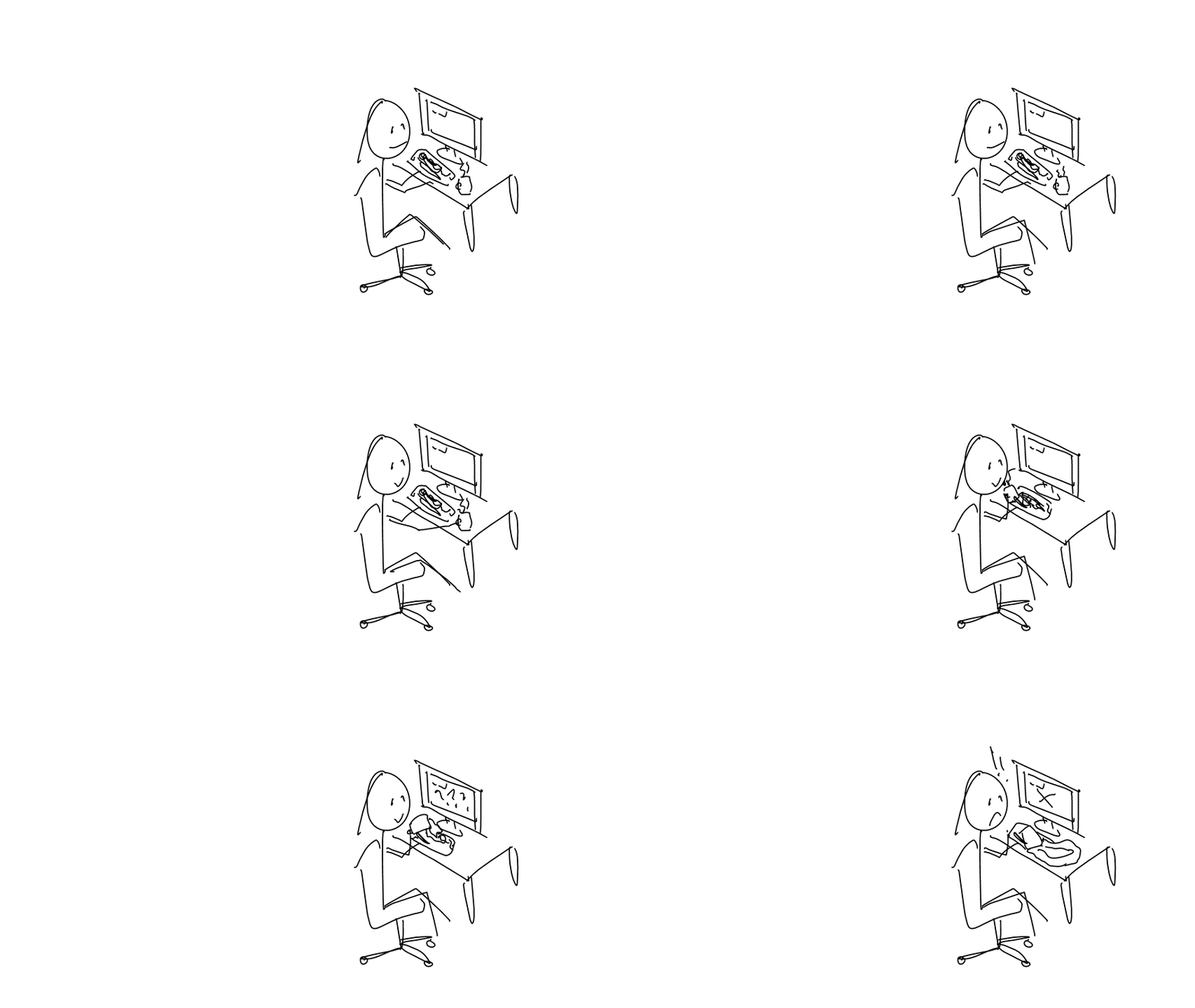
Figure 9. A realistic representation of me in my daily life.
Sometimes life is stranger than fiction. Here I am, waiting on a phone call from IT after I found out that my access token has never been granted (despite using it for 3 years or so) and my account doesn’t have VPN access and never has. I wonder. Chances are I just punched in my new PIN wrong so many times that I got turfed out of the system and accidentally overwrote a few things. The extra fun part is when my password shows up as my username during the restoration process.
This week we were asked to reflect on the science portrayed in one of our favourite shows. Admittedly, I am not a huge consumer of classical media and often can’t remember the details (The Expanse is a great book, but I didn’t finish the show, and I didn’t enjoy The Martian enough to critique it). I thought I’d share about one of my favourite animes instead, an absolute classic of a time travel show: Steins;Gate (Fig. 1).
Figure 1. Steins;Gate game art. This was released as a visual novel at first before the anime adaptation. The main protagonists are shown on the cover with a falling phone and time travel evice.
Steins;Gate appears to be a comedy/slice-of-life anime that starts off with our male protagonist Hououin Kyouma/Rintaro Okabe who suffers from delusions of grandeur and believes himself to be a mad scientist. He is a high-school student attending a university during the summer. His close friends include Daru (a stereotypical, overweight, pervy nerd who salivates over a picture of the Large Hadron Collider from SERN on his laptop background) and Mayuri (a slightly younger female cosplay designer that is portrayed as airheaded). The anime takes place in Akihabara, a well known “techy pieces and odds and ends” sort of place in Tokyo that is very real (the equivalent of this in Osaka is Den-Den Town!) where they build weird gadgets and eventually…make a gellifying microwave that leads to time travel by the means of text. Oh, and in the meantime, Kyouma encounters Makise Kurisu outside of a summer lecture series by a famous scientist after he interrupts the theories on time travel.
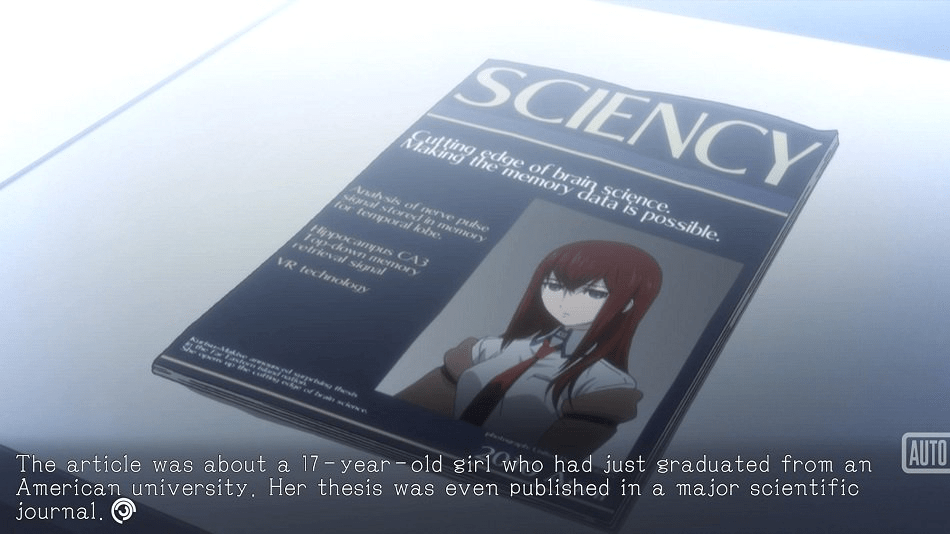
Here’s where the real-life and science really begin to blur. Kurisu is a prodigy in neuroscience research and has published in “Sciency” (Fig. 2). She gets roped into the antics of the other high-schoolers as they try to decipher the gel-formation and the mini-blackhole that is somehow forming within the microwave. Say what.
Figure 2. A screenshot from the translated game. Makise Kurisu on the front cover of the print magazine Sciency.
The show rapidly shifts towards existential crisis mode as the text-activated microwave sends texts into the past, resulting in subtle changes in the timeline and the group being hunted down by evil time travel aware people. Kurisu builds a device to send back memories into the past so Kyouma can download his thoughts each time from his phone while they try to restore the mistakes they’ve made and aim for a happier timeline. At some point they also need an ancient IBN (IBM) machine to hack into SERN to erase any data they had on the lab.
I really love this particular anime. It’s an incredible snapshot of the times and is littered with very specific jokes (many of which might cause pause today) and reminds me of my own high school experience in many ways. It convinced me to try Dr. Pepper (Fig. 3). Also quick shoutout to the translation team that actually broke down every single joke in the visual novel version! It’s still on my todo list to clock in the 80 or so hours to play through the entire game…
Figure 3. Dr. Pepper. Me despising Dr. Pepper is probably one of my biggest “failings” as an otaku in my school days.
Here are some fun tidbits that might be worth exploring!
Black Hole Theory – the crossing of event horizons results in time travel
Light Speed Theory – presumably moving faster than the speed of light leads to some sort of future travel. It is unclear what this actually means in the show
Tachyon Theory – particles that move faster than the speed of light and could be used to send messages by bouncing off a mirror and returning before it left
Wormhole Theory – this one is explained slightly more in-depth during a lecture. The show explains this as a hole where the time between the entry/exit is zero. If a wormhole is sufficiently long, then the arrival time is in the past. Returning to the entry, time travel occurs at the same location. One of the points made here is that exotic matter is required to stabilize the worm hole
Exotic Matter Theory – material with abnormal properties that behave the opposite to F = ma, now confirmed to exist! This would allow for physical movement of objects into the past
and so on and so forth
Without the requisite physics background, I can’t comment how accurate some of these descriptions were. The show uses what appears to be the tachyonic antitelephone where if a signal were sent sufficiently fast enough (greater than the speed of light), then the signal causes an effect before the signal is even sent. To send things faster than the speed of light, a mini Kerr-black hole is created in the microwave. This Kerr black hole is stable only during very specific hours of the day, someone directly by the activity of CRTs on the ground floor from the group’s landlord (Fig. 4). The particular frequencies of the components in perfect resonance are handwaved, and even the group is baffled. But repeated use and testing shows that this indeed is the situation. Science!
Figure 4. Mr. Braun with his I ❤ CRT apron. This is the video game art.
This is fine and dandy when the data limit is 36 bytes (this is shown by the cropping of text messages when long messages are sent), but really falls apart when they start sending entire human memories through the black hole through physical compression of the data (Fig. 5). In the show, the urgency is off the charts so no one stops to think whether or not this really works. We also see that the memory downloading when Okabe picks up the phone causes an immense amount of strain but is near instantaneous, uncompressing in his brain. I suppose this could happen if the compression was only during the blackhole time travel transfer moment, and it immediately pops up as is.
Figure 5. Ah yes. Let’s put on this cute little headset and pull out all of your memories while simultaneously beeping them through the microwave phone. Ding! Also check out that IBM keyboard!
We also see the arrival of a PHYSICAL craft towards the latter half of the show, when Daru’s daughter from the future resistance arrives, crash landing on a building that is shown both damaged, and undamaged in the very beginning of the show. This device somehow contains enough energy to simply jump in time, twice! The device was developed to prevent SERN (now clearly an evil research group vying for world domination) from discovering time travel at all by stealing the group’s research. We have still yet to see if this is at all possible, since the travel occurs in 2036. Unlike exotic matter, I’m not sure if we’ll suddenly see a satellite-like craft crashing into a high-rise building in 2010 retroactively.
Some other fun quirks in the show include:
the presence of maid cafes (very real)
@channel (a 2chan reference perhaps)
Rai-net tournaments (a play on the many card game tournaments in Japan, it reminds me of Digimon somewhat)
Akihabara as a whole (the show uses real locations and buildings)
and flip phones! What a time. The show does an excellent job showing everyone’s individual phones and phone charms. In the visual novel (the show is based off of a game), the choices are made all through text message! You can also choose to pick up or ignore phone calls! Its a throwback to see everyone in the show “text” to email addresses, which remains a baffling situation to me
A list of the planning and scheduling resources I use intermittently or all the time. I’ll update this periodically. Currently I use a mix of Google Calendar, a Weekly Planner, and a Daily Planner/large notebook.
Google Calendar
Nothing new here! I have several calendars that I’m subscribed to and use. The top three that I pay attention to are:
my lab calendar (x2). We update our extended out of office dates, shift dates, group meeting times, and events that may be of interest to others here. I usually use this to check when the next group meeting is, if I’m on the hook for anything to share at a meeting, and if anyone is out of town/busy
my personal calendar. I schedule things like game nights, personal meetings, and events I’d like to attend here
my personal work calendar. This is shared with my supervisors. When I need to get a lot of work done in a short amount of time, or I have huge swaths of work hours I can leverage, I plan out detailed tasks that help me accomplish larger goals with “Target” dates in which I send completed writing tasks to my supervisors/labmates/coauthors for review. I also put in major timeline checkmarks here
Weekly Planner
For those who have been subject to my love of the Hobonichi Weeks, let it be known that I moved into a Midori because their cat covers (and the price jump on the Weeks) convinced me. The weekly planner is a slim, vertical layout, with 2 pages per week. On the left side is M-S broken up vertically throughout the page, and on the right side is a blank graph page. I tend to carry this around all the time to mark in
3-5 tasks I want to complete for the day, and
any scheduled appointments/meetings I have that day.
The graph side is for notes, impromptu ideas, tracking granular details, etc. There are overflow pages at the end, but this isn’t suitable for taking many notes.
Daily Planner
This is where I log meeting notes, plan things in detail, and use as an adhoc planner for whatever it is I need at the moment. (Previously I did this in the Hobonichi Weeks, but I found that the slim format was actually a detriment and I needed more horizontal space). I’ve used everything from a blank notebook, gridded notebook, sticky notes, and tip-ins from scrap paper for this. This year I’m using a Hobonichi Cousin because there is a lot I want to get done and its nicely formatted for me. I use this to
set monthly goals/tasks on one page per month
take meeting minutes
use as scratch paper! Currently it’s arranged so that it’s one day a page. If I overflow the date, I just flip back to the last empty page and jot down the “date/page” I continue on. I often write down equations in these pages when I’m trying to do unit analysis and I need to get away from my code for a moment, scribble out plots and graphs that I think should appear and compare to what I see on a computer screen, or outline things such as my weekly plan, my thesis structure, jot down who I want to reach out to for whatever topic, write down short summaries of papers I’ve read, etc. This is also where those extra random stickers I accumulate throughout the year often end up…
My goal with this format is to actually develop an index this year. If there are key writings that I want to go back to, I don’t want them lost. Last year I just stuck in book marks, but it eventually got overwhelming. This year I want to take advantage of the “year at a glance” page and write down a brief header in those spots so I know where to go looking for when I want to check on the contents of a meeting I had.
This could easily be replicated in something likeOneNote or any other note taking software, but I’ve found I never really used those, and spending the extra few minutes to write down important things from a paper I want to remember works better than trying to dig up my highlights in my reference manager!
Bonus: Google Forms
Sometimes it’s just too much work to trawl through your calendar and fill out a tracker. To track things that take up my time, I use Google Forms! I write out a 3-4 question form for something I want to keep track of all in one place, and I know that I won’t want to do on paper/keep flipping to. The major use of this one is my Teaching Assistant duties. I keep track of my hours in 15-30 minute chunks and classify my tasks. This has come in helpful when discussing expectations and remaining hours in my contract. Its also useful for profs to know how to better assign hours to their TAs for the following year! I create one of these forms each year, and sometimes a more detailed one for certain courses I’m assigned to. I have my phone out all the time, so I might as well use it when I’m feeling guilty that I’m not doing work!
Questions in the form are:
What course is this for?
What tasks did you do? (eg. marking, proctoring, communications, prep work)
How many hours did it take?
Notes (more details, for example, noting that it was Assignment 1 that I was working on, or if it was an unexpected conversation that was course relevant)
Bonus: Check-ins
All of these tools are useless if you don’t use them. I typically review my calendar 2-3 times a day (and have noticed I’ve missed meetings because it’s muted, so I’m workig on a solution to that!), my weekly planner once in the morning and once at the end of work + whenever I need to jot down an appointment, and my daily planner daily-ish if I want to use all that extra space.
Back in the days when it was socially acceptable to admit to owning a Nintendo Wii (no U to be seen back then), I was a huge fan of playing Super Paper Mario when I could borrow it from a friend (Fig. 1). The storyline was typical, Mario and friends travel through a number of dangerous worlds, defeating baddies, collecting goodies, and facing off the final boss at the end. I confess I never defeated the game (but no spoilers here!), as the save system was in such a way that I would persistently load into the final play-through with minimal health and entirely forget the controls each time I tried. Perhaps the smart thing would have been to restart all over again. But this is not important.
Figure 1. Super Paper Mario game cover. Anyone else remember this game?
Super Paper Mario was a game that let you flip between 2D and 3D. This flipping ability let’s the player access an additional layer of the world that previously was hidden. You could make changes in the 3D world that affected the way the 2D world worked, by moving things in and out of the plane, and sometimes seeing passages that prevently didn’t exist. The 2D and 3D worlds were intimately related. This is my convoluted and off the cuff explanation for Fourier transforms (I’ll find out after this once I reread the Wikipedia entry for the umpteenth time).
Figure 2. Completely unrelated to this post, but I once made some fanart of this scene in highschool for an art project. I found the art style to be very charming. I want to say it was for an illustration class, but had I done it again, I think I would have done a 3D installation for this recreation.
Imagine you’re dealing with this convoluted passage way, trying to navigate your way to a Pure Heart. You flip into the 3D space and you see that there is a frequency, a regularity, or perhaps everything is just a little lower than you’d like. You bonk some blocks with your head, dodge some goombas, and flip back into 2D. There it is! A straight path to the exit. It was there all along, but you had to move things in the 3D world to access it.
In my world, this is exactly what Fourier transforms are for. You take a signal that seems rather confusing, and want to see some of it’s characteristics in the frequency domain. Once you’ve flipped into frequency space, you can see all the details that make up your time signal. This might give you some clues to your final destination. But you also might need to tweak a few things to clean up the interpretation. By applying a function that can only be done in the frequency space, you have affected your time domain as well. You can see the results of your work by flipping back into the time domain.
Fourier transforms can be applied to more than time signals, and work for any sort of complicated situation you have. Say you want to recreate a complex squiggle in 2D, but want to make it exclusively out of single curves in 3D, you can do that. There’s more to it, but let’s say I have a strong itch to find a second-hand Wii and give Super Paper Mario another shot. Bleck!
RE: Faculty Member in the Ornithology Department Opening
To whom it may concern,
I am listing some traits I possess, most suitable for the opening in the Faculty of Ornithology. Several of my publications involve the persistently difficult to consume Tweety Bird, a rare specimen of a canary. I have documented its behaviours extensively and have branched into other similar topics of detailed and immersive research, including that of mice and pigs. My wide-ranging experience and flexibility in the workplace may be suitable for cross-disciplinary opportunities. I also actively participate in service for disadvantaged members, as evidenced by my support of Granny and her knitting hobbies. I am keen to continue my work with a supportive faculty that encourages exploration studies and diversity in the field.
Yours, Sylvester J. Pussycat Sr.
Context: “enrichment” portion of a lab meeting. What would it look like for a cartoon character to apply for a faculty job?
I recently was notified by a friend that an interesting article had dropped. Coffee and volcanoes! How exciting is that? I cracked open the article and was initially excited, then increasingly dismayed. Here is the article: Study: Why a spritz of water before grinding coffee yields less waste, tastier espresso. I found very little to be excited about on the first read through, and felt some internal panic welling up. This was for sure going to lead to some poorly thought out, widely spread content. Here is the paper for reference: Moisture-controlled triboelectrification during coffee grinding. All “quotes” are from the paper.
Background
For the past few years that I have been involved with grinding coffee at home and brewing specialty coffee while on a low budget. I have heard that adding in a few drops of water will reduce some of the static electricity in the process whereby the finer coffee grounds stick to the burrs and internals of the grinder. Personally I have never actually tried this, as I find the bits sticking to the surface to be quite useful in removing fines from my overall grind. I’ve just tapped off the fines afterwards and run a finger to dislodge the remainder in the grind receptacle. Seeing the article title, I thought, perhaps someone has finally quantified what the effective static reduction is like!
Seeing also the note about a volcanologist involved in the work, I was hopeful that the analogies would prove meaningful. I read through the article as it meandered along in some of the past work from the lab and found that they had identified two general factors contributing to the charged particles. The article does a reasonable job summarizing the paper, in that the team tested a number of variables and collected a slew of data. This part was surprising. The paper was written such that a regular audience could parse the work and the writers at Ars Technica could summarize each segment. I then took a look at the paper.
Matter
The highlights on the site are fairly straightforward, but the print version is confusing. The paper opens up with what is presumably a visual abstract with some key words overlain an image of some ground coffee on some unidentified mechanism. There is a brief background on the sources of charge (fracture and friction), with reference to some industrial interest in further studies on surprise charge. The authors claim to address three things: coffee parameters affect charge, demonstrating most of the charge is from the fracturing process, and charge is also dependent on moisture content. The introduction ends off with
“In the context of both understanding the fundamentals of triboelectrification and bolstering our efforts toward brewing more reproducible and sustainable coffee, this article offers strategies to control the charging of coffee particles and posits opportunities therefrom.”
The Results and Discussion section broke down those three aspects as follows
Charge parameters. They demonstrate that beans are charged via contact with typical coffee setup materials. It is unclear why they use the Starbucks Blonde Roast (blend) here. They then claim that coffee must be ground, typically to grain size of 100 nm to 2 mm. I was unable to find their reference here, as I usually grind coarser for a French press. Perhaps it is a reference to espresso grinds only. They skip ahead to state that finer grind sizes resulted in aggregates held together by electrostatic forces. They ground 1 g at a time and found both the net charge, and the charge distribution.
On origin. They used several Mexican coffees with different roasters and roast levels and found three different net polarities, “But those coffees were roasted by different roasters to different colors, and the data suggest, perhaps unsurprisingly, that origin alone does not dictate the polarity of charge.” I can confirm, this is unsurprising and the point on origin is not meaningful as one farm produces differently than the next, even if they are immediate neighbours.
They repeated this for 30 coffees and found a weak relationship between Agtron value (roast level) and charge. Instead, they pinpointed the 2% moisture content as the possible culprit (R-squared = 0.41). This runs counter to volcanic ash and an interesting point! It also indicates that they were able to measure moisture content of these coffees.
Two suggestions were provided. First, dark roast tends to be more brittle, and more associated with negative charge. The second, is that water content plays a role.
The distribution of negative particles is skewed towards fines and “boulders”. I did not get the same interpretation from the selected figures in the paper. In one of the images, the negative charge has a greater peak in the larger grain size range, but in the other, the two peaks are quite similar. An allusion to ion scavenging is made here. To that note, I wonder what their target grind size was as they later explain different roasts resulted in different size distributions. However, I didn’t see a distribution for neutral grains.
Roast parameters on charge.
Moisture. They roasted a 12% moisture green bean to a variety of different final products. They repeated for a 9% moisture green bean and found that the roast parameters were more important than the initial product moisture content for overall charge to mass ratio. The final moisture of the roasts fell between 1 – 3%.
Grind size. They used a different set of coffees from the moisture test, showing two coffees with net positive/negative charge and found that finer grinds correlated to higher charges. They also did a test using the same grind size across 13 coffees and showed darker roasts typically resulted in smaller mean diameter and more negative charge. “Figure 4C offers one explanation as to why darker coffees may yield slower espresso shots for the same brew parameters. It may not only be the increased volatile content but also the reduced bed permeability.” That is, lower grain size from the same grind is pulling slower shots. Note that your barista should be aware of the properties of their coffee beans that day, and should have each roast dialed in for the day. Because of the grind size difference with the roast levels, they repeated the experiment such that the same size distributions were had for each roast. They still found that negative charges correlated more strongly with darker roasts
Granular mechanisms. This targets the question of, how does the grind mechanism contribute to electrification? The authors pre-ground the coffee and then put it back through to evaluate the effects of frictional charging from grind interactions and coffee/grinder contact. There was about a 90% reduction in charge after testing on seven coffees by passing through a larger grind setting. Presumably they neutralized the coffee grounds prior to regrinding.
Addition of water. “Anecdotally, baristas have observed that the incorporation of small amounts of liquid water onto the whole-bean coffee prior to grinding results in seemingly reduced charging. In our hands, it also resulted in near-zero grounds being retained by the grinder, an observation that has implications for reducing waste and increasing quality of beverages. Perhaps we will revisit this in a future study, but for now, we are more interested in whether the addition of water neutralizes the effects of fracto- and triboelectrification or modulates particle aggregation via capillary forces.”
They found that humidity affected the charge once relative humidity was greater than 60%.
For seven coffees, they progressively added more water. Increase in water addition took place between 25 – 40% RH. They found that water content of 20 ul/g resulted in close to 0 net charge on the grounds and suggested either a cooling effect, or rapid ion transfer.
They also tested this with saline solutions to evaluate the effect of ion transfer. They found that the results were similar, so electron transfer in the dry case is more likely the cause of charging.
Here I find my major issue with the article. “To deduce whether the coffee particles were forming neutral aggregates”. This comes rather out of left field, perhaps they meant to create a new section? It seems that they were trying to answer what the net 0 charge consisted of, but never quite managed to say so.If this plays a significant role with volcanic ash, I feel that it would have helped the reader had they included more content in the Introduction. They found that the size distribution was improved with the addition of water, and found mostly neutral components in comparison to the “dry, field” grind result. The caption does not clarify what “field” and “no field” refer to, likely the method in which they sorted the bins. Water also reduces clumping.
Then they brewed some espresso using parameters that were unlike any of their prior parameters. 18.0 g dry mass coffee was used to produce 45.0 g liquid coffee extract, ground at setting 1.0, tamped at 196 N, and brewed using 94°C water, kept at 7 bar static water pressure with a 2-s pre-infusion. They found that without added water (unclear how much), the shot took less time and had a slightly lower TDS (total dissolved solids). The first drops enter the cup at the same time (~10s). They then fit a sigmoidal function to a hypothetical situation where the flow will achieve a constant and then looked at the flow rate for 3 samples of wet vs dry ground. “In other words, this is conclusive [bolding by me] evidence to suggest that dry-ground coffee is producing a bed with markedly more porous pathways.” They note that lower pH corresponds with higher S (more acidic coffee is less charged). They speculate on the role of internal moisture prior to roast.
That’s a lot! They went on to note that they made some assumptions about the burrs (in this case, their contribution is fixed, perhaps this is why they didn’t use other machines) and relate the Seebeck coefficient to the amount of charge from fracturing. They state that “Agtron number is proportional to the electronic band gap, both of which are reduced with darker roasts.” Without reference, so I will have to take their word for it. They related this to the Seebeck coefficient and oxidized organic molecules having low-laying orbitals. This seems to be a pretty big addition to the general knowledge of organic molecules, so I am surprised they did not highlight this more in the Introduction.
“Furthermore, light, medium, and dark coffees and their roast profiles can feature markedly different charging regimes, even for coffees with the same Agtron values. This highlights that modern roasting paradigms are highly artisanal and pose fundamental challenges for using commercially sourced coffee in academic settings.”
Alright. This feels like pandering.
“One could imagine the development of in-ground mineralization to make designer brewing water in situ without the risk of damaging boilers in espresso settings.”
I really don’t know where they were going here. Are they suggesting adding/removing heaps of salt and hardness to accommodate for water in advance and pulling shots with distilled? This is an interesting point I wish they elaborated upon.
Methods
I’ll highlight some interesting aspects I saw in the Methods section.
A pipette was used to introduce water onto whole-bean coffee, and the coffee was shaken in a sealed container to ensure homogeneous distribution.
Whole-bean coffee was stored in H2O-impermeable vacuum bags and kept at −20°C. The coffee was allowed to equilibrate to room temperature in the vacuum bag before grinding
I am curious to see how long the coffee was shaken to “ensure homogeneous distribution”. I also see that they didn’t comment on the effects of freezing the coffee prior to use, as freezing beans is quite controversial amongst coffee enthusiasts.
Notably, they did not provide a method to clean the grinder in between experiments, nor is there data indicating the mass loss during the process.
Commentary
“Many commercial coffee roasters treat their roast profiles as proprietary, and it is impossible to back calculate the precise profile from examination of only the roasted whole beans. There is academic value in standardizing roast profiles across the industry, thereby allowing for direct comparisons between coffees. But we are not advocating for this on the industrial scale, as that would sterilize an artisanal aspect of the industry. Instead, we developed our own profiles with the aim of isolating roast through the development of systematically “darker” coffees.”
This segment indicates that the authors care about the artistry of specialty coffee. Unfortunately, this theme runs through much of the paper and I found it to strongly influence how the paper was written. I then wonder, who was this paper written for?
As a consumer and coffee enthusiast, I am left with the following thoughts and questions
Lack of testing. Only ONE grinder was used during this test. I think they selected a sensible one if they were only going to use one, it’s reasonably accessible to different shops and the settings they used were straightforward. I do imagine perhaps there were complications justifying it on a budget (industry grinders are astoundingly expensive if there was no specific target goal for the research that served direct benefits). This is evident in James Hoffman’s video where he discusses the paper and interview with one of the authors, where he ends with a suggestion that at home brewers should fill in the gap.
Not understanding the difference between specialty crops and variability between farms that could be adjacent to each other. Given how many external individuals were involved in the work, this should have been caught early on.
Use of the standard dark/light roast ratings via Agtron was useful, but I wonder if there was the opportunity to develop a new standard for roast levels here. Perhaps based on water content before and after roasting?
Freezing? This changes how the coffee works. Why did they freeze things? Why did they not evaluate the effect of “resting” coffee? How fresh were the roasts? Why didn’t they roast more of their own sample? Why choose to use a number of different roasts? Was it just a PR stunt? Clearly they had collaborators, going back to the first thought, why not borrow a few grinders for controls?
I think there is the possibility that this work can be really extended and become useful for your average hobbyist. For example, nailing down the variable effect on extraction or charge scaled to average grind diameter and how variable the results can be if you have an even vs uneven grind
Who is this paper actually written for? The authors refer to the “artisanal process” a fair amount, and note some complications in terms of getting roast profiles. They also do not use grinders across the hobbyist market, nor test out burrs made of different materials (which should have a notable effect).
My thoughts as someone who attempts to write and share science via papers:
Absolute statements. The authors make a number of absolute statements that are not understood to be true, even by a regular audience. One such example is, “All coffee is ground”. Coffee beans are typically harvested, dried, then roasted to produce what the consumer sees as “coffee beans”. These can then be further processed by grinding to make a standard “coffee” drink, but can also be coated in chocolate, or have some of the volatiles extracted via CO2.
Lack of structured testing. Opportunistic testing makes sense when one is in the field, or has limited time/funding/equipment. The authors picked and chose one strand from each of the experiments to continue on with the next step, resulting in very little data. Perhaps there were limited controls on the experiment that they do not address.
Magical proposals. I am still baffled as to where the idea of “aggregates” comes from. This might be a matter of coming from a very different field, but if it is as intuitive as it seems, then it is surprising it wasn’t proposed earlier in discussion of volcanic ash. The role of neutral aggregates is not elaborated upon in terms of some of the other tests they did. Perhaps this lies somewhere in the realm of volcano science? The concept of aggregates was not surprising in and of itself, but it is unclear what fraction of aggregates were formed, and how they affected the final production when the aggregate ratio decreased. It’s worth noting here that I don’t possess an espresso grinder and perhaps all the “fines” that I’m thinking of are actually the espresso grind size, and the goal was to limit the loss of coffee. Which is a great target! Coffee prices are going up and grams can add up. That said, they could have been clearer in the introduction when mentioning potential industry impacts that this was one of their intentions.
Awareness. I think this article was actually great in terms of awareness for how one changes one parameter at a time when trying to perfect a coffee brew. The authors are potentially well on their way to changing how the standard espresso at a coffee shop is pulled, but given the sterilization of specialized coffee in recent years, perhaps their target was truly the at home tinkerer.
The only profound thing this article has demonstrated is how easy it is to blow up on the internet if you have the right connections or work on a topic that touches the lives of many. Does anyone remember how science indicated red wine was both good and bad for your health?
Sketchy Science Segment
As an additional Sketchy Science segment, here is my daily brew using a size 2 V60. This uses ~25 g of coffee (pure speculation on my part, it’s been a while since I checked) and ~380 mL of water. I use straight tap water with ~35 mg/L sodium in it with a CaCO3 hardness of 149 mg/L. I couldn’t find the pH on a public site, but a sample test with the Master Freshwater API Test kit indicates I have a water pH of ~7.4 straight from the tap. I have two kettles, one electronic to boil quickly, and one gooseneck for a controlled pour.
Boil 600 mL of water in an electric kettle to 100 deg C.
Grind coffee to around ~2 mm while heating water in kettle.
Transfer 400 mL water into a stovetop gooseneck kettle (this drops the temperature and bypasses the slow and inefficient heating on the stove). This typically drops my temperature to around 85 C.
Pre-wet filter so it sticks to the plastic V60 (I used to use a ceramic, but had too much heat loss from it). Dump excess water.
Pour ground coffee into the center of the wet filter, tap sides to even out the coffee bed. (At this stage, I find it most useful for fines to get stuck on the side of my grinder so very little ends up in my pour). Poke a shallow indent in the middle of the coffee bed
Gently pour from the gooseneck into the indent, and let the water slowly flow over, covering the coffee bed. This takes around 30 – 50 mL of water. Relatively fresh coffee should now “bloom” and release CO2 during this process. The goal is to get all of the grounds somewhat damp for the actual pour. Let sit for around 30 s.
Pour in a circular motion until you reach just over the half way mark of the size 2 filter. Give a gentle swirl in a clockwise motion to settle the agitated grounds so they funnel along the V60 grooves. Swirling counter to the groove direction will result in a lumpy bed.
While the water is still in motion, top off the water in a circular motion to ¾ up the filter. Let drain. This uses up around 200 mL
Walk away and futz around for a minute
Come back and do a second pour of around 125 – 150 mL. No swirling required. Let drain
Walk away and pack your bag for work
Pour ~100 mL. The water should be fairly slow to pass through now as the filter is getting clogged. Wait until you can see the sludge at the top and the filter is very slow to drip.
Optionally top off with the now ~40 – 50 deg C water and let drain. I heard in passing somewhere that the last little bit is actually the sweetest aspect. I can’t say I disagree when I decant out coffee earlier during the process.
Swirl the carafe gently to mix, then transfer into your preferred drinking vessel. Put a small amount aside in hopes that someone else will drink and appreciate your work.
Notes: I wanted to compare my water parameters to Third Wave Water, but I was unable find the information easily on their site. My guess is that it’s buried in a video somewhere. Since I first heard of their inception, they seem to have produced a number of water adjusters for multiple types of brews… I did find SCA water standards which their main product is inspired by and found Calcium Hardness 50 – 140 ppm, Alkalinity 40 – 70 ppm, pH 6 – 8 (huge range of acceptable pH, target of 7.0). My water hardness seems quite a bit higher than the standard, which I can certainly taste and experience when drinking water from the tap. https://sca.coffee/heritage-coffee-standards
Disclaimers: I have followed James Hoffman on YouTube for years, and I am really not a fan of his “science” work. I mostly appreciate what a big fan of coffee he is and usually only watch content when I am interested in the idea (clickbait titles). I typically end up disappointed when I see a basic Excel spreadsheet with no error bars or only one test, then avoid watching his content for several weeks in a row. I found his content on how to do coffee cuppings very interesting though, do check that out! I am told that the content is usually quite high quality in terms of robustness, so I must be lucking out. The commentary on AeroPress was quite interesting RE: industry insights however, and it’s still on my list of reading content to check out his Coffee Atlas. As always, check your sources folks. Clearly there is a lack of research in the realm of coffee, perhaps it’s time other scientists start branching out to bring in related ideas.
Conclusions
Here are some questions I would love answered, or perhaps answers are out there and I haven’t stumbled upon them yet.
Why do we break the crust during cupping? What is the actual goal here?
What is the perfect number of swirls and swirl motion to get a flat bed during a pourover if we consider grain size distribution, water temperature, and the standard V60 size 2 with Hario filters after the initial bloom?
Is there a perfect way to age a Coffee Sock? Surely the fabric and weave alter over time.
What is the most efficient way of cleaning a French Press without dumping grounds into the sink and flooding the garbage with water?
What’s up with Third Wave Water? What kind of testing did they participate in to develop their water conditioners?
We never did find out if the espresso was tastier at the end of the paper. Is it time to quantify taste preference in coffee for the average person vs the elitists?
A speedy writeup today while I take a break from thinking about the numerous emails I have been putting off. Despite the prompt I received, I do find myself spending a surprising amount of time helping out other TAs (teaching assistants) figure out what is, and isn’t okay. Having TAed (verb) for quite some time now, I have dealt with wonderful and atrocious instructors, other TAs, and students. Here are some words of wisdom.
Top skills I used while TAing:
Patience. Much patience has been applied. Be observant in your patience
Time Management. TAing is a “job” insofar as it is one of the only ways to fund your research, which is likely what your supervisor and the institution consider to be your real job. Nontheless, you have hours assigned to focus on something else. Try to strike that balance
Self-preservation. It’s good to check in with yourself. Are things okay?
Some handy strats for first-time TAs:
Read the contract. Do it. The instructor is obliged to meet with you at some point in most contracts. You are obliged to confirm if the contract makes sense. This is a great time to mention your comfort level with the materials and if you need hours to learn the content to be successful in your other duties
Track your hours. All your hours. If you forget to, go back and estimate each week. Meetings, emails, prep, despairing over the assignment, formatting feedback, all of it. Then forecast. Do you actually have enough hours for the rest of the term?
Balance any need to “care” for the students, yourself, and the course. Forget the institution’s reputation and a disdain or admiration for cheaters for a moment. Will anyone appreciate the effort you’re putting in? Will you gain something from it for yourself? Spend a little bit of time figuring out what feedback actually gets used. It may be handy to compile a general list of issues rather than provide specific comments. Do not entertain one on one meetings instigated by sob stories unless the student has done a minimum to ask specific questions or have read the general feedback. The exception to this is if you have hours set aside for this task. TAs are not trained to take care of the mental health of their students nor deal with exceptional circumstances. Have a handy list of references to point them elsewhere if need be. A reference document on how to “save as pdf” is astonishingly useful. So is “how to save a file and where to find it”
Communicate often and early. If the instructor is not accesible, then with the other TAs. Check that contract. See if it is being upheld. Count those as hours. This ties in with…
Front loading your work. Within reason of course. Get the rubrics, read the assignments, set up your TA hour tracker, let the students know that YOU know about the myriad ways in which they can be academically dishonest, and set and enforce your boundaries early on!
For the long-term TA, you may be jaded. Or even as a first-timer, you may simply not care for this aspect of your job. There are certainly ways to optimize your true working hours and not be reviled by your earnest coworkers.
For the passionate TA who cares about academic integrity, rigor, passion, and performance from students… It will be difficult and disappointing sometimes. Being actively involved with the course progression, reading the syllabus and course goals, checking the grade distribution, skimming the assignments you didn’t mark might help you identify the pain points of the course, or what the students are underprepared for. Feel free to suggest small changes or potential improvements to the course. If something is working well in your section, mention it to the others. In the case of your coworkers not caring abotu the same things you do, you may need to argue truthfully that it will save everyone work in the next few months. Good luck.
Lastly, it is worthwhile mentioning that professional relationships are sometimes difficult to navigate. The academic sphere does not always foster teaching skills nor empathy. If you suspect something is not quite right, get a second opinion. Tenure and a different cultural background do not justify a complete lack of communication, competence, nor care.
Thoughts? For brevity’s sake, I have not included my thoughts and experiences on academia as a whole. Thus, context has been stripped from this post. Nonetheless, I suspect the general skills/strategies should still hold regardless of what kind of job it is, if human interaction is somehow involved.
Addendum: This post has predominantly been prescriptive, in the hopes that it will be intuitive as to why the strategies have been listed. However, I strongly believe that “tools, not solutions” is the best thing you can provide to students that have the time and enthusiasm to improve.