They used to call me the bug queen.
Sometimes life is stranger than fiction. Here I am, waiting on a phone call from IT after I found out that my access token has never been granted (despite using it for 3 years or so) and my account doesn’t have VPN access and never has. I wonder. Chances are I just punched in my new PIN wrong so many times that I got turfed out of the system and accidentally overwrote a few things. The extra fun part is when my password shows up as my username during the restoration process.
This week we were asked to reflect on the science portrayed in one of our favourite shows. Admittedly, I am not a huge consumer of classical media and often can’t remember the details (The Expanse is a great book, but I didn’t finish the show, and I didn’t enjoy The Martian enough to critique it). I thought I’d share about one of my favourite animes instead, an absolute classic of a time travel show: Steins;Gate (Fig. 1).

Steins;Gate appears to be a comedy/slice-of-life anime that starts off with our male protagonist Hououin Kyouma/Rintaro Okabe who suffers from delusions of grandeur and believes himself to be a mad scientist. He is a high-school student attending a university during the summer. His close friends include Daru (a stereotypical, overweight, pervy nerd who salivates over a picture of the Large Hadron Collider from SERN on his laptop background) and Mayuri (a slightly younger female cosplay designer that is portrayed as airheaded). The anime takes place in Akihabara, a well known “techy pieces and odds and ends” sort of place in Tokyo that is very real (the equivalent of this in Osaka is Den-Den Town!) where they build weird gadgets and eventually…make a gellifying microwave that leads to time travel by the means of text. Oh, and in the meantime, Kyouma encounters Makise Kurisu outside of a summer lecture series by a famous scientist after he interrupts the theories on time travel.
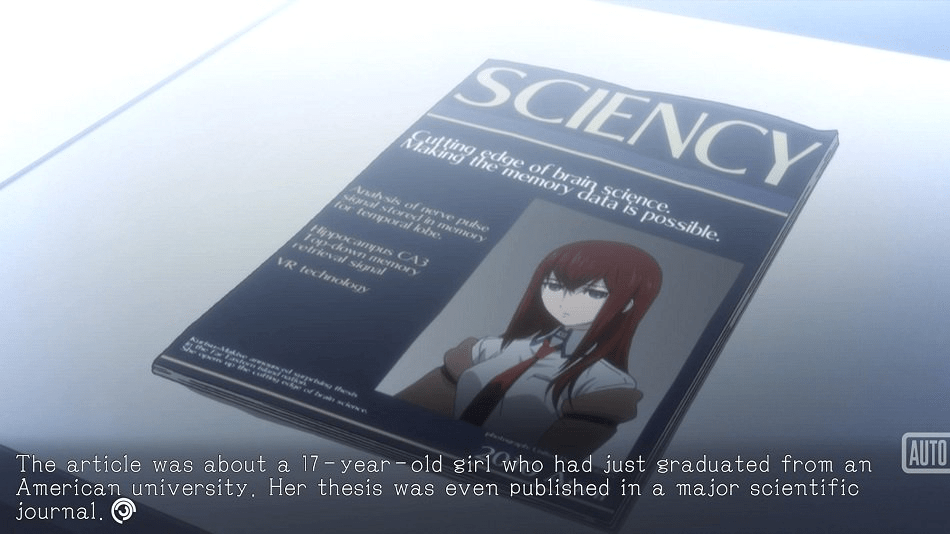
Here’s where the real-life and science really begin to blur. Kurisu is a prodigy in neuroscience research and has published in “Sciency” (Fig. 2). She gets roped into the antics of the other high-schoolers as they try to decipher the gel-formation and the mini-blackhole that is somehow forming within the microwave. Say what.
The show rapidly shifts towards existential crisis mode as the text-activated microwave sends texts into the past, resulting in subtle changes in the timeline and the group being hunted down by evil time travel aware people. Kurisu builds a device to send back memories into the past so Kyouma can download his thoughts each time from his phone while they try to restore the mistakes they’ve made and aim for a happier timeline. At some point they also need an ancient IBN (IBM) machine to hack into SERN to erase any data they had on the lab.
I really love this particular anime. It’s an incredible snapshot of the times and is littered with very specific jokes (many of which might cause pause today) and reminds me of my own high school experience in many ways. It convinced me to try Dr. Pepper (Fig. 3). Also quick shoutout to the translation team that actually broke down every single joke in the visual novel version! It’s still on my todo list to clock in the 80 or so hours to play through the entire game…

Here are some fun tidbits that might be worth exploring!
Time Travel Theories. Most of the ones used by the show can be read about in-depth on the fandom wiki: https://steins-gate.fandom.com/wiki/Time-travel_theories
- Neutron Star Theory – time travel to the future
- Black Hole Theory – the crossing of event horizons results in time travel
- Light Speed Theory – presumably moving faster than the speed of light leads to some sort of future travel. It is unclear what this actually means in the show
- Tachyon Theory – particles that move faster than the speed of light and could be used to send messages by bouncing off a mirror and returning before it left
- Wormhole Theory – this one is explained slightly more in-depth during a lecture. The show explains this as a hole where the time between the entry/exit is zero. If a wormhole is sufficiently long, then the arrival time is in the past. Returning to the entry, time travel occurs at the same location. One of the points made here is that exotic matter is required to stabilize the worm hole
- Exotic Matter Theory – material with abnormal properties that behave the opposite to F = ma, now confirmed to exist! This would allow for physical movement of objects into the past
- and so on and so forth
Without the requisite physics background, I can’t comment how accurate some of these descriptions were. The show uses what appears to be the tachyonic antitelephone where if a signal were sent sufficiently fast enough (greater than the speed of light), then the signal causes an effect before the signal is even sent. To send things faster than the speed of light, a mini Kerr-black hole is created in the microwave. This Kerr black hole is stable only during very specific hours of the day, someone directly by the activity of CRTs on the ground floor from the group’s landlord (Fig. 4). The particular frequencies of the components in perfect resonance are handwaved, and even the group is baffled. But repeated use and testing shows that this indeed is the situation. Science!

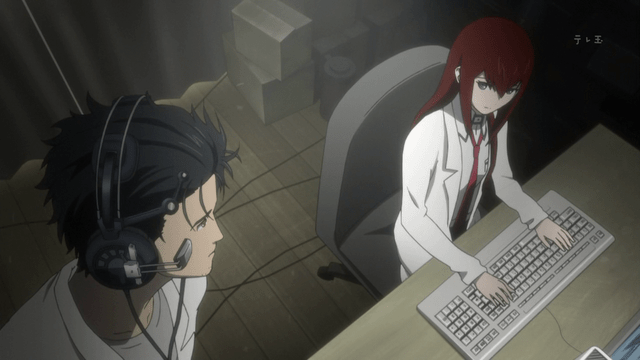
This is fine and dandy when the data limit is 36 bytes (this is shown by the cropping of text messages when long messages are sent), but really falls apart when they start sending entire human memories through the black hole through physical compression of the data (Fig. 5). In the show, the urgency is off the charts so no one stops to think whether or not this really works. We also see that the memory downloading when Okabe picks up the phone causes an immense amount of strain but is near instantaneous, uncompressing in his brain. I suppose this could happen if the compression was only during the blackhole time travel transfer moment, and it immediately pops up as is.
We also see the arrival of a PHYSICAL craft towards the latter half of the show, when Daru’s daughter from the future resistance arrives, crash landing on a building that is shown both damaged, and undamaged in the very beginning of the show. This device somehow contains enough energy to simply jump in time, twice! The device was developed to prevent SERN (now clearly an evil research group vying for world domination) from discovering time travel at all by stealing the group’s research. We have still yet to see if this is at all possible, since the travel occurs in 2036. Unlike exotic matter, I’m not sure if we’ll suddenly see a satellite-like craft crashing into a high-rise building in 2010 retroactively.
Some other fun quirks in the show include:
- the presence of maid cafes (very real)
- @channel (a 2chan reference perhaps)
- Rai-net tournaments (a play on the many card game tournaments in Japan, it reminds me of Digimon somewhat)
- Akihabara as a whole (the show uses real locations and buildings)
- and flip phones! What a time. The show does an excellent job showing everyone’s individual phones and phone charms. In the visual novel (the show is based off of a game), the choices are made all through text message! You can also choose to pick up or ignore phone calls! Its a throwback to see everyone in the show “text” to email addresses, which remains a baffling situation to me

El-Psy-Congroo.
 Abstract ED