-
The Things I Tell TAs
A speedy writeup today while I take a break from thinking about the numerous emails I have been putting off. Despite the prompt I received, I do find myself spending a surprising amount of time helping out other TAs (teaching assistants) figure out what is, and isn’t okay. Having TAed (verb) for quite some time now, I have dealt with wonderful and atrocious instructors, other TAs, and students. Here are some words of wisdom.
Top skills I used while TAing:
- Patience. Much patience has been applied. Be observant in your patience
- Time Management. TAing is a “job” insofar as it is one of the only ways to fund your research, which is likely what your supervisor and the institution consider to be your real job. Nontheless, you have hours assigned to focus on something else. Try to strike that balance
- Self-preservation. It’s good to check in with yourself. Are things okay?
Some handy strats for first-time TAs:
- Read the contract. Do it. The instructor is obliged to meet with you at some point in most contracts. You are obliged to confirm if the contract makes sense. This is a great time to mention your comfort level with the materials and if you need hours to learn the content to be successful in your other duties
- Track your hours. All your hours. If you forget to, go back and estimate each week. Meetings, emails, prep, despairing over the assignment, formatting feedback, all of it. Then forecast. Do you actually have enough hours for the rest of the term?
- Balance any need to “care” for the students, yourself, and the course. Forget the institution’s reputation and a disdain or admiration for cheaters for a moment. Will anyone appreciate the effort you’re putting in? Will you gain something from it for yourself? Spend a little bit of time figuring out what feedback actually gets used. It may be handy to compile a general list of issues rather than provide specific comments. Do not entertain one on one meetings instigated by sob stories unless the student has done a minimum to ask specific questions or have read the general feedback. The exception to this is if you have hours set aside for this task. TAs are not trained to take care of the mental health of their students nor deal with exceptional circumstances. Have a handy list of references to point them elsewhere if need be. A reference document on how to “save as pdf” is astonishingly useful. So is “how to save a file and where to find it”
- Communicate often and early. If the instructor is not accesible, then with the other TAs. Check that contract. See if it is being upheld. Count those as hours. This ties in with…
- Front loading your work. Within reason of course. Get the rubrics, read the assignments, set up your TA hour tracker, let the students know that YOU know about the myriad ways in which they can be academically dishonest, and set and enforce your boundaries early on!
For the long-term TA, you may be jaded. Or even as a first-timer, you may simply not care for this aspect of your job. There are certainly ways to optimize your true working hours and not be reviled by your earnest coworkers.
For the passionate TA who cares about academic integrity, rigor, passion, and performance from students… It will be difficult and disappointing sometimes. Being actively involved with the course progression, reading the syllabus and course goals, checking the grade distribution, skimming the assignments you didn’t mark might help you identify the pain points of the course, or what the students are underprepared for. Feel free to suggest small changes or potential improvements to the course. If something is working well in your section, mention it to the others. In the case of your coworkers not caring abotu the same things you do, you may need to argue truthfully that it will save everyone work in the next few months. Good luck.
Lastly, it is worthwhile mentioning that professional relationships are sometimes difficult to navigate. The academic sphere does not always foster teaching skills nor empathy. If you suspect something is not quite right, get a second opinion. Tenure and a different cultural background do not justify a complete lack of communication, competence, nor care.
Thoughts? For brevity’s sake, I have not included my thoughts and experiences on academia as a whole. Thus, context has been stripped from this post. Nonetheless, I suspect the general skills/strategies should still hold regardless of what kind of job it is, if human interaction is somehow involved.
Addendum: This post has predominantly been prescriptive, in the hopes that it will be intuitive as to why the strategies have been listed. However, I strongly believe that “tools, not solutions” is the best thing you can provide to students that have the time and enthusiasm to improve.
-
Leveraging AI: Having ChatGPT Write Your Proposal
Editor’s note: This post was originally drafted in February, shortly after discussion around ChatGPT in the academic space was booming. The views of the author have generally remained unchanged.

Fig 1. Character art inspiration for a role playing game. Generated using Stable Diffusion. I have, in the past, been accused of writing much like a robot. At the time, this was a major offense and I was rather hurt by this remark. In retrospect, they weren’t necessarily wrong. I was on internship at the time, and part of my role involved writing emails in response to client inquiries. In writing these emails, I wanted to acknowledge their questions, confirm their accounts, and either provide the answer to their query, or to politely inform them that their concerns were on hold while I forwarded their inquiry to the appropriate team. This method was very formulaic, and lacked personality due to the professional tone I used. Several of the questions had very straightfoward answers where we could copy paste the response from the FAQs or had a standard procedure to resolve. The language I used was neutral, with as few words with specific positive or negative connotations as possible. Several clients I interacted with were from different countries and time zones, so I used simplified terms and sometimes elaborated on key points or more technical phrases. I would end with a pleasantry and an open invite for further follow-up as need be. Indeed, this sounds exactly like the kind of chat bot I would want to deal with CS inquiries. I would be happy to interact with such a bot.
Speaking of bots, the recent discussion on the interwebs has been quite concentrated on the preview of ChatGPT (and various other similar productions from Google and Microsoft). I have also seen some concerns in the academic world in terms of increased rates of cheating or using ChatGPT to answer thinking questions or to write long form responses. While these concerns are legitimate (there is no doubt that some individuals out there are directly using the outputs for this purpose), it does not necessitate an institution wide email banning the use of AI in response shortly thereafter.
This (hypothetical) email sent to all of its students might state that the use of AI tools in part or entirety was not permissible for assignments, academic work, and coursework – unless they were explicitly asked to use them. Teaching Assistants did not receive guidance on this separately from the students. In this situation, if a TA meeting were to occur for a writing assignment with no further discussion regarding ChatGPT, I assume that the instructors did not receive additional advice in how to detect this form of cheating. This email highlighting ChatGPT as the primary offender and not including the names of some other commonly used sites and resources for cheating would be an interesting choice. Naming a specific tool and a less than polished email might suggest administration having a knee-jerk reaction.
Such a response did occur at my institution. For a variety of reasons, I found this rather disappointing. Part of it is in the name, AI-tools. Banning the use of new tools at an academic institution is an interesting choice, even if it does lead to the increased use of these tools for cheating or more efficient cheating. After all,
- it is safe to state that some portion of students will always cheat and some of them will get away with it.
- and, the use of an AI-tool does not necessitate the act of cheating.
- therefore, we should ban AI-tools?
That is an interesting chain of logic. While it is easier and more accessible to cheat in this fashion, I am not convinced that banning its use will greatly decrease the frequency of cheating. Rather, I feel that it might have been helpful to reiterate the goals and values one is meant to learn from doing work without cheating. Then there is some reward for choosing not to cheat, rather than a hint of a punishment for doing so. This requires meaningful course content and a consequence for failure to attain the minimum requirements.
I also found it disappointing that there was little acknowledgement to these new developments as interesting and potentially serving a good use in the near future. The first response I saw from the academic community was sarcasm and fear (though perhaps reddit is not the most ideal source for anything else). This seems rather contrary to the regular newsletter publishing of recent developments and relevant global news to students. While it makes sense that academic integrity is of high priority in this instance, I’m not sure the last time flat out banning something has worked if there isn’t enforcement. Some examples: we currently are required to mask on campus, yet the vast majority of individuals remain unmasked. Smoking is not allowed near entrances, but I often see security smoking there.
Now, to be frank, I don’t think this is all that novel of an AI-tool and the popularity of it for use in cheating will fall off as something “better” occurs. I imagine if the developers are aware of integrity concerns, they may eventually develop a method in which academics can request a comparison of submissions to responses tied to specific accounts (update: OpenAI has indicated they will integrate fingerprinting into their service). Or perhaps not, until some law comes to force for these companies, which judging by the speed of which they have been addressing companies leveraging personal data, may be a long ways away.
Perhaps the “newness” and “groundbreaking” level didn’t merit a whole news spread, but I think there is a fair amount of potential application for ChatGPT in various service areas in the future. As for the benefits to the academics, and other folk that make their living based on what comes out of their brains, see the points coming up.
So why the ban? Cheating has never been allowed, but it hasn’t been easy to prevent it. Thus far, my experience with reporting plagiarism shows that the reporting procedure is incredibly long and draining. I don’t even see most of the work that goes into reporting the cheating after I explain to the course supervisor why I think a student has cheated. Minor incidents are not always pursued in full and the typical work around is to provide very low marks to students. These method does not result in a mark on transcripts, and a student can often withdraw at this point unless the instructor is particularly vindictive and saves the reveal for the end of the course.
I wholeheartedly believe that cheating needs to be addressed more seriously, and more resources put into making sure that students with more privilege do not “get away” with it by being better cheaters. Cheating is a skill of sorts, just not one that is specifically meant to be fostered in the academic environment. The entire purpose of not cheating to do very fundamental things is to develop an appreciation for the rigour involved in research and effective communication. Using other people’s work while providing attributions for the individuals that did the work is another important skill that is hopefully developed prior to post-secondary, and comes as second nature. [There is a separate conversation to be had about the desire some individuals may feel about needing to take ownership of various ideas that can be apparent in the work place]. Feelings on cheating aside, here is an argument for why entirely “banning” AI is not the answer. Note that this is assuming that the students who were planning on cheating will do so using any resources available to them.
- there is a lot to be learned from these AI-tools. In a recent lab meeting, we discussed the potential for inspiration (specifically from art generation), feedback/editing (suggestions from text based tools), and code revision. Naturally, this is a dangerous path to go down if you never learn the fundamentals, but assuming you do have the skills to produce the final work, I see AI-tools as a potentially faster way to get feedback and break through art-blocks. Or one that can open paths that you might have not considered (despite it being trained by a number of like minded individuals, there is a possibility for some deviant ideas buried in there or different takes based on the aggregate answers during the derivation).
Have you ever stared at a document you had written until your eyes turned red and your head was swimming? You know there are minor improvements you can make, but all your co-workers are busy and the Writing Centre has been booked up due to poor planning. There is a free tool staring you in the face that can rewrite your sentences in several different styles. How many steps beyond a thesaurus and word editor is it? No doubt someone also panicked when students started using a wider range of vocabular they previously did not possess. Did anyone notice when their emails started getting written for them? Rarely does my gmail say precisely what I want it to, but when it does, it’s rather nice to not type up everything. Microsoft Word often wants to cut down on my excessively long-winded phrases too. I even accept the suggested changes sometimes.
1b. Turns out, ChatGPT is pretty decent at suggesting basic scripts and packages for processing without going through an entire blog post.
- a number of random generation tools exist on the internet that are not labelled as AI. For example, I have a few complex spreadsheets that have been shared on the internet that can fully generate various sized villages and towns, with the names of each individual, where they work, what their major belongings are, and what kind of personalities they have. Just about anything can be used for inspiration. Why should we discount AI? One argument I see for this is that it can potentially start spouting out fairly stale information unless it is continually trained with newer versions being released. Part of this is that the “inspiration” it provides soon becomes bog-standard and no different from a friend with strong opinions as an AI is trained to have “right” answers. But the interpretative value of the results is quite dependent on the user. Without any changes, the baseline response is “cheating” if it is used directly. Subtle modifications and revisions to adapt it So it becomes more of an iterative process. Say I am interested in creating a alternate timeline where two major events in our current timeline have slightly different results. I could plot the entire progression of these changes all the way to the modern world. Or I could ask for a well-rounded answer from a resource that has more knowledge of these events and their impacts for the subsequent changes and potential results on the current day. Even if they aren’t correct or plausible, it provides a framework in which to build upon
- pretending new technology doesn’t exist does us no favours in academia. While it’s not necessary to immediately jump upon the shiniest newest instrument or model, completely avoiding it and shutting it out is not usually a good approach either. The typical intermediate approach is to acknowledge it, and to cautiously integrate it. Jumping in head first tends to produce work where the results are not meaningful or well understood (this is evident in the machine learning space or the use of statistics in sciences). Ignoring it entirely seems to be somewhat antithetical to the values of innovation and integration of all relevant aspects of human life in research.
- it cannot be ignored. Cheating or not, AI is around. We might as well familiarize ourselves with it if we anticipate having to interact with it in the future. At the present, the main concern is cheating on written assignments (again, why image-based AI were specifically mentioned, I’m not sure as digital art assignments can be evaluated in a very straightforward manner for cheating). The work arounds have been reasonably straight forward, such as adding cheating detection tools, or handwritten assignments, or “scaffolding” assignments where the students integrate feedback and respond to the evaluations. That said, the amount of time to integrate these changes is non-trivial, and it can result in more work. I suspect this is part of the reason why academic institutions may attempt to ban chatGPT altogether instead of providing resources and support for teachers and TAs having to mark these assuming that the tools will be used regardless. I vaguely remember the dark times where students were forced to install invasive software on their computers to catch twitchy eyes or browser opening, rather than support and time being provided for professors to change their curriculums to be harder to cheat on or to focus more heavily on interactive work to demonstrate their knowledge. Students still cheated. Meanwhile, ChatGPT could make for an interesting instructional tool were it integrated in course content. For example, in a first year course, students could submit a prompt and identify the correct/incorrect aspects of the response and to supplement the response with specific relevant aspects for the course. A literature course could break down the stylistic writing choices based on various prompt triggers. A machine learning course could go ahead and train it based on specific sets of data. Prior to this email rolling out, we were encouraged to think of ways that ChatGPT could benefit, rather than hinder us as graduate students and researchers. I was personally hoping that it would be fairly good at parsing out cryptic and uncommented code by perhaps analyzing the structure and tracing variables. It can certainly read my spaghetti code and format it into a slightly more human reader friendly version, though I would caution testing any code that gets reformatted in this manner. The non-academic way in which I might use this bot is to see if it will retain memory about some world-building I want to do based on some real world information (that is preferably not quite accurate)! Seems like the perfect job for AI to be honest. I also noticed when I was trying to slowly tease out a proposal from the bot that…it does indeed write the way I do. Some of the specific aspects of my project were very easily identified, as well as some methods to apply them in. I asked for the following questions, modifying each question based on the response and which aspects of the response I wanted an elaboration on.
The Proposal
elisa
what does a research proposal look like?
can you give me an example research proposal on the martian atmosphere and cloud interactions with topography?
how does this change if we consider exclusively cloud interactions near craters?
what would an expanded methodology look like?
how would the proposal on craters change if this were in preparation for a phd dissertation?Some observations I made were: references were not real, though the authors often were. ChatGPT was unable to generate real URLs when providing suggestions. ChatGPT was to some extent able to parse code from GitHub repositories. ChatGPT knows more about plants than I would have expected, but is entirely wrong on its stance of calatheas as an easy indoor plant to take care of when my apartment is subject to someone else’s whims for the temperature (and thus, humidity). When discussing pets, ChatGPT had a more “humane” slant and often had disclaimers about the advice it was issuing. The stylistic language is quite flexible. ChatGPT was able to provide purple prose, scientific report, and various other styles for its responses. ChatGPT in its free form is very confident and left leaning based on the questions I asked of it. The history of each conversation may influence the subsequent responses.
I have not had the chance to interact with versions of ChatGPT where the “confidence” can be dialed up or down. I think lower confidence (less safe answers) could provide some interesting discussion points when thinking about what is common in research and what the next steps should be.
The major downfall I noticed was, the necessity to create an account and likely a bunch of other information. Nothing is truly free after all.

Fig 2. Character art inspiration. Key words included braids and glasses. Generated using Stable Diffusion. -
Grad Life: Normalizing Failure, Plus ++
This here blogpost is a focus discussion on failure within the academic sphere. Initially I had planned on pushing the concept a little further by discussing failing in advance or by inaction. Instead, I spent a bit of time reflecting on what it means to fail and whether “success” is all that. The post takes inspiration from a publication from the CV of Failures that has become increasingly popular to discuss and share amongst colleagues following a reflection on an article in Nature Reviews (The Need to Normalize Failure – https://doi.org/10.1038/s41570-022-00454-x), which highlights how creating a CV of Failures at an earlier academic stage can be shared.
I think an underdiscussed aspect of a “short” CV of failures is the sheer amount of time it takes to apply to various scholarships and fellowships. I have made the active decision to skip over some scholarships from time to time in order to use that time more productively. While one can say, “applying is good experience”, this feels awfully similar to “unpaid art for exposure”. It doesn’t balance out here. Instead, I find my time more worth while spent making a dedicated effort to apply for scholarships that I have been recommended to, or truly feel that I align within ~70% or so of the required expectations. I then consider the applicant pool and my competition to see if I am fit for the competition. While this process likely cuts me out from more scholarships than I would like (experience shows that I likely would have succeeded more than once had I gone ahead with the application), I find it a reasonable method in which to choose what I do. Of course, with limited experience, I could be spending my time poorly. However, when I found myself with limited mental capacity following a major injury, I realized that pushing through and increasing the number of hours I did “work” was not always a viable method.

Fig. 1. Exposure Bucks! Experience! Image from: https://cindysadler.com/update/2016/11/05/how-to-pay-an-artist-with-exposure Another aspect that I consider is the necessity to have fancy fellowships to your name. The need for success demands that individuals with a reasonable source of monetary support are also obliged to strive for titles and the financial support that comes alongside them, reducing the likelihood that someone less privileged with fewer experiences may receive the same title. This is not a complaint per se, but somewhat a criticism of the method in which various accolades are handed out. If one does not have a history of receiving awards, then they may be less likely to receive more in the future, which is quite discouraging in terms of time spent. While there are opportunities for one to jump into the race of cascading awards, it is easier to “win” when you have already won in the past.
Let’s talk about my CV of Failures then. The most biting failure was to achieve a Mitacs scholarship that I was informed was very easy to get, where almost no one gets rejected. The liason and my supervisor had gone over my application, its relevance, and various other requirements with a fine toothed comb. It was a stellar application. Not only did I get rejected, they informed me that they could still provide some form of financial support if I found several thousands of dollars somehow. I then had to spend a not unreasonable amount of time looking up ways I could scrounge up the money from different sources and get them all to agree to fund the same project. When the details finally worked themselves out with days to spare, I recall breaking down in public from relief and exhaustion and gratefulness to those involved. Of course, the trip was delayed due to the COVID-19 pandemic and the subsequent attempts to communicate a work-around went quite poorly. A mixed failure I suppose.
More recently, I took part in an NSERC funded program and competition of sorts to develop some innovative project with a specific theme. Our team pushed the boundaries of the definitions and put forth incredible work connecting various sectors and individuals with legitimate criticisms of various extant policies. I was proud of the work we did. We did not win the competition. While the criteria were unknown to us, I believe it was in part due to being a little too outside the box. While the entire purpose was to make connections and supplement our resumes, the fallout between individuals and poor management decisions still ongoing left a bitter taste in my mouth. I had received what I had been looking for (funding to support my delayed MSc, a failure on its own for various reasons), but lost my enthusiasm for a project I cared about. Another mixed failure. We didn’t win, we didn’t publish, and I was left with a sense of bitterness and lack of trust in terms of the “connections” I had formed.
I suppose it is also worth noting some general failures which meant a lot to me at the time:
- failing to get into the engineering program I wanted to
- failing to receive a number of scholarships, mostly industry related
- failing to get an internship in something actually relevant to my degree and studies (In some cases, I knew who had received the position, and it did not make me feel any better.)
- failing my first road driving test (in retrospect, I really should have believed everyone when they said I picked the worst possible center to do it at)
- failing a course (almost, I decided to sensibly drop out and enjoy my time better. Dropping a course was considered a failure to me at the time)
- failure to remember to apply to some “critical” scholarships
What have I learned during this time? The humans involved with making decisions are often very thoughtful and kind. For smaller awards, the financial status of the applicant is actually taken into account when they say they will consider it. For larger awards, it makes a difference to have concrete evidence of your past successes. Merit based methods aren’t fail-proof. Those who do the choosing sometimes do not make choices that they themselves are even happy with. Maintaining connections and finding a mentor to walk you through some of these details can make a difference in the time spent and wasted. Sometimes failure is not dependent on you, and can be due to other sources. There is sometimes undue burden to achieve scholarships, which can greatly change one’s living and working environment.
I am always optimistic that various awards, jobs, and titles will eventually go to those who deserve it. But perhaps, it would be nice not to have the pressure to aim for such achievements, and doing the work itself would be the achievement. Perhaps we shouldn’t normalize the need for awards other than for very exceptional circumstances and it would be nice if the chance at financial support didn’t require skipping other scholarships to be considered eligible. Let me propose another article, The Need to Normalize Weighing Time Investment and Rethinking Success Factors. Connecting with others over shared failure can be great for bonding, but I would be wary that failure can also become a “success metric” and the normalization needs to be for more than failure.
-
Grad Life: End of First PhD Term
Tis the season, to hopefully take a quick break from work and research! As the term ends, I’m busy wrapping up my TA duties, studying for exams, and prepping to meet with my supervisors to see where things are headed for the next term. A few other things have happened since drafting up these thoughts. Herein also wraps up my first month or so of living alone on purpose.
It’s also the season of reduced sunlight and impulse buys. Instead of talking about the silly things I purchased during the Black Friday/Cyber Monday sales, let’s address my increasing plant collection. I’ve been trying to purchase things more locally (which is quite easy when you live on the fringes of the largest city in the country). I swung by a plant studio to pick up a discounted snake plant (people really love quoting that one NASA study about air purification, but I assure you this baby plant does nothing to enhance my air quality) and a request plant (variegated string of hearts)! I was beyond delighted that the staff were willing to pull out various plants they had sold (and were in the midst of packing) when I started I mentioned that there rare plants that I had wanted to see in person before dropping several double digits. Also, I may have acquired a dragon-scale plant in questionable conditions from the Superstore (I haven’t stepped into one for years, I had no idea things were so pricy!) while buying basic home things like measuring cups (Fig. 1). I had previously purchased a very lovely plant from the same distributor die within a couple of weeks, so my expectations are low (string of turtles at half price, very sad). So far, so good though. The leaves are yellowed, and it seemed that it had been over watered for quite some time.
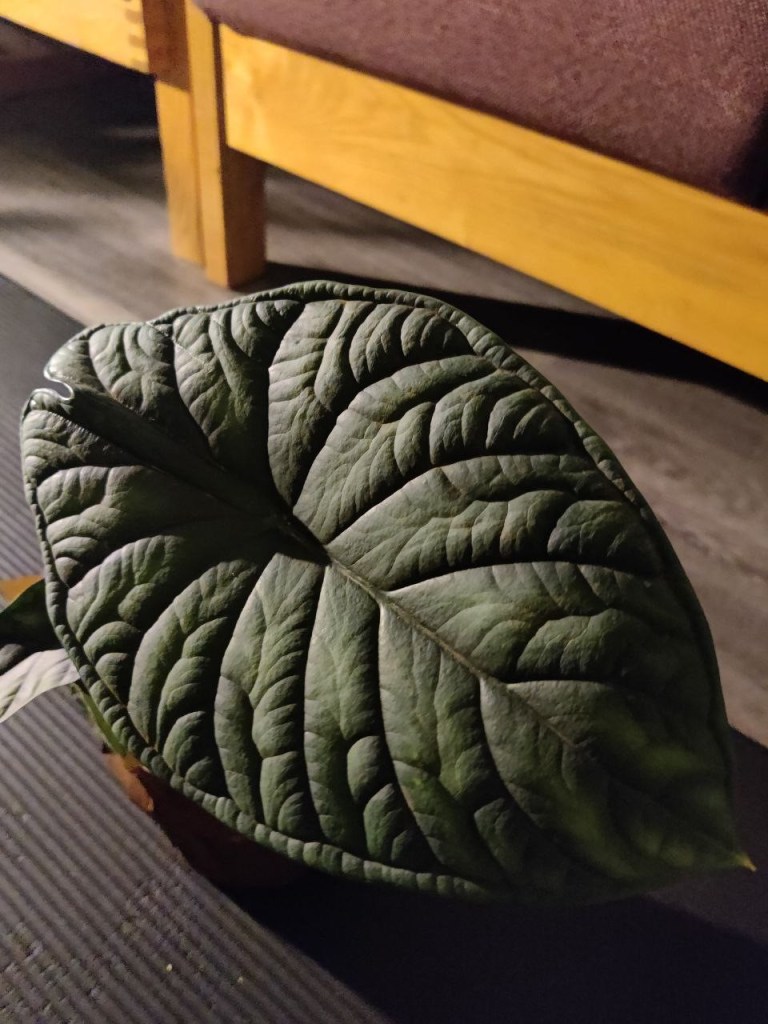
Figure 1. A giant dragon-scale leaf, leaf for scale. Some yellow tinges visible in dramatic lighting. In roughly the same time frame, I remembered that Toronto was hosting a week long One of a Kind exhibit of sorts. Instead of swinging by to check out handmade pottery and buying art, as I was greatly tempted to do, I pulled out some of my ancient art assignments from highschool and stuck it on the walls. Now I have arty walls, very satisfying. The next thing is to deal with the generic looking, rather scratchy furniture that seem to be required fixtures in the apartment. I’d like a comfy, cozy chair. I think I have the perfect IKEA lounge chair now that there’s some room after cleaning up a few boxes off of the floor. Chances are that it’ll become the requisite “laundry chair”, where the “not dirty but not clean” clothes will go. I also think it’s time to look for a slim shoe tray thingy with the change of the season and the potential for the snow to start sticking around. I’d also love some more lighting fixtures or alternatives to the fluorescents for my main lighting. Bah. Fluorescent lights. Still. While I’d love to make the place a little nicer, I’ve more or less avoided bringing in anything new into my life in terms of decor and furniture.
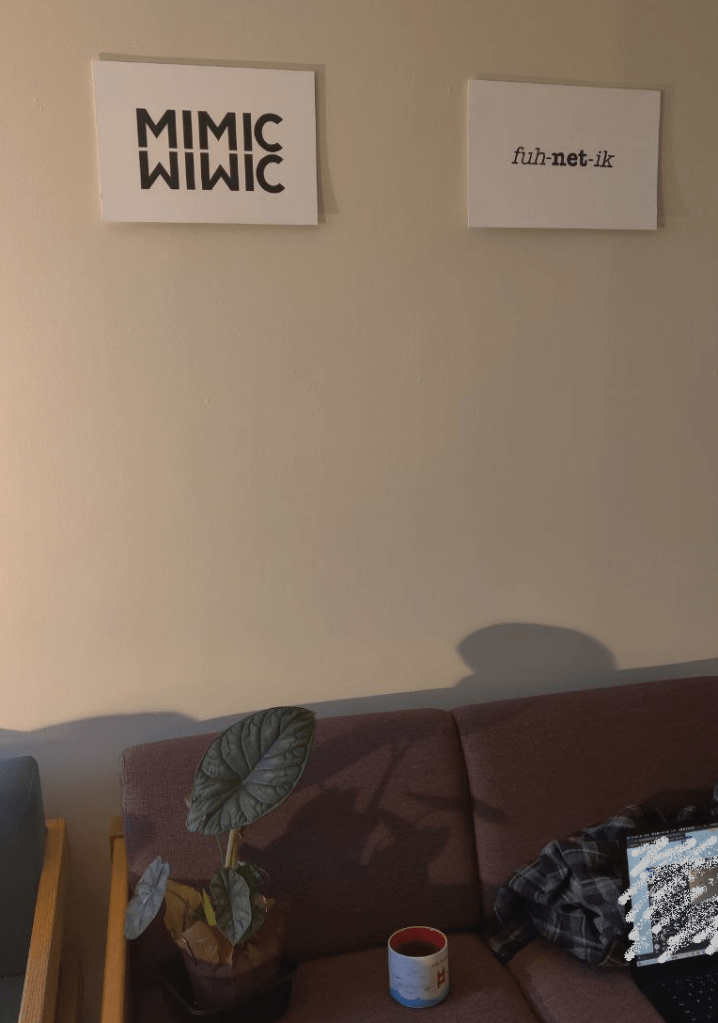
Figure 2. Some old art on the walls. Non-optional couch that came with the apartment. Dragon scale alocasia sitting up looking pretty. If you wonder why my laptop and drink are on the couch, it’s because I often sit on the yoga mat on the floor next to the couch. :’) Was I a sensible consumer during all of this? Not necessarily. There was some shopping I did in the lead up to the “big” sales, primarily because I wanted to avoid the feeling of being rushed. Some things that genuinely seem useful and have long term value include – a small cushion that can be heated, a desk lamp to hold UV spectrum LED lights for my plants (and for myself to have yellow lighting), and a giant – Costco sized bottle of concentrated dish detergent. It’s one of my life’s greatest banes to have to repurchase small bottles of expensive dish detergent every couple of months. On top of that, instead of taking advantage of the sales to replace my wireless headphones (slowly on their way out), my major electronics purpose was an e-reader (to replace the one I lost several years ago on a plane). Oh, and a new microphone since I spend a lot of time speaking online in comparison to pre-pandemic conditions. Overall an interesting mash-up of things I was interested in this year.
To side step again from the frenzied shopping season that takes place right around the US Thanksgiving and a lead up into the holiday season, here are some things I’ve been thankful for and am looking forward to: family that sends me food, a hand held coffee grinder, a holiday season full of cats and cat-sitting, and being on commission for a piece of art because someone decided they liked my style.
So here we are at the end of the term. I’ve mostly moved in and set up. Classes are just about done and I didn’t end of overshooting my allocated TA hours. Work is ongoing and I have finally made progress on my pet electronic project. I have found that my office neighbour is into plants and is willing to take care of them when I’m out. I’m generally pleased with how things are going despite the dim, dark days ahead.
-
Grad Life: The Usual Beginning of Term Issues
I’ve been prompted to discuss some of the recent issues I’ve been having. There’s been a slight delay on some issues popping up, but as projects rise and fall, changes to my computer set up are required. Also I just moved. Again. We’re now counting 9 moves since I’ve started graduate studies. Let’s chat.
Projects and Pathing
What feels like a common silly thing to wrestle with which each new code package is the installation of specific dependencies and setting up folders and paths in a particular fashion to allow the use of said new fancy code package. Without going into detail, I’m astonished that I was able to follow some specific set of instructions to install GDAL (notorious for being tricky to set up since a number of dependencies need to be upgraded and downgraded at various steps in the installation). However, I’m at a loss when it comes to the more cryptic error messages (Figs. 1 and 2).
Usually what I do is Google and check various forums for days on end, find some workaround and install something completely different instead. This time it’s looking like I really might have to figure out the issue. On a related note, speaking with my labmates did help out for another software problem I was having. Thank you!
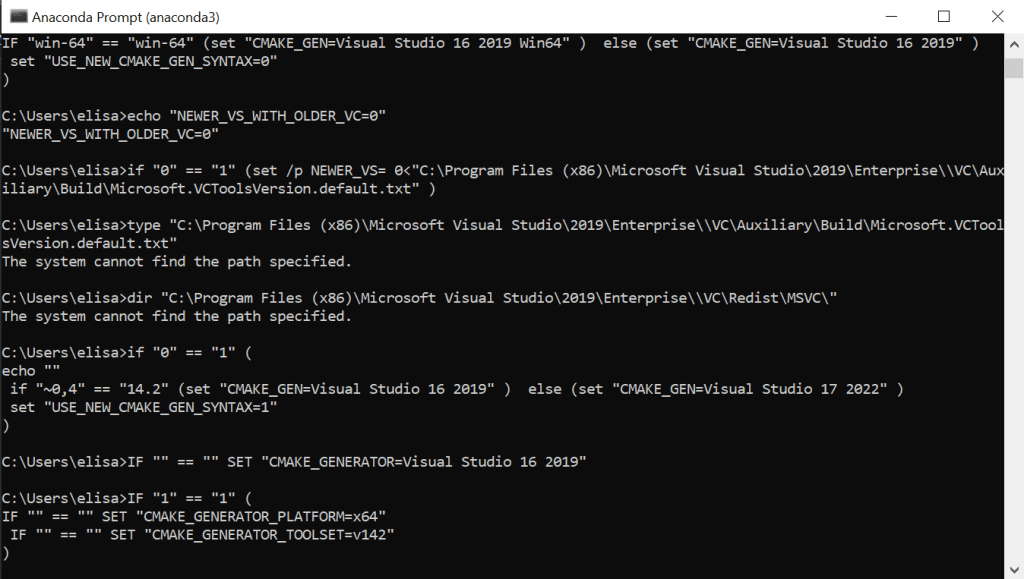
Figure 1. A screenshot of Anaconda. I cracked open my “clusters” environment and got a series of messages that I have no recollection of setting up. Here I was just trying to reproduce the weird error that I get when I try to import a python package! More to solve I suppose. I should start documenting what I do to set up my environments. 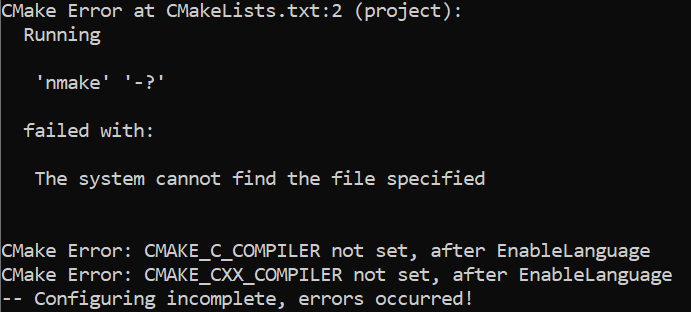
Figure 2. The actual issue. The log has nothing useful in it by the way. Housing
Wow, what a problem. This is a nation-wide issue of course. There’s the actual cost of housing that means I get to spend something like 80% of my income and have 20% leftover for groceries and any sort of enjoyment in life outside of work, then there’s bad housing. Let’s document my housing experiences briefly.
Location zero: never even moved in. I got a last minute notification that the place I had originally planned was not going to work out.
Location one: Landlord insisted on meeting up in a different city. Played games with the offer (stating there was another tenant they preferred). Entered premises without notice. Did not resolve issues. Gave me keys to everyone’s bedroom and asked me to keep it a secret (I refused) because they didn’t have a property manager and didn’t want to drive in to unlock the doors for people. Refused to address the issue of a surprise pet someone had been hiding in their room (and causing allergic reactions) despite this being a condo with no pet rules. Failing to notify the condo association of the tenants and associated vehicle licenses. Gaslighting and yelling. It goes on.
Location two: Landlord lived in the house. When viewing the place, they indicated that kitchen and pool were for common use. Linens were provided. Moved in. Got yelled at for cooking and having “food scents”. Insisted that people in the past just ate take out every day. Threatened to call the police on me. Put something questionable in my room that caused it to smell. Lied about the passcode for the entrance. I didn’t even last the two weeks I had paid for.
Location three: Just a crash pad at a friend’s place while avoiding Location two and figuring out where to go.
Location four: Perfectly fine! The place was a little small and out of the way. This was a non-issue until the pandemic rolled around and I was stuck indoors all the time due to a wasp problem in the backyard.
Location five: Pretty great. Minus the extreme heat (no AC) and roommates that had weird sleeping hours that resulted in a lot of stomping overhead. The folks were great, but the random footsteps overhead really got to me after a while. I was all set for the rest of my degree. Until I wasn’t.
Location six: Turns out it’s really hard to find housing when the university suddenly declares in person classes again. After 60+ calls and messages, and several in person visits where people were making offers on the spot, I finally found a place reasonably priced and close enough to bus. Only issue is that the landlord hated onions. Okay. I could deal with that for a bit.
It turns out that it was a lot more than that. There was a lot of random sudden sniffs outside my door, and loud music being played all the time from upstairs, and a lot of guests (guess what we weren’t allowed to have?). The heat would also get randomly turned off and she demanded our windows be opened for hours to air out. Eventually me and my law school roommate decided to look into the legality of our living conditions and decided that we were indeed protected by the Residential Tenancies Act and our lease was nonsense. Over the holidays our landlord someone developed some terrible illness wherein her doctor insisted that no scented things were allowed in the house. Of course, they felt welcome to inspect our quarters. Somehow my roommate spilled an entire bottle of perfume that the landlord didn’t notice, but my diffuser that had water in it for over a month was a problem. No wonder I didn’t submit my thesis in time to work from home the next term.
Location seven: Great! Lovely roommate, reasonably nice location. Wasps in the house and mice in the walls. Can’t win ’em all. Those issues never got resolved properly. There was also incredibly poor heat distribution in the house and a gap in our entry door, so we often had a space heater on. Oh, and the house down the street was regularly broken into and we had a couple fires in the five months I was there. I wouldn’t have enjoyed living there much longer.
Location eight (skipping over living from home and living at a remote campsite for three weeks): Okay. Housing in Toronto is rough. A family friend let me stay for a bit while I was waiting on residence to let me in. It was a lot of being treated like a surrogate daughter though. Not the most comfortable, but alright.
Location nine: Finally! I have arrived! I applied way back when I received my original acceptance and followed up after the response date had passed. I was on the wait list. Cool. Then I got in and picked a date. Great! I emailed closer to the move in date asking where the lease was. I was informed it was in the works. It showed up in my inbox a week before move-in with some additional information. For example, there was a link that informed me I would receive a move-in time via email and I should confirm this worked for me. The email never arrived despite reaching out several times and getting a response for elevator booking on the Friday before move-in. No one seems to work on the weekends.
Move-in day. I waited until around 10 that morning, calling in several times to see if I could get a hold of someone. I even got transferred once. To no avail. Anyhow, I show up and it’s all good. Then I get into the apartment. Fairly quickly, I notice it is not all good. There are several issues with the apartment, most of which are cleanliness and electrical related. I have a quick chat with the office that gave me keys, and they assure me that I can submit a maintenance request and most issues will be addressed between 24 and 48 hours.
Surprise! I am unable to fill out the maintenance form. To that point, I am also unable to complete the arrival inventory (where I can state the condition of things where I found them). I email IT and someone fixes this a day later citing a mysterious issue and I have now have access. Alright then. I fill out the form and make 3 specific maintenance requests, and within a day, I see notice that my requests have been updated and are in various stages of progress. I come back after going to a workshop out of town and see a notice indicating that one request is a non-issue, and another has been confirmed as an issue. A nice little notice informs me that they will be coming back. Cleanliness issues have not been addressed.
A week passes, and I check with the front desk how to escalate. They are surprised to hear that my issue is ongoing. I follow the information I was given to reach out to another group to figure out what has been going on. Another 48+ hours passes, and I hear nothing. I email again, requesting an update. 48+ hours go by. Nothing.
This morning, I ask the front desk to escalate. They are surprised to see me again, and apologize once more, this time promising to reach out to the custodial staff directly. I come back mid-day to address my rumbling stomach, and find my door open and people inside my apartment. Weird. Someone just emailed me confirming they would come by tomorrow morning to take photos. After extensive discussion and several phone calls (from the staff in my apartment), I am assured that their superiors have contracted someone to come by tomorrow. We shall see if this happens. It is evident that there are some communication issues within the Maintenance group themselves. At first, no one was addressing my issue. Now there are at least 4 other people involved. Apparently people had been trying to knock on my door for the last 2 days instead of simply emailing me back.
Lessons (RE)Learned
Being a student with limited financial resources can be rough. No doubt about it. I spoke with a few others who had been living in residence and they made it clear that they had ongoing issues that had never been resolved or required escalating several times and external intervention to address. I have absolutely paid my way out of bad housing situations in the past, but this isn’t a viable solution for everyone all the time. Being persistent in resolving issues is the only way they move forward, and it takes more time than I would like to spend. It would be wonderful if the people I had to interact with were competent, especially when I am reliant on them or pay for a service. To quote roughly the individual I spoke with the first time around regarding cleanliness, “It’s because they’re part-timers. I don’t get it. They should work hard until they’re full-time, then they can slack off on the job.” Admittedly, I bit my tongue when I heard that from what appeared to be one of the full-time staff. I think I may have responded with, “Right, so 24-48 hours?”
Pile of Projects, Solutions?
I’d love to be able to compartmentalize my life so that I can focus on one thing at a time. Research, TA duties, housing, a semblance of financial security, and my personal life. It doesn’t quite work out that way though. So instead, I write myself a small to-do list for each “project” in my life and see how much bandwidth I have that day or week. This doesn’t always work out (I still have what is hopefully an hour long task to wrap up a short project), but it seems to help. I will eventually find some time to work on my pet projects, such as in Figure 3. Electroforming and shampoo making, here I come!
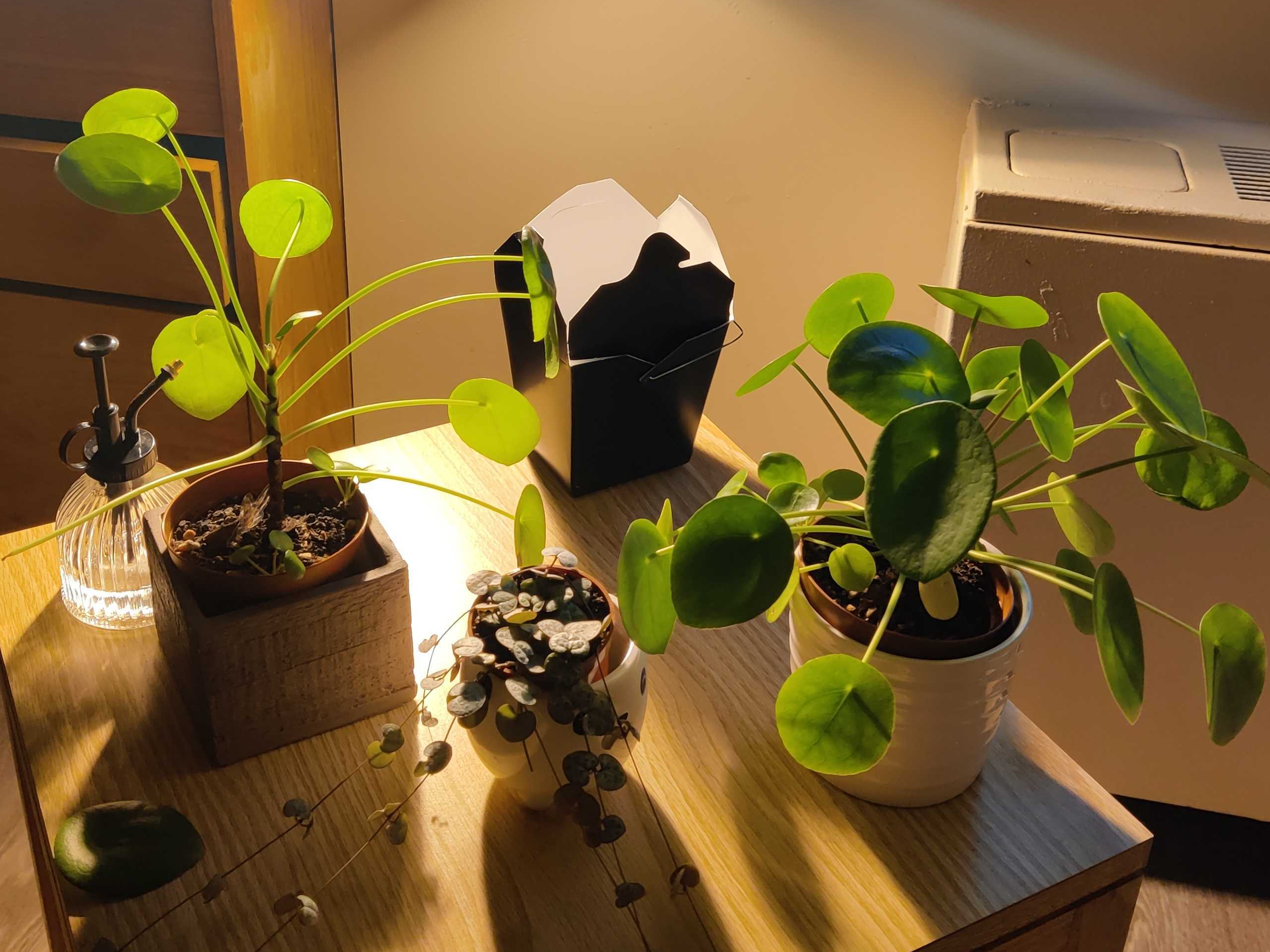
Figure 3. Not all is bad. I finally picked up an LED lamp that mimics part of the spectrum necessary for happy plant growth. It also provides a warm light instead of the fluorescents everywhere else in the apartment! -
Grad Life: Stuck at Home During a Conference
My last post discussed catching COVID-19 and all the fun I had with the resulting data that came about it. What I didn’t cover was the conference I was attending remotely during the bulk of the time I was sick. At first, I was supposed to attend the 54th DPS (Division for Planetary Sciences) meeting in person. Alas, this was not possible after contracting a very contagious virus. Instead, I found myself prepping to check in online and make the best of it. Here are some of the tips that I developed when I was getting ready for another conference online (AGU). An alternate version of these tips can be found on the PVL blog (http://york-pvl.blogspot.com/).
Tips for attending a scientific conference (when you’re remotely at a hybrid event):
- Identify your favourite conference snacks and drinks
- Purchase, make, or make student-budget friendly versions of said snacks and drinks
- Plan chores that require at most 1 hour of your time. Preferably a bunch of 10-15 minute chores
- Acquire bluetooth headphones
- Identify some clothes for dressing up (or down)
- Pick a few “key” sessions you want to be awake for and some interesting ones to pad out the rest of your time
- Chat with your lab mates on your preferred communication method of choice.
Let’s break these down a bit. Say you were really looking forward to attending the conference in person and had already planned for those days to be away. However, you’ve fallen sick or some event has taken place that prevents you from attending. You might as well try to get part of the conference experience at home! While there will be significantly less mingling with others and networking opportunities will be at most, awkward and stilted, you can still delight in the little snack breaks while reflecting on the state of the field.
This brings us to tip number 1. If you’ve been to a conference before, what snacks did you enjoy during the breaks? Personally I like that there are usually several tea options, and sometimes the coffee is palatable. The previous conference I had attended online (planned), I had the time to order some coffee samples and pick up a variety of snacks from the asian supermarket. This time I was stuck in quarantine, so I made sure I had a kettle and a massive stock of tea bags. This covers tip number 2 as well. It doesn’t have to be fancy, but having the ability to make hot drinks on demand is quite nice. It’s reminiscent of downing drinks to soothe your throat in the dry, conference room air.
Since I had to attend the conference online rather last minute, I wasn’t able to grab a photo of all the cute snacks and drinks that I had during this time. I will say that my favourite snack was a soft matcha flavoured cake. My favourite drink was lavender tea, freshly plucked from the front yard when my folks could remember to grab some for me, since I was functionally under house arrest.
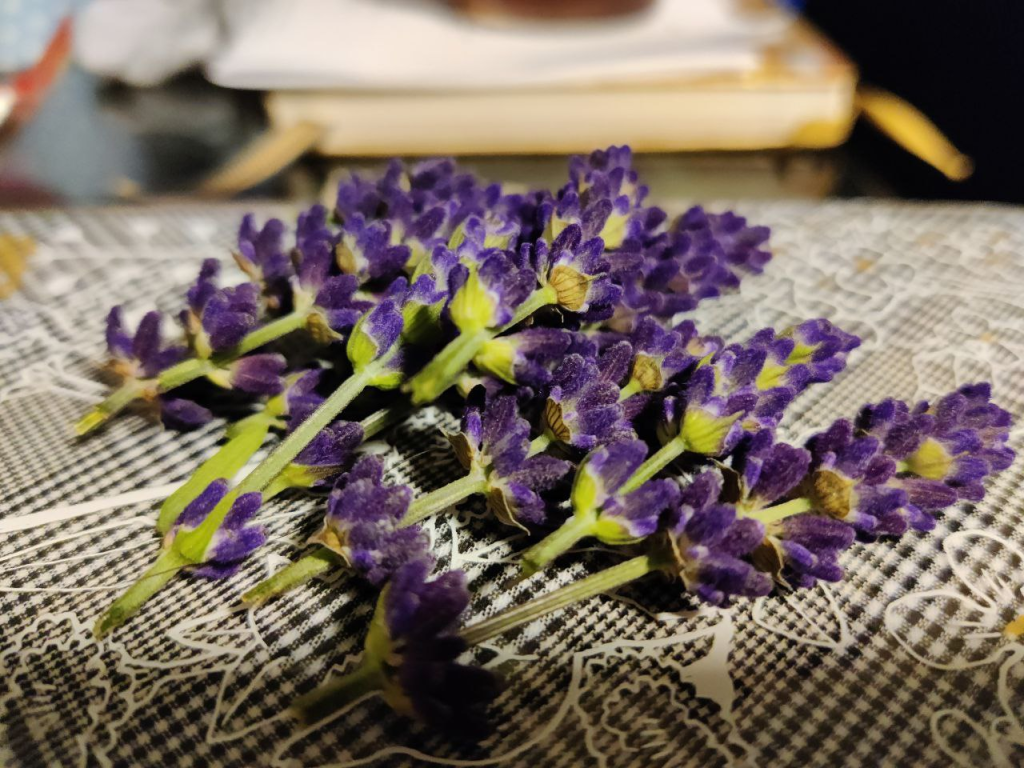
Lavender from my folks. This + honey made my sore throat much better. Herbal tea (infusion if you’re picky) is a nice alternative to the gallons of coffee I usually imbibe. Tip number 3 and 4 involve keeping yourself busy. Unlike an in-person conference, there are very few things you can look at that you are unfamiliar with. You likely won’t have access to the attendees (no camera facing that way, zoom only shows the speakers) so figuring out who else is at that session is out unless they speak up during Q&A. Instead, you could be getting some mundane tasks done! I personally can’t look at a screen continuously, so laundry, cleaning the kitchen, organizing bookshelves, watering/trimming plants, etc. all give me breaks away from the screen, but I’m not doing anything so critical that I can’t check what’s on the screen if it’s particularly important. Tip 4 gives you the flexibility to move around without fear of wires tangling or blasting the audio (less of an issue if you don’t have roommates, but still a nice option). Earphones are also an option, but I find headphones to be a bit better with universal fitting. Also, you now have the wonderful ability to choose to go to the bathroom while still listening to the sessions.
It’s all good to be perfectly cozy while stuck at home (or if you’re so inclined, going outside while still plugged into the conference). A big part of the conference experience is being present though. For me, that means dressing in a slightly snappier manner than I normally might. Regardless, I would want to have a change of pace for “conference time”, much like when working from home, it’s helpful for me to dress up for “work hours”. Dressing down could be a fun alternative to this though. After all, no one can see that you’re in the goofiest of onesies. Similarly, no one will know (other than your housemates) that you attended in a full ballgown and mask. So that’s tip 5.
Tip 6 is applicable to any conference you attend. There is only so much time in a day, so pick your favourite events to go to. Figure out what’s relevant to your interests. Not much more to say about this one. Tip 7 is similarly applicable always. Should you find yourself longing for some company, or wanting to experience the social aspect of the conference, checking in with your lab mates or anyone else at the conference can be nice. If you’re all together (remote or in person), it can be nice to schedule some hangout time outside of the planned events.
Lastly, it’s always a good idea to tap out whenever you’re feeling tired. No point attending a conference in your brain is on the fritz. Return to your comfy couch, or pop back into that hotel room as need be. Enjoy your next conference!
-
Sketchy Science: A Study on (personal) COVID-19 Rapid Test Results
Welcome to my first post! Here I tell you about one of the silly things that I get up to when I’m sick and don’t quite have the capacity to focus on regular work.
Disclaimer: I am by no means a medical professional. No advice is being offered in this article. This article is intended to be humorous and demonstrate some basic techniques to pull data from images.
Acknowledgements: My family for taking me in when I was feeling unwell and insisting I eat well during the bout of COVID I got. They also got extra tests for me when I wanted to be consistent about the materials I was using for this study.
Materials and Methods: COVID-10 Rapid Tests (Rapid Response Diagnostics, Rapid Response (R) COVID-19 Antigen Rapid Test Cassette for At Home use) retrieved from various Shopper’s Drug Mart pharmacy sections. 11 samples were taken. 2 blanks were discarded following calibration. Samples were taken every 24 hours with up to 5 hours difference from the 7 pm ET reference time. Figure 1 demonstrates the contents of each box of tests.
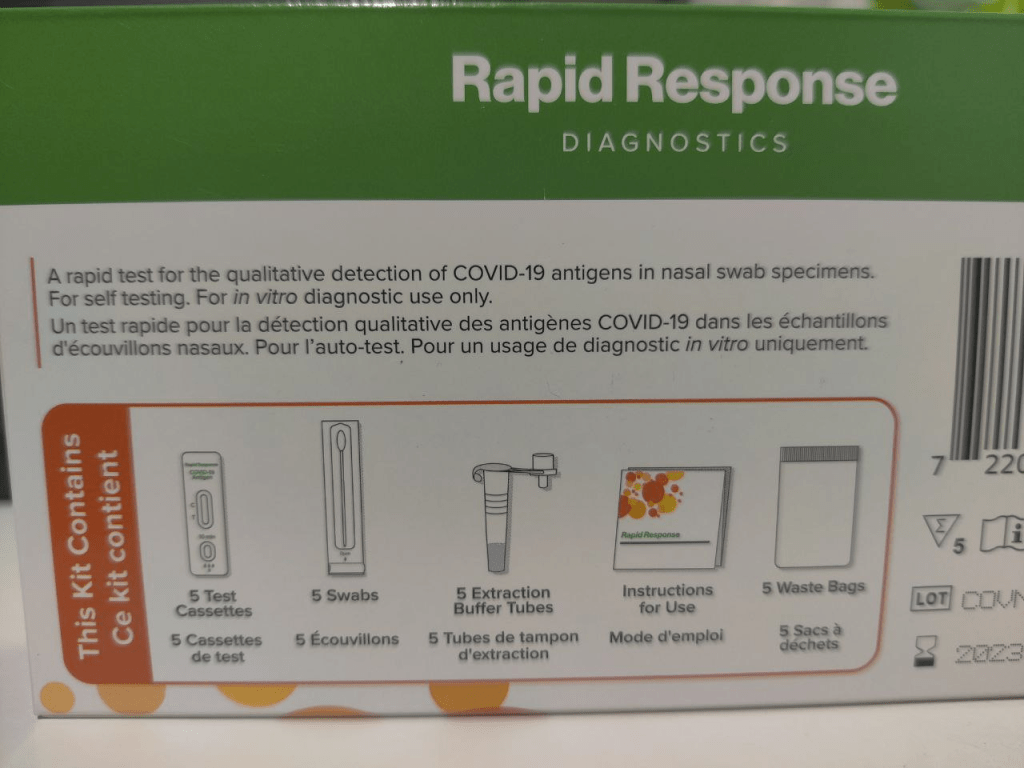
Figure 1. Back of the Rapid Response (R) COVID-19 Antigen Rapid Test Cassette. Image provides brief description of the purpose of the contents and an illustration of the contents of the kit. Included are 5 test cassettes, swabs, extraction buffer tubes, and waste bags. Instructions for Use are also included. To create the sample, the provided swab was inserted into the right nostril until the swab encountered the back of the nose and swirled several times to collect mucosal liquid. The same swab was applied to the left nostril in the same manner. The collected fluid on the swab was then swirled into the pre-packaged test vial. The test vials (buffer extraction tubes) in all cases were vials with a foil seal, retaining the buffer. The buffer soaked into the swab was removed from the swab via pinching of the plastic tube as the swab is pulled out. Unlike previous iterations of the tests, the swab could be removed immediately after soaking and mixing of the fluids. The buffer vial had an attached lid with a nozzle. The lid was attached after the swab was removed and 3 drops were squeezed onto the sample plate. 10 minutes after the initial drops were applied, the sample result was observed. One red line next to the “C” symbol indicated that the test was functionally normally. One red line next to the “T” symbol indicated that the result was positive. No other anomalies indicated that the sample results were reasonably reliable. Detailed instructions can be found at btnx.com/covid19athome.
The tests were taken beginning on Oct 3, 2022 back when the test subject woke up with a fever. 2 samples were taken during the first 36 hours (midday 1, evening day 2). Both tests resulted in “negative” scores on the rapid tests. These tests are not included in the visual analysis of the COVID positivity progression and were used to calibrate expectations. The third test was taken in the evening of day 3 and resulted in a faintly positive score. Subsequent tests were taken in the evening each day. The tests were aligned each night and it was observed that while the fabric/wicking material of the samples were drying out, the intensity of the red lines remained similar to their initial conditions at the end of the 10 minute waiting period. Images of the collected tests were taken using a OnePlus8T+5G phone using the default camera settings. The lighting available for the image was a 3 panel white LED approximately 20 cm above the middle of the samples. The photos were taken after nightfall and with no other illumination sources.
The selected “best” image was cropped to only include the samples to reduce any external interference (Fig.2). As the image was taken with a relatively perpendicular shot, additional skew was not required for the image. Boxes where the reference line (C-line) and the test line (T-line) were selected. The RGB pixel values were extracted from the the boxes for the 10 samples that were aligned next to each other. The values from the C-line and the T-line were then compared to each other in a few different ways to demonstrate the progression of having COVID to testing negative.
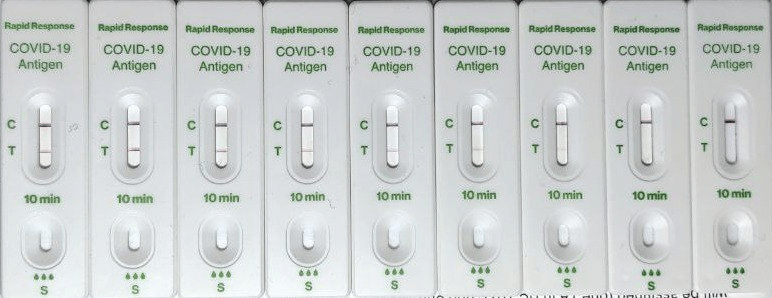
Figure 2. Cropped image containing results of the COVID19 Rapid Tests as taken by a cellphone camera. The last two tests are negative (no visible reading in the T-line). Results: The RGB values were selected in pixels in xy dimensions of x by y pixels. This resulted in 100 pixels in each box selection. Isolating only the R-value for the C-lines (which one would potentially expect to be the most useful) provided a clear pattern where the R value is lowest when the pixel includes the C-line. In retrospect, this should be fairly straightforward to understand as the “white” background pixel is created from high values of all RGB components (256).
A plot of the maximum RBG values is shown for each one of the C- and T-lines in Figure 3. A clear maximum value for the T-line can be seen from each RGB component from samples 5 and 6 with a steep fall-off towards a minimum value with sample 8. Figure 4 shows the “normalized” R values for the T-line based on the minimum R-value in each sample test and scaled by the minimum R-value from the C-line.
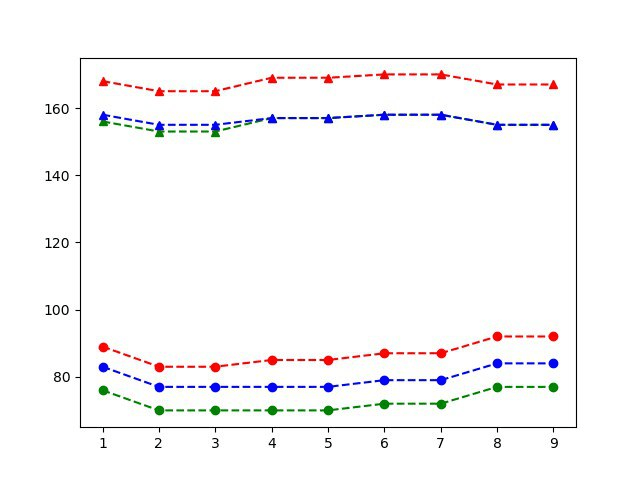
Figure 3. Minimum RGB values in the area for the C-line (circles) and T-line (triangles). The difference in value can potentially be attributed to unbalanced lighting. 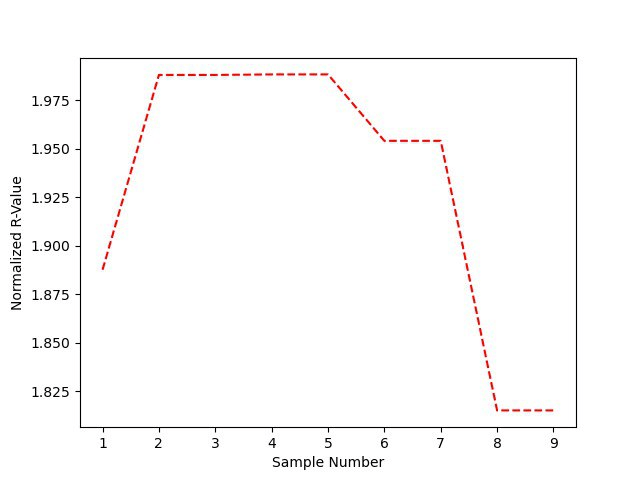
Figure 4. Normalized R-values for each sample (minimum R in T-line divided by minimum R in C-line). Discussion: Visual inspection of the COVID19 Rapid Tests would suggest that there was a rapid increase in the “redness” of the T-line in the first 3 days, with a slow taper off. It is possible that the saturation of the red is actually quite similar from test to test, and it is the thickness of the T-line that varies. In such case, checking the contribution to the R-value is not a useful indicator of “positiviness”. Instead, the thickness of the lines should be considered. In addition, there were no redundant samples. Future studies should consider 3 rounds of swabbing and taking the average metric of each sample run.
Conclusions: A faint positive is still positive. COVID sucked, but I was fortunate enough to not lose my sense of smell for too long (likely a blocked nose). We shall see about long-COVID.
References: Me.
Editor 2: …
Supplementary Material: Images from homemade meals during this time are included in this section. Image S1 includes a noodle soup with noodles made from scratch (I think). Image S2 is a mysterious fried rice concoction.
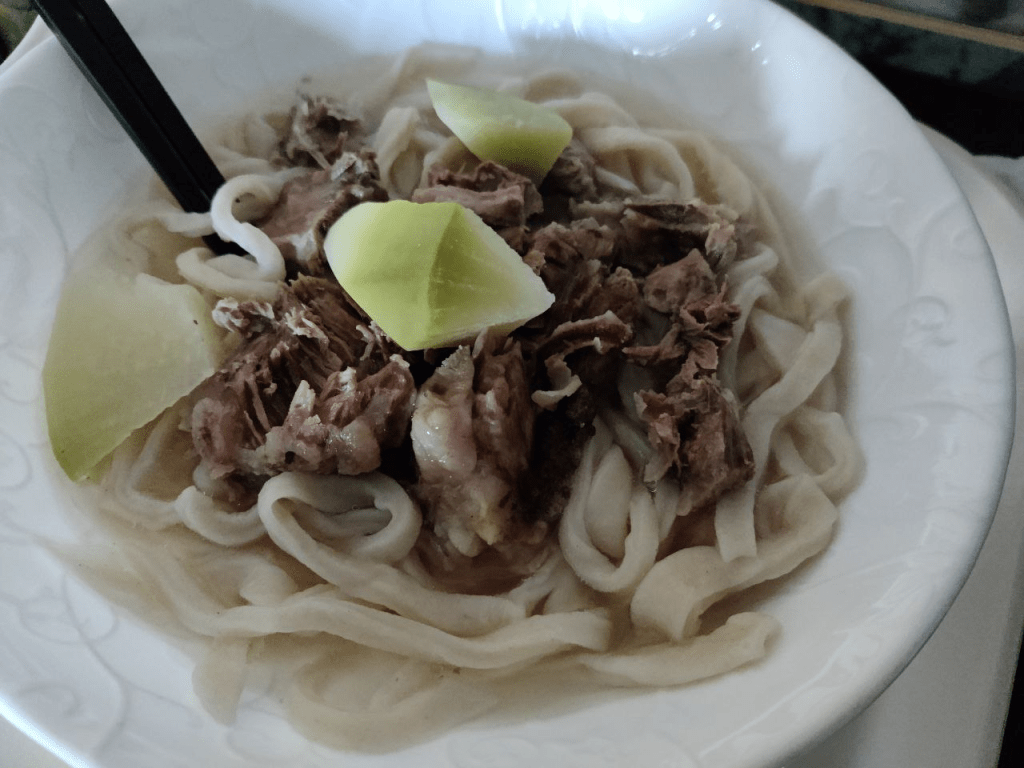
S1. Noodles. Yum. 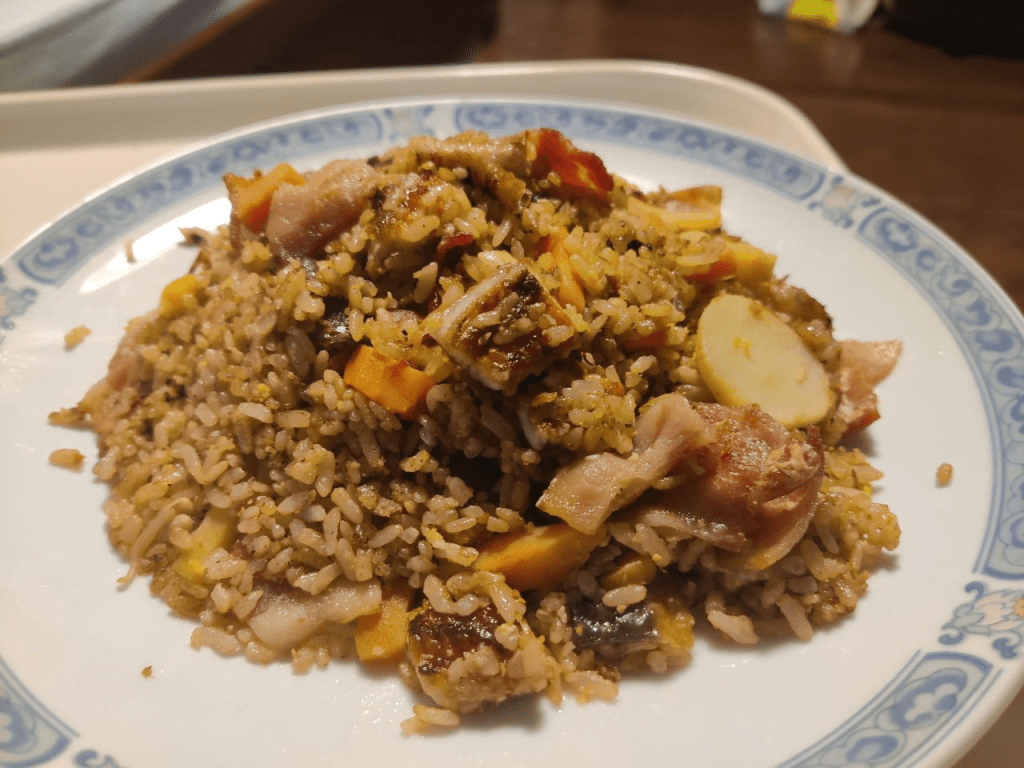
S2. Fried rice! -
Hello World!
This is Elisa. Abstract-ED is the blog. More to come.
-
Subscribe
Subscribed
Have a WordPress.com account? Log in now.

